
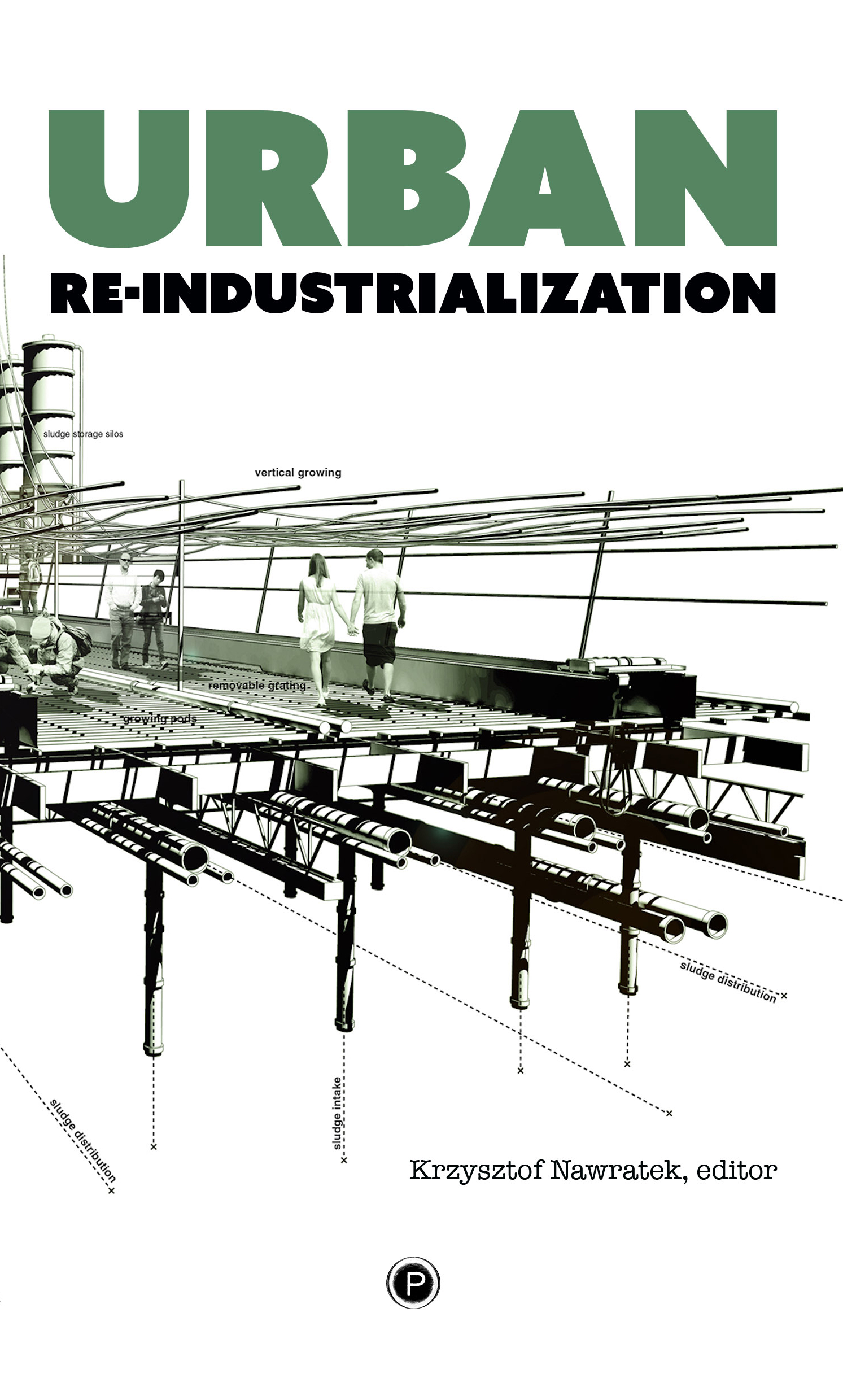
Book information
- Publisher
- punctum books
- Publication
- Published 25 July 2017
- Place
- Earth, Milky Way
- Catalogue record
- View in the catalogue
Abstract
Urban re-industrialisation could be seen as a method of increasing business effectiveness in the context of a politically stimulated ‘green economy’; it could also be seen as a nostalgic mutation of a creative-class concept, focused on 3D printing, ‘boutique manufacturing’ and crafts. These two notions place urban re-industrialisation within the context of the current neoliberal economic regime and urban development based on property and land speculation. Could urban re-industrialisation be a more radical idea? Could urban re-industrialization be imagined as a progressive socio-political and economic project, aimed at creating an inclusive and democratic society based on cooperation and a symbiosis that goes way beyond the current model of a neoliberal city?
In January 2012, against the backdrop of the 2008 financial crisis, Krzysztof Nawratek published a text in opposition to the fantasy of a ‘cappuccino city,’ arguing that the post-industrial city is a fiction, and that it should be replaced by ‘Industrial City 2.0.’ Industrial City 2.0 is an attempt to see a post-socialist and post-industrial city from another perspective, a kind of negative of the modernist industrial city. If, for logistical reasons and because of a concern for the health of residents, modernism tried to separate different functions from each other (mainly industry from residential areas), Industrial City 2.0 is based on the ideas of coexistence, proximity, and synergy. The essays collected here envision the possibilities (as well as the possible perils) of such a scheme.
Chapters
Where its authors and editors are based
Countries of the institutions the book's authors, editors and chapter authors were affiliated to when it was published.
- AUTHORS / EDITORS
- CITATIONS Phase 2
- USAGE Phase 3
| Country | Authors / editors |
|---|---|
| United Kingdom | 10 |
| United States | 3 |
| Australia | 1 |
| Hong Kong | 1 |
| Ireland | 1 |
| Poland | 1 |
About this data
These figures cover 18 works. Each value comes from the most trusted source that has it; a correction made by OBC staff outranks every source.
| Source | Confidence | Works |
|---|---|---|
| Thoth | 90 / 100 | 18 |
| Works with a publication date | 100% |
|---|---|
| Works with a DOI | 100% |
| Works with a funder recorded | 0% |
| Authors with an affiliation | 91% |
| Affiliations matched to an institution (ROR) | 100% |
| Affiliations with a country | 100% |
Countries come from the institution each author was affiliated to when they published, as recorded in ROR. A country is never guessed, so authors without a matched institution are not counted on the maps.
Funders come from OpenAlex for articles and Thoth for books, where publishers recorded them. Most works record none, so a funder's figures show what is recorded, not everything it funded.
Chapters count as works: their authors and editors, and the countries of their institutions, are in every figure where Thoth records an affiliation for them.
Citations (Phase 2) and usage (Phase 3) are not collected yet.