
Book view
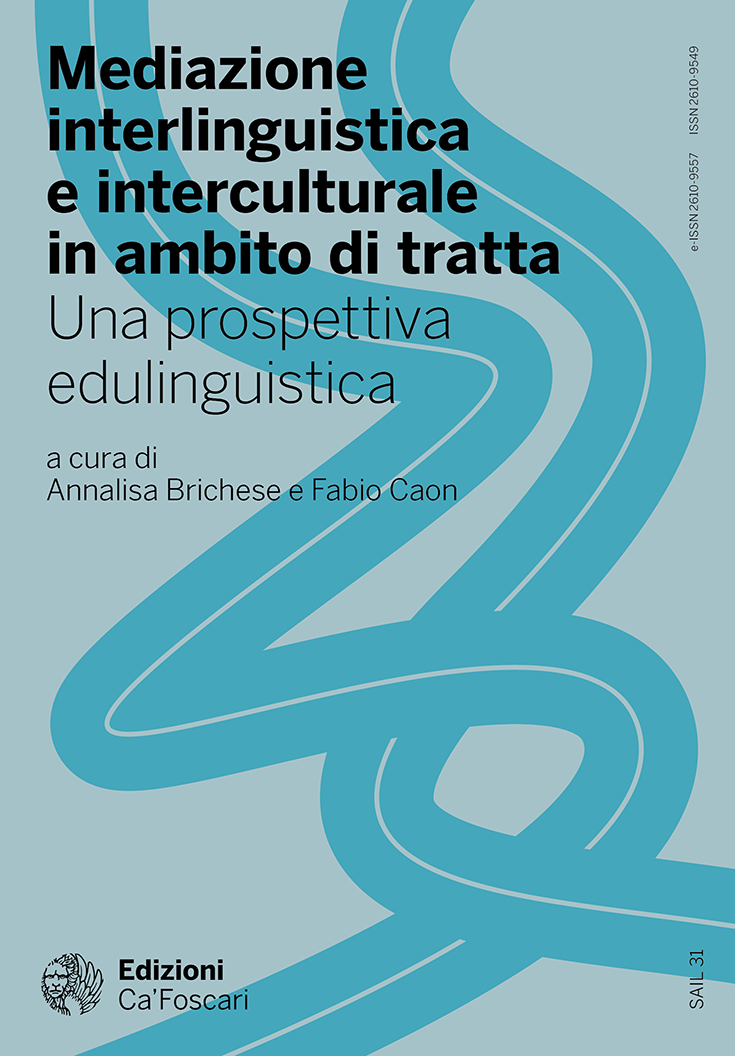
Mediazione interlinguistica e interculturale in ambito di tratta
Una prospettiva edulinguistica
Edited by Annalisa Brichese, Fabio Caon
Book information
- Publisher
- Edizioni Ca' Foscari
- Publication
- Published 14 October 2025
- Place
- Venice, Italy
- Series
- SAIL
- Catalogue record
- View in the catalogue
Abstract
Within the Anti-Trafficking System, the role of the interlinguistic and intercultural mediator is strategic, as they act as an essential bridge between trafficking survivors and the professionals who, in various capacities, intervene in cases of human trafficking (e.g. medical personnel, social workers, psychologists, police officers, lawyers, magistrates, community workers, etc.). This bridge is essential to communicate effectively and to facilitate the success of operations aimed at intercepting perpetrators, as well as supporting those who, for various reasons, have become victims of exploitation. Not only linguistic and interlingual skills, but also intercultural competences, are essential to enhancing the professionalism of interlinguistic and intercultural mediators. The main goal of this volume, produced through a collaboration between the Veneto Region and Ca’ Foscari University of Venice, is to explore the relationship between language education and intercultural mediation, and to provide mediators – and other stakeholders involved – with a reference point for more informed and appropriate interventions in response to potential professional needs. To this end, the book – after providing a state-of-the-art overview of mediation in the anti-trafficking field and outlining the specific characteristics of mediators working in this sector – presents the connection between language education, intercultural communication, mediation, and the legislation on mediation and trafficking. Beyond this informative foundation, contributions are aimed at presenting practical guidelines for mediators. These guidelines relate to strategies and techniques for mediation in trafficking, relational skills in trafficking mediation, and communication techniques useful for conflict management. Finally, focused attention is given to mediator training, which continues to vary widely (in content and quality). The proposals for certifying mediation skills in trafficking thus represent one of the key steps towards qualifying and standardizing the professional profile of mediators nationwide.
Where its authors and editors are based
Countries of the institutions the book's authors, editors and chapter authors were affiliated to when it was published.
- AUTHORS / EDITORS
- CITATIONS Phase 2
- USAGE Phase 3
| Country | Authors / editors |
|---|---|
| Italy | 2 |
About this data
These figures cover 1 work. Each value comes from the most trusted source that has it; a correction made by OBC staff outranks every source.
| Source | Confidence | Works |
|---|---|---|
| Thoth | 90 / 100 | 1 |
| Works with a publication date | 100% |
|---|---|
| Works with a DOI | 100% |
| Works with a funder recorded | 0% |
| Authors with an affiliation | 100% |
| Affiliations matched to an institution (ROR) | 100% |
| Affiliations with a country | 100% |
Countries come from the institution each author was affiliated to when they published, as recorded in ROR. A country is never guessed, so authors without a matched institution are not counted on the maps.
Funders come from OpenAlex for articles and Thoth for books, where publishers recorded them. Most works record none, so a funder's figures show what is recorded, not everything it funded.
Chapters count as works: their authors and editors, and the countries of their institutions, are in every figure where Thoth records an affiliation for them.
Citations (Phase 2) and usage (Phase 3) are not collected yet.