
Book view
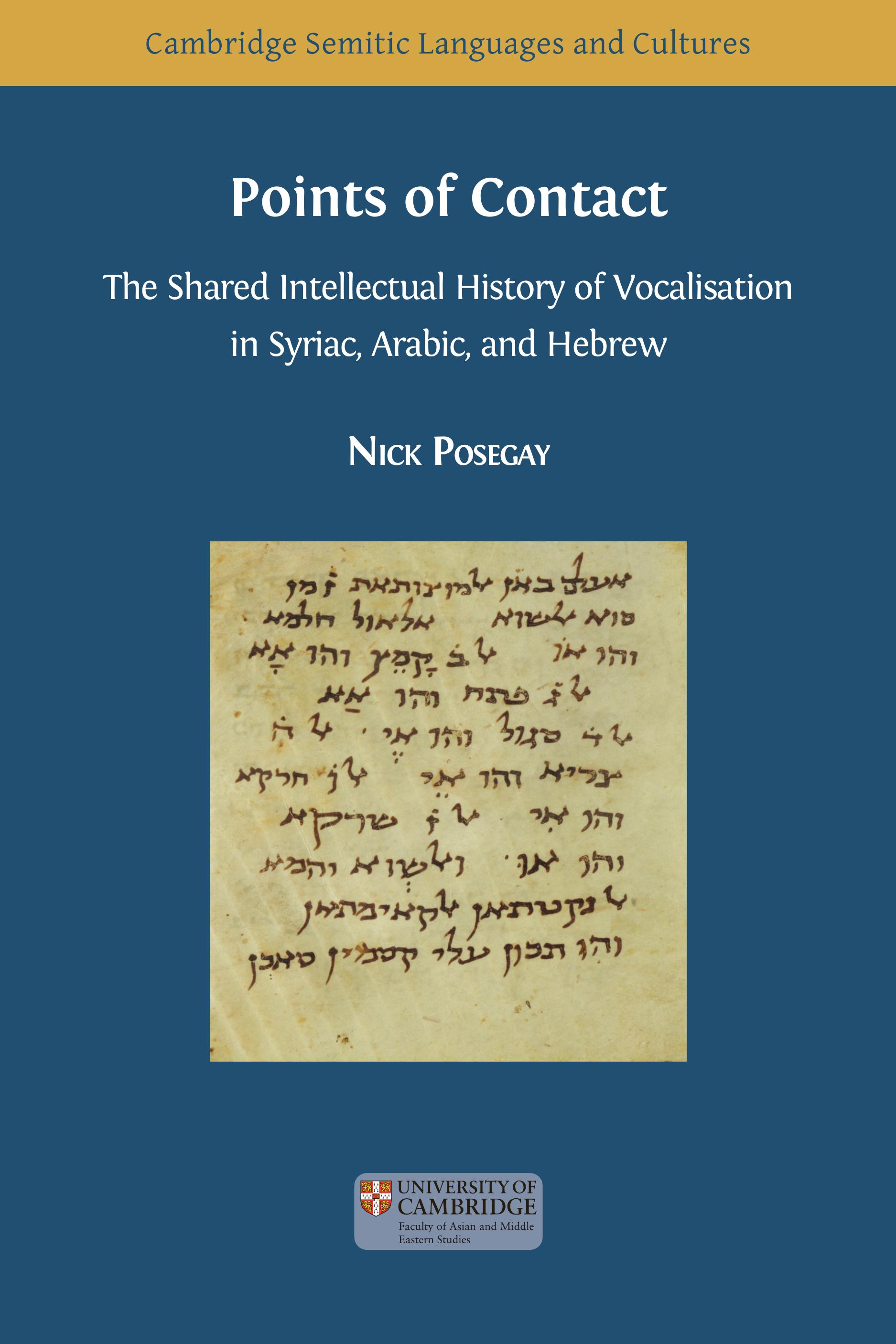
Points of Contact
The Shared Intellectual History of Vocalisation in Syriac, Arabic, and Hebrew
By Nick Posegay
Book information
- Publisher
- Open Book Publishers
- Publication
- Published 14 December 2021
- Place
- Cambridge, UK
- Series
- Semitic Languages and Cultures
- Catalogue record
- View in the catalogue
Abstract
In the first few centuries of Islam, Middle Eastern Christians, Muslims, and Jews alike all faced the challenges of preserving their holy texts in the midst of a changing religious landscape. This situation led Syriac, Arabic, and Hebrew scholars to develop new fields of linguistic science in order to better analyse the languages of the Bible and the Qurʾān.
Part of this work dealt with the issue of vocalisation in Semitic scripts, which lacked the letters required to precisely record all the vowels in their languages. Semitic scribes thus developed systems of written vocalisation points to better record vowel sounds, first in Syriac, then soon after in Arabic and Hebrew. These new points opened a new field of linguistic analysis, enabling medieval grammarians to more easily examine vowel phonology and explore the relationships between phonetics and orthography.
Many aspects of this new field of vocalisation crossed the boundaries between religious communities, first with the spread of ‘relative’ vocalisation systems prior to the eighth century, and later with the terminology created to name the discrete vowels of ‘absolute’ vocalisation systems.
This book investigates the theories behind Semitic vocalisation and vowel phonology in the early medieval Middle East, tracing their evolution to identify points of intellectual contact between Syriac, Arabic, and Hebrew linguists before the twelfth century.
Chapters
| Chapter | Author | Institution at publication |
|---|---|---|
| 1. Introduction | Nick Posegay | University of Cambridge |
| 2. Conceptualising Vowels | Nick Posegay | University of Cambridge |
| 3. Early Relative Vowel Phonology | Nick Posegay | University of Cambridge |
| 4. The Development of Absolute Vowel Naming | Nick Posegay | University of Cambridge |
| 5. Conclusion | Nick Posegay | University of Cambridge |
| 6. Glossary of Selected Vocalisation Terminology | Nick Posegay | University of Cambridge |
Where its authors and editors are based
Countries of the institutions the book's authors, editors and chapter authors were affiliated to when it was published.
- AUTHORS / EDITORS
- CITATIONS Phase 2
- USAGE Phase 3
| Country | Authors / editors |
|---|---|
| United Kingdom | 1 |
About this data
These figures cover 7 works. Each value comes from the most trusted source that has it; a correction made by OBC staff outranks every source.
| Source | Confidence | Works |
|---|---|---|
| Thoth | 90 / 100 | 7 |
| Works with a publication date | 100% |
|---|---|
| Works with a DOI | 100% |
| Works with a funder recorded | 0% |
| Authors with an affiliation | 100% |
| Affiliations matched to an institution (ROR) | 100% |
| Affiliations with a country | 100% |
Countries come from the institution each author was affiliated to when they published, as recorded in ROR. A country is never guessed, so authors without a matched institution are not counted on the maps.
Funders come from OpenAlex for articles and Thoth for books, where publishers recorded them. Most works record none, so a funder's figures show what is recorded, not everything it funded.
Chapters count as works: their authors and editors, and the countries of their institutions, are in every figure where Thoth records an affiliation for them.
Citations (Phase 2) and usage (Phase 3) are not collected yet.