
Book view
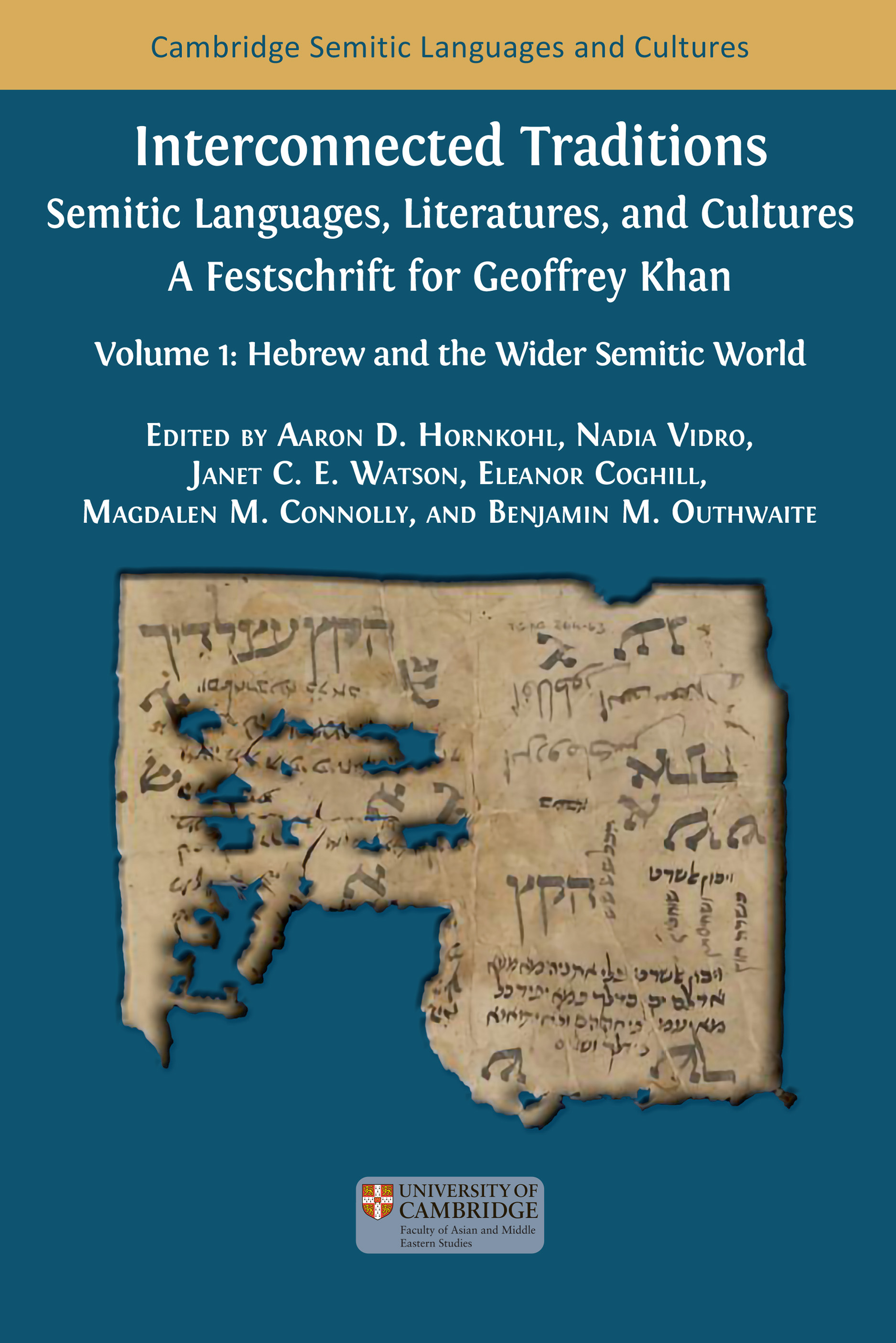
Interconnected Traditions: Semitic Languages, Literatures, Cultures—A Festschrift for Geoffrey Khan
Volume 1: Hebrew and the Wider Semitic World
Edited by Aaron D. Hornkohl, Nadia Vidro, Janet C.E. Watson, Eleanor Coghill, Magdalen M. Connolly, Benjamin Outhwaite
Book information
- Publisher
- Open Book Publishers
- Publication
- Published 7 March 2025
- Place
- Cambridge, UK
- Catalogue record
- View in the catalogue
Abstract
Geoffrey Khan’s pioneering scholarship has transformed the study of Semitic languages, literatures, and cultures, leaving an indelible mark on fields ranging from Biblical Hebrew and Aramaic dialectology to medieval manuscript traditions and linguistic typology. This Festschrift, celebrating a distinguished career that culminated in his tenure (2012–2025) as Regius Professor of Hebrew in the Faculty of Asian and Middle Eastern Studies at the University of Cambridge, brings together contributions from a vast and representative array of scholars—retired, established, and up and coming—whose work has been influenced by his vast intellectual legacy.
Reflecting the interconnected traditions that Khan has illuminated throughout his career, this volume presents cutting-edge research on Hebrew and Aramaic linguistics, historical syntax, manuscript studies, and the transmission of textual traditions across centuries and cultures. Contributors engage with topics central to Khan’s scholarship, including the evolution of the Biblical Hebrew verbal system, the intricacies of Masoretic notation, Geniza discoveries, Samaritan and medieval Judaeo-Arabic texts, and computational approaches to linguistic analysis.
As Khan retires from his role as Regius Professor, this collection stands as both a tribute and a continuation of his work, honouring his lifelong dedication to understanding and preserving the linguistic and literary heritage of the Semitic world.
The content of this book has been updated.
Chapters
Where its authors and editors are based
Countries of the institutions the book's authors, editors and chapter authors were affiliated to when it was published.
- AUTHORS / EDITORS
- CITATIONS Phase 2
- USAGE Phase 3
| Country | Authors / editors |
|---|---|
| United Kingdom | 11 |
| Israel | 5 |
| United States | 5 |
| South Africa | 4 |
| Canada | 3 |
| Germany | 3 |
| Russia | 2 |
| Sweden | 2 |
All 9 countries
| Country | Authors / editors |
|---|---|
| United Kingdom | 11 |
| Israel | 5 |
| United States | 5 |
| South Africa | 4 |
| Canada | 3 |
| Germany | 3 |
| Russia | 2 |
| Sweden | 2 |
| Belgium | 1 |
About this data
These figures cover 34 works. Each value comes from the most trusted source that has it; a correction made by OBC staff outranks every source.
| Source | Confidence | Works |
|---|---|---|
| Thoth | 90 / 100 | 34 |
| Works with a publication date | 100% |
|---|---|
| Works with a DOI | 100% |
| Works with a funder recorded | 0% |
| Authors with an affiliation | 93% |
| Affiliations matched to an institution (ROR) | 100% |
| Affiliations with a country | 100% |
Countries come from the institution each author was affiliated to when they published, as recorded in ROR. A country is never guessed, so authors without a matched institution are not counted on the maps.
Funders come from OpenAlex for articles and Thoth for books, where publishers recorded them. Most works record none, so a funder's figures show what is recorded, not everything it funded.
Chapters count as works: their authors and editors, and the countries of their institutions, are in every figure where Thoth records an affiliation for them.
Citations (Phase 2) and usage (Phase 3) are not collected yet.