
Book view

Historiographies of Game Studies

What It Has Been, What It Could Be

Edited by Alisha Karabinus, Carly A. Kocurek, Cody Mejeur, Emma Vossen
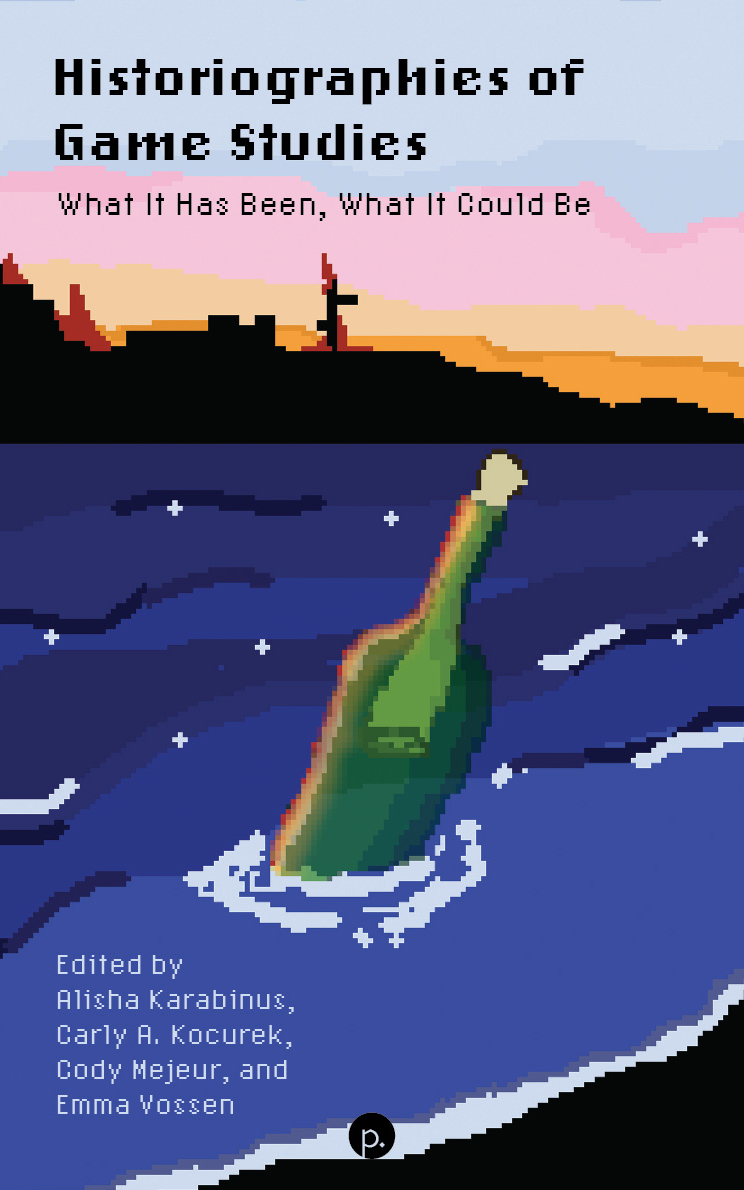
Cover of Historiographies of Game Studies

Book information

Publisher
punctum books
Publication
Published 25 July 2025
Place
Earth, Milky Way
Catalogue record
View in the catalogue
34 Chapters FULL LIST: Chapters
Total citations Phase 2: not collected yet
Total usage Phase 3: not collected yet

Abstract

Historiographies of Game Studies offers a first-of-its-kind reflection on how game studies as an academic field has been shaped and sustained. Today, game studies is a thriving field with many dedicated national and international conferences, journals, professional societies, and a strong presence at conferences in disciplines like computer science, communication, media studies, theater, visual arts, popular culture, and others. But, when did game studies start? And what (and who) is at the core or center of game studies? Fields are defined as much by what they are not as by what they are, and their borderlands can be hotly contested spaces.

In this anthology, scholars from across the field consider how the boundaries of game studies have been established, codified, contested, and protected, raising critical questions about who and what gets left out of the field. Over more than two dozen chapters and interviews with leading figures, including Espen Aarseth, Kishonna Gray, Henry Jenkins, Lisa Nakamura, Kentaro Matsumoto, Ken McAllister, and Janet Murray, the contributors offer a dazzling array of insightful provocations that address the formation, propagation, and cultivation of game studies, interrogating not only the field’s pasts but its potential futures and asking us to think deliberately about how academic fields are collectively built.

Chapters

ChapterAuthorInstitution at publication
Introduction Alisha Karabinus, Carly A. Kocurek, Cody Mejeur, Emma Vossen Grand Valley State University; Illinois Institute of Technology; University at Buffalo, State University of New York
A Story or a Machine? Jaroslav Švelch Charles University
Anthropology, Play Studies, and the Entanglements of Game Studies Laya Liebeseller, Josh Rivers
Archiving Play, Archiving Histories Lee W. Hibbard University of Michigan
Autoethnographic Denial Stephanie C. Jennings
Confessions of a Game Studies Insider Christopher A. Paul Seattle University
Contributor Biographies Alisha Karabinus, Carly A. Kocurek, Cody Mejeur, Emma Vossen
Definitions and Misunderstandings in Game Studies Cody Mejeur, Espen Aarseth University at Buffalo, State University of New York; IT University of Copenhagen
Definitions, Boundaries, and Issues Week Alisha Karabinus Grand Valley State University
Down on Luck Michael Anthony DeAnda DePaul University
Frontmatter Alisha Karabinus, Carly A. Kocurek, Cody Mejeur, Emma Vossen
Is It All Just Cultural Studies? Adrienne Shaw Temple University
Ken S. McAllister Judd Ethan Ruggill University of Arizona
Ludic Dissertations Justin Wigard University of North Dakota; University of Richmond
My Mother Was a Jump Rope Rhyme Carly A. Kocurek Illinois Institute of Technology
Navigating a Complex Space betsy brey, Henry Jenkins University of Waterloo; University of Southern California
Navigating Public History and Game Preservation Racquel M. Gonzales University of Rochester
Of Parents and Siblings, Disciplines and Debates: Tobias Unterhuber Universität Innsbruck
On the Political Function of Triflers and Spoilsports in Game Studies Liam Mitchell Trent University
Queering the Game Studies Canon Bo Ruberg University of California, Irvine
Re-Historicizing Game Studies with C.L.R. James Cameron Kunzelman, Michael Lutz Mercer University
Redirecting Ludification Dennis Jansen Utrecht University
Reflecting on the Evolution of Intersectional Game Studies Sarah Christina Ganzon, Lisa Nakamura Simon Fraser University; University of Michigan
The Influence of Aesthetics and Semiotics on Game Research in Japan Douglas Schules, Kentaro Matsumoto Rikkyo University; Dokkyo University
The Past, Present, and Future of Game Studies Bianca Batti, Janet H. Murray Georgia Institute of Technology
The Separation of Analog and Digital Game Studies Evan Torner University of Cincinnati
Turns in Game Studies victoria l. braegger, Kishonna Gray Missouri University of Science and Technology; University of Michigan
Unveiling the Path Outi Kaarina Laiti University of Helsinki
Video or Digital? Jasper van Vught, Joris Veerbeek Utrecht University
What Video Games Have Taught Us Kirk M. Lundblade University of Central Florida
Why Are You Being an Ass on the Internet? Jennifer deWinter, Gillian Smith Illinois Institute of Technology; Worcester Polytechnic Institute
Young Scholars, and Old Debates Emma Vossen Brock University
“Publish in English or It’s Game Over” Samuel Poirier-Poulin Université de Montréal
“There’s Nothing Written about It” Alison Harvey York University

Where its authors and editors are based

Countries of the institutions the book's authors, editors and chapter authors were affiliated to when it was published.

  • AUTHORS / EDITORS
  • CITATIONS Phase 2
  • USAGE Phase 3
Authors / editors by country
CountryAuthors / editors
United States21
Canada6
The Netherlands3
Japan2
Austria1
Czechia1
Denmark1
Finland1
About this data

These figures cover 35 works. Each value comes from the most trusted source that has it; a correction made by OBC staff outranks every source.

Sources
SourceConfidenceWorks
Thoth90 / 10035
Completeness
Works with a publication date100%
Works with a DOI100%
Works with a funder recorded0%
Authors with an affiliation75%
Affiliations matched to an institution (ROR)95%
Affiliations with a country100%

Countries come from the institution each author was affiliated to when they published, as recorded in ROR. A country is never guessed, so authors without a matched institution are not counted on the maps.

Funders come from OpenAlex for articles and Thoth for books, where publishers recorded them. Most works record none, so a funder's figures show what is recorded, not everything it funded.

Chapters count as works: their authors and editors, and the countries of their institutions, are in every figure where Thoth records an affiliation for them.

Citations (Phase 2) and usage (Phase 3) are not collected yet.