
Book view
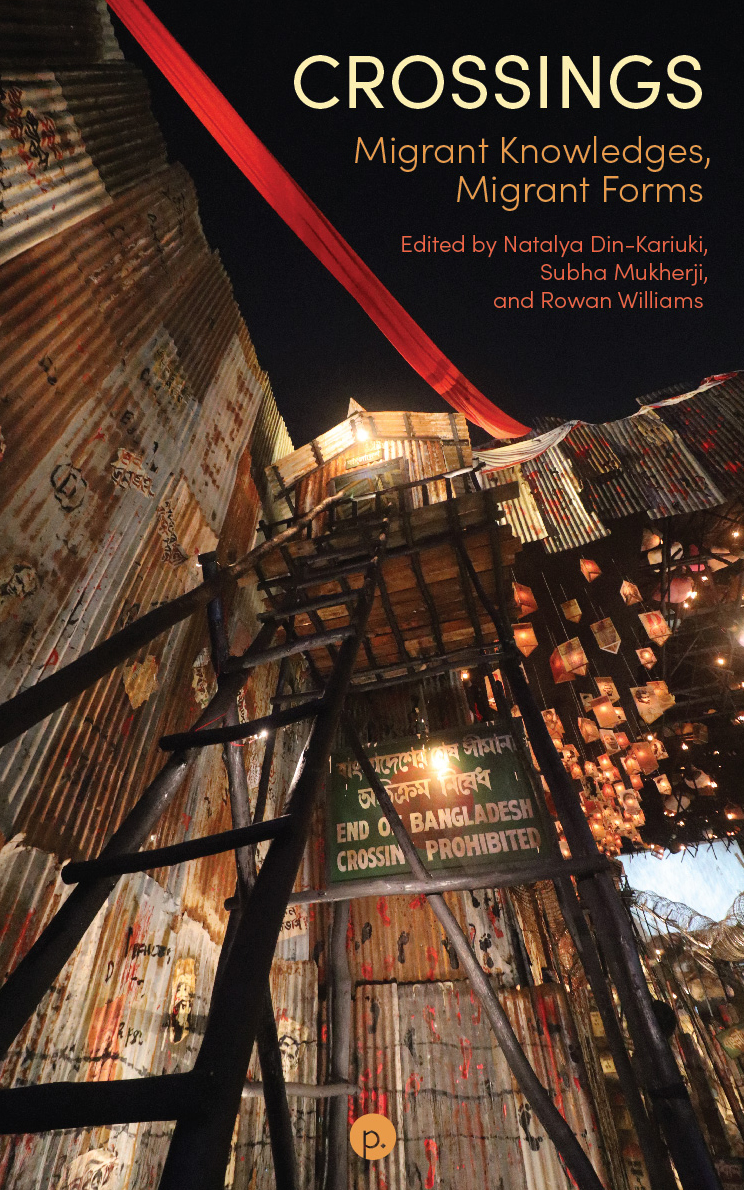
Crossings
Migrant Knowledges, Migrant Forms
Edited by Natalya Din-Kariuki, Subha Mukherji, Rowan Williams
Book information
- Publisher
- punctum books
- Publication
- Published 3 October 2025
- Place
- Earth, Milky Way
- Catalogue record
- View in the catalogue
Abstract
Crossings: Migrant Knowledges, Migrant Forms brings together activists, artists, scholars, and migrants with diverse histories to explore what the experience of migration does with, and to, knowledge, and how its own ways of knowing find expressive form. As the volume’s authors think about physical and imaginative crossings, and the traversals and transactions of knowledge they entail, the book itself crosses and complicates disciplinary and formal boundaries and the barriers between critical and creative intervention. Crucially, it brings together voices and forms emerging out of the experience of dislocation with responses to the encounters it generates.
The volume’s discussions begin in the early modern world, and move freely across periods to dwell on the urgent experience of migrancy in our own times, while also responding to an urgent need to connect the local with the global experience of migrant knowledge and migrant aesthetics. Crossings stakes the claim that creative art, backed by humanities-based thinking, can meet the imaginative and ethical demands that the unknowable reality of mass displacement places on us, in a way that governments, institutions, and public discourse have calamitously failed to do. But aesthetic practice itself needs to be re-positioned if it is to rise to these political and human challenges, negotiating the points of friction between its own predilections and the matter of migration.
Crossings offers “migrant forms” – art about migration, objects from migrant life shaped into artifacts, and migrant self-expressions – as the means of this imaginative re-orientation, and a tool for activating a radical alternative to economic models of social benefit. Crossings takes its place in an emergent ecology of migrant forms, both speaking to and participating in that ecology.
Chapters
Where its authors and editors are based
Countries of the institutions the book's authors, editors and chapter authors were affiliated to when it was published.
- AUTHORS / EDITORS
- CITATIONS Phase 2
- USAGE Phase 3
| Country | Authors / editors |
|---|---|
| United Kingdom | 14 |
| United States | 4 |
| Argentina | 2 |
| India | 2 |
| Italy | 2 |
| Ireland | 1 |
About this data
These figures cover 41 works. Each value comes from the most trusted source that has it; a correction made by OBC staff outranks every source.
| Source | Confidence | Works |
|---|---|---|
| Thoth | 90 / 100 | 41 |
| Works with a publication date | 100% |
|---|---|
| Works with a DOI | 100% |
| Works with a funder recorded | 0% |
| Authors with an affiliation | 54% |
| Affiliations matched to an institution (ROR) | 100% |
| Affiliations with a country | 100% |
Countries come from the institution each author was affiliated to when they published, as recorded in ROR. A country is never guessed, so authors without a matched institution are not counted on the maps.
Funders come from OpenAlex for articles and Thoth for books, where publishers recorded them. Most works record none, so a funder's figures show what is recorded, not everything it funded.
Chapters count as works: their authors and editors, and the countries of their institutions, are in every figure where Thoth records an affiliation for them.
Citations (Phase 2) and usage (Phase 3) are not collected yet.