
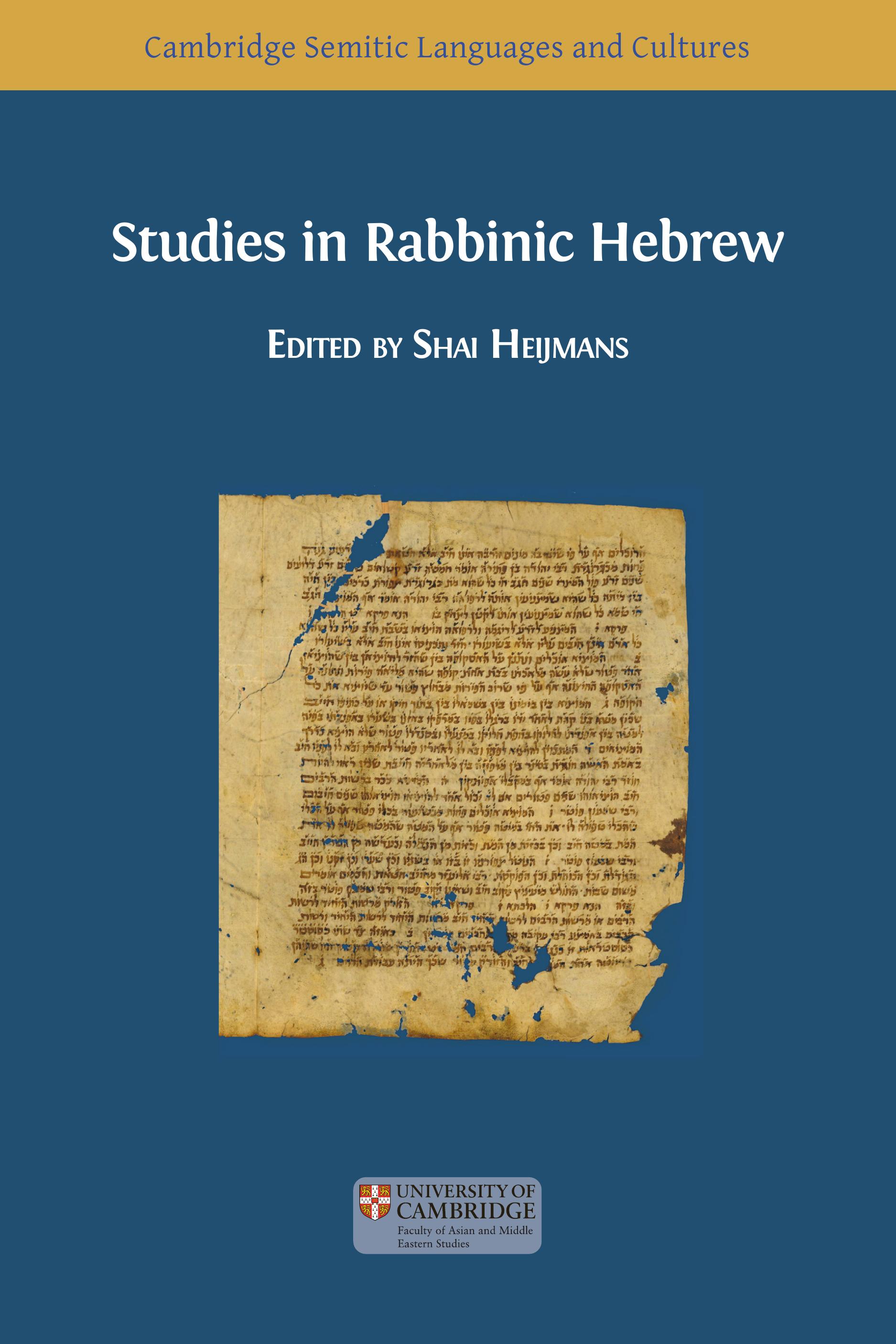
Book information
- Publisher
- Open Book Publishers
- Publication
- Published 19 May 2020
- Place
- Cambridge, UK
- Series
- Semitic Languages and Cultures
- Catalogue record
- View in the catalogue
Abstract
This volume presents a collection of articles centring on the language of the Mishnah and the Talmud – the most important Jewish texts (after the Bible), which were compiled in Palestine and Babylonia in the latter centuries of Late Antiquity. Despite the fact that Rabbinic Hebrew has been the subject of growing academic interest across the past century, very little scholarship has been written on it in English.
Studies in Rabbinic Hebrew addresses this lacuna, with eight lucid but technically rigorous articles written in English by a range of experienced scholars, focusing on various aspects of Rabbinic Hebrew: its phonology, morphology, syntax, pragmatics and lexicon. This volume is essential reading for students and scholars of Rabbinic studies alike, and constitutes the first in a new series, Studies in Semitic Languages and Cultures, in collaboration with the Faculty of Asian and Middle Eastern Studies at the University of Cambridge.
Chapters
| Chapter | Author | Institution at publication |
|---|---|---|
| Introduction | Shai Heijmans | University of Cambridge |
| 1. Rabba and Rava, ʾAbba and ʾAva | Yochanan Breuer | Hebrew University of Jerusalem |
| 2. The Vocalisation of MS Cambridge of the Mishnah | Yehudit Henshke | University of Haifa |
| 3. Adjacency Pairs and Argumentative Steps in The Halakhic Give-and-Take Conversations in The Mishnah | Rivka Shemesh-Raiskin | Bar-Ilan University |
| 4. Tannaitic Aramaic | Christian Stadel | Ben-Gurion University of the Negev |
| 5. Rabbinic Entries in R. Judah Ibn-Tibbon's Translation of Duties of the Hearts | Barak Avirbach | Oranim Academic College of Education |
| 6. The Distinction Between Branches of Rabbinic Hebrew in Light of the Hebrew of the Late Midrash | Yehonatan Wormser | Hebrew University of Jerusalem |
| 7. Two Textual Versions of Psiqata of the Ten Commandments | Shlomi Efrati | Hebrew University of Jerusalem |
| 8. Vowel Reduction in Greek Loanwords in the Mishnah | Shai Heijmans | University of Cambridge |
Where its authors and editors are based
Countries of the institutions the book's authors, editors and chapter authors were affiliated to when it was published.
- AUTHORS / EDITORS
- CITATIONS Phase 2
- USAGE Phase 3
| Country | Authors / editors |
|---|---|
| Israel | 7 |
| United Kingdom | 1 |
About this data
These figures cover 10 works. Each value comes from the most trusted source that has it; a correction made by OBC staff outranks every source.
| Source | Confidence | Works |
|---|---|---|
| Thoth | 90 / 100 | 10 |
| Works with a publication date | 100% |
|---|---|
| Works with a DOI | 100% |
| Works with a funder recorded | 0% |
| Authors with an affiliation | 100% |
| Affiliations matched to an institution (ROR) | 100% |
| Affiliations with a country | 100% |
Countries come from the institution each author was affiliated to when they published, as recorded in ROR. A country is never guessed, so authors without a matched institution are not counted on the maps.
Funders come from OpenAlex for articles and Thoth for books, where publishers recorded them. Most works record none, so a funder's figures show what is recorded, not everything it funded.
Chapters count as works: their authors and editors, and the countries of their institutions, are in every figure where Thoth records an affiliation for them.
Citations (Phase 2) and usage (Phase 3) are not collected yet.