
Book information
- Publisher
- punctum books
- Publication
- Published 20 December 2013
- Place
- Brooklyn, NY
- Catalogue record
- View in the catalogue
Abstract
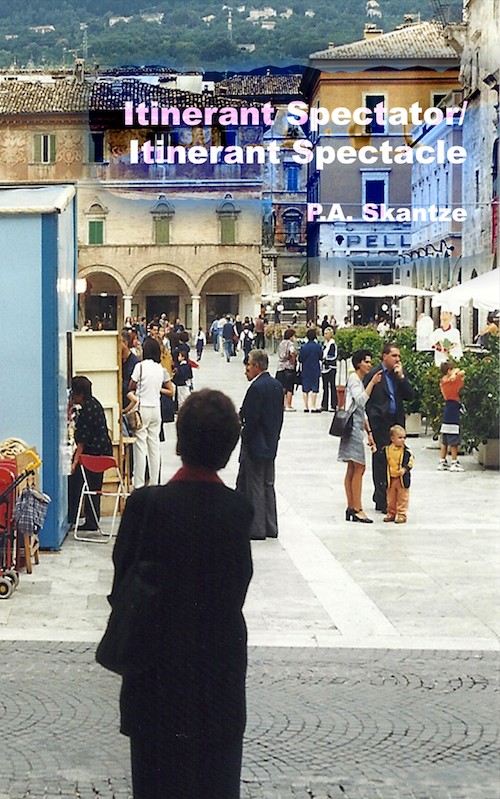
Itinerant Spectator/Itinerant Spectacle moves across the landscape of European performance in late 20th and early 21st centuries, recounting performance in circulation across national borders and across the itinerant bodies of spectators who travel to meet performances that travel. Itinerant Spectator/Itinerant Spectacle suggests spectating is a practice — an act of interpretation engaged in more than simply receiving the affects of a performance, a companion practice to the making of performance. The work forms a part of Skantze’s ongoing explorations of what she terms the ‘epistemology of practice as research.’
IS/IS theorizes spectating as a practice that extends beyond the theatre, as a practice of writing as recollecting (and recollecting as writing) at the center of what has been called “criticism.” The book grounds spectatorship in the subjective, embodied, differenced practice of spectating not from a fixed location or standpoint but from a ground that constantly shifts, that is, from the ground of the roving positionalities of the “itinerate spectator.” Following Walter Benjamin, for example, Skantze importantly adopts the privileges of the flaneur as a feminist and rather queer project, one that refuses to be tied to the minor position, to that of the impossible “flaneuse.”
The methodology of the book takes inspiration from the writings of W.G. Sebald and his employment of something Skantze describes as “a staging of memory,” a way to offer the reader an example of how memory works in the midst of a description of a particular recollection. This construction invites the reader/participant to ‘discover,’ to ‘remember’ alongside the writer. Further, this methodology invites the reader to incorporate her/his own ideas and memories of the practice of spectating through an openness in the language of remembering and description.
Individual sections of the book demonstrate spectating as itinerant ‘on the job training’ in various modes of reception. Topics include: the idea of reparation in performance about nations, the past and injustice; the power of sound and the intricacies of seeing/hearing performance in many languages; the architectural information absorbed by the spectator and its role in fashioning story; the shifts made in spectating at festivals between theatre and dance; and the political consequences and traps of mobility and immobility.
Where its authors and editors are based
Countries of the institutions the book's authors, editors and chapter authors were affiliated to when it was published.
- AUTHORS / EDITORS
- CITATIONS Phase 2
- USAGE Phase 3
| Country | Authors / editors |
|---|---|
| United Kingdom | 1 |
About this data
These figures cover 1 work. Each value comes from the most trusted source that has it; a correction made by OBC staff outranks every source.
| Source | Confidence | Works |
|---|---|---|
| Thoth | 90 / 100 | 1 |
| Works with a publication date | 100% |
|---|---|
| Works with a DOI | 100% |
| Works with a funder recorded | 0% |
| Authors with an affiliation | 100% |
| Affiliations matched to an institution (ROR) | 100% |
| Affiliations with a country | 100% |
Countries come from the institution each author was affiliated to when they published, as recorded in ROR. A country is never guessed, so authors without a matched institution are not counted on the maps.
Funders come from OpenAlex for articles and Thoth for books, where publishers recorded them. Most works record none, so a funder's figures show what is recorded, not everything it funded.
Chapters count as works: their authors and editors, and the countries of their institutions, are in every figure where Thoth records an affiliation for them.
Citations (Phase 2) and usage (Phase 3) are not collected yet.