
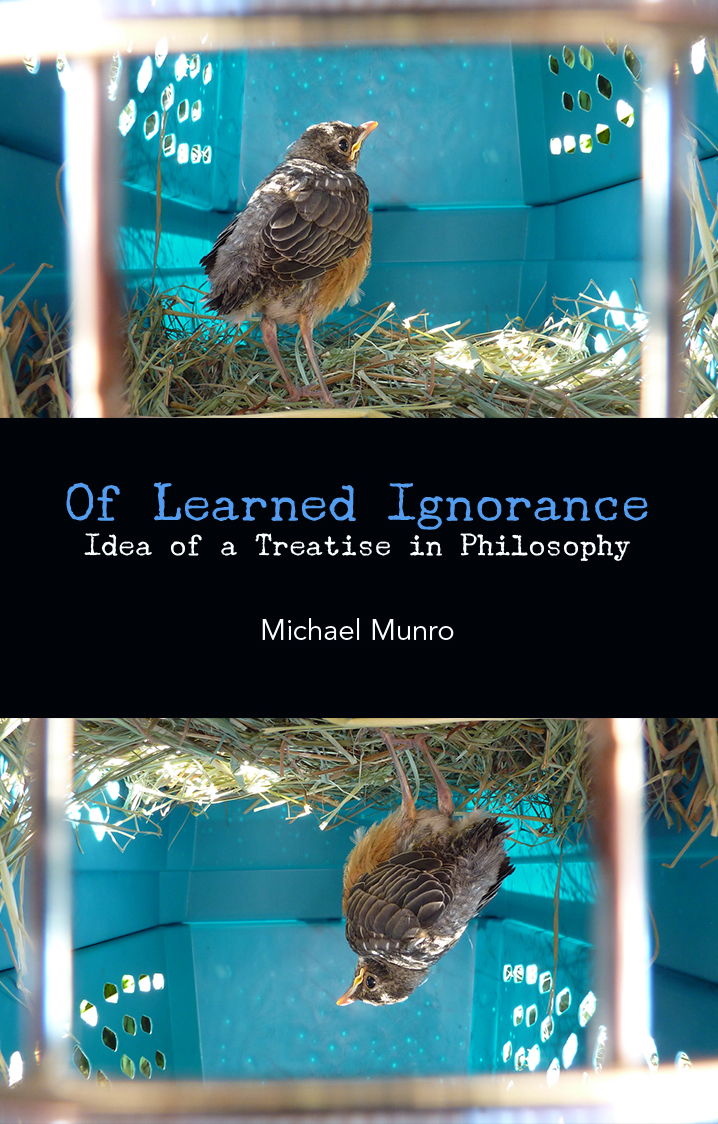
Book information
- Publisher
- punctum books
- Publication
- Published 4 June 2013
- Place
- Brooklyn, NY
- Catalogue record
- View in the catalogue
Abstract
What is a problem? What’s asked in that question, and how does one even begin to take its measure? How else could one begin, except as one does with any other problem—by way of its impulsion.
Of Learned Ignorance: Idea of a Treatise in Philosophy is about philosophy because philosophy is about problems: philosophy, in a word, is where problems become a problem.
After Anti-Oedipus, in the Kafka book and in A Thousand Plateaus, what Deleuze and Guattari counsel, strikingly, is sobriety. Sobriety is what they praise in Kafka. And it is sobriety that seems above all else to be necessary here. (Steven Shaviro has pointed out the prominence of structure in Deleuze’s writing: “even when Deleuze’s prose, by himself or with Guattari, seems to be ranging anarchically all over the place, in fact it has a rigid and unvarying architecture, which is what keeps it from falling apart.”)
Of Learned Ignorance is a dead letter because it names a problem. It’s a dead letter because it is, cautiously, a love letter. It’s a dead letter because it lovingly stages an experiment in whimsy, and perhaps above all, because it is problematic (in the Kantian sense): It is a (sober) attempt at exemplifying what it talks about — and what eludes it: A series of footnotes, with blank (transcriptive) pages above, effects something like the integration of a differential, the reciprocal determination where the sources enter into in relation to one another in order to produce a paper, essay, or (inexistent) (chap)book. Of Learned Ignorance, in facing down a problem, makes a wager; it courts failure; it puts it all on the line. All, yes, for love — a kind of love … (of wisdom?).
Where its authors and editors are based
Countries of the institutions the book's authors, editors and chapter authors were affiliated to when it was published.
- AUTHORS / EDITORS
- CITATIONS Phase 2
- USAGE Phase 3
No affiliations with a known country in these years yet.
About this data
These figures cover 1 work. Each value comes from the most trusted source that has it; a correction made by OBC staff outranks every source.
| Source | Confidence | Works |
|---|---|---|
| Thoth | 90 / 100 | 1 |
| Works with a publication date | 100% |
|---|---|
| Works with a DOI | 100% |
| Works with a funder recorded | 0% |
| Authors with an affiliation | 0% |
Countries come from the institution each author was affiliated to when they published, as recorded in ROR. A country is never guessed, so authors without a matched institution are not counted on the maps.
Funders come from OpenAlex for articles and Thoth for books, where publishers recorded them. Most works record none, so a funder's figures show what is recorded, not everything it funded.
Chapters count as works: their authors and editors, and the countries of their institutions, are in every figure where Thoth records an affiliation for them.
Citations (Phase 2) and usage (Phase 3) are not collected yet.