
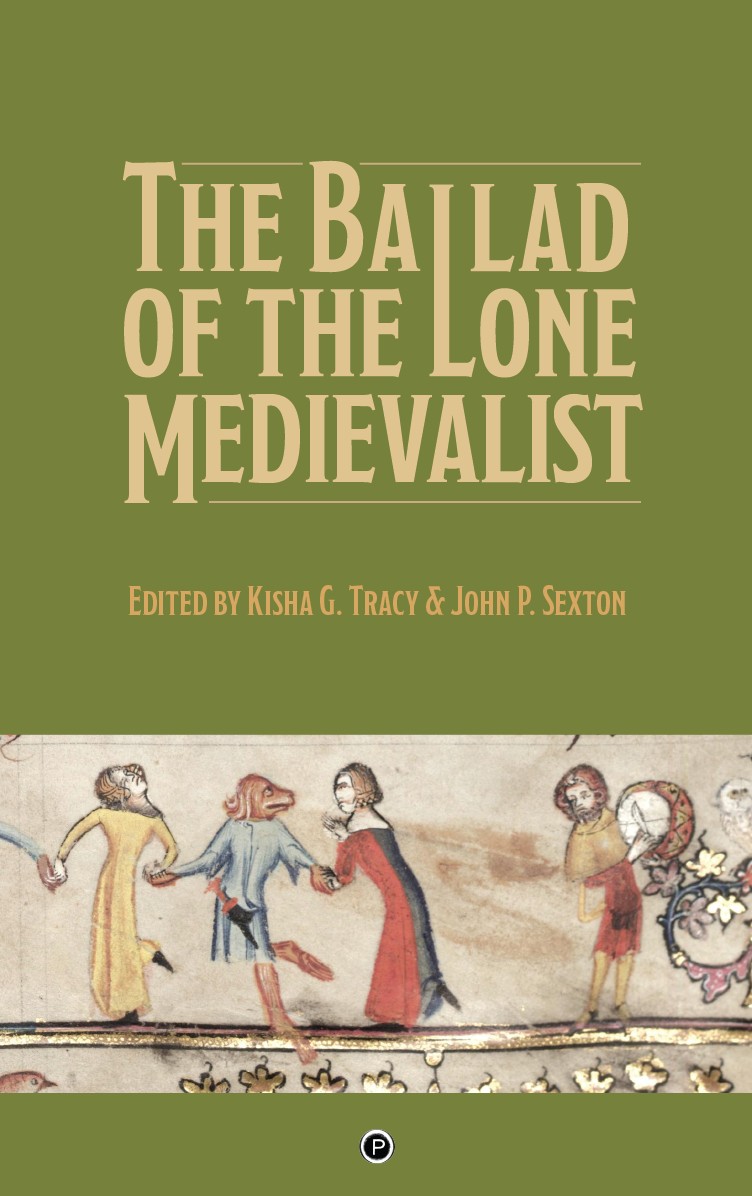
Book information
- Publisher
- punctum books
- Publication
- Published 23 August 2018
- Place
- Earth, Milky Way
- Catalogue record
- View in the catalogue
Abstract
Working medievalists are often the only scholar of the Middle Ages in a department, a university, or a hundred-mile radius. While working to build a body of focused scholarly work, the lone medievalist is expected to be a generalist in the classroom and a contributing member of a campus community that rarely offers disciplinary community in return. As a result, overtasked and single medievalists often find it challenging to advocate for their work and field.
As other responsibilities and expectations crowd in, we come to feel disconnected from the projects and subjects that sustain our intellectual passion. An insidious isolation even from one another creeps in, and soon, even attending a conference of fellow medievalists can become a lonely experience. Surrounded by scholars with greater institutional support, lower teaching loads, or more robust research agendas, we may feel alienated from our work — the work to which we’ve dedicated our careers.
The Lone Medievalist (the collaborative community and the book) is intended as an antidote to the problem of professional isolation. It is offered in the spirit of common weal that marks the ideals (if not always the realities) of so many of the communities we study — agricultural, professional, national, notional, and of course, monastic. The Ballad of the Lone Medievalist isn’t only about scholarship, or teaching, or institutional life, or the pursuit of new learning — it’s about all of them.
The essays in this volume address all aspects of the professional and intellectual life of medievalists. Though many of us acknowledge and address the challenges in being Lone Medievalists, these essays are not intended as voces clamantium; they are offered to provide strategies, camaraderie, and an occasional bit of inspiration. They are a call to action, a sharing of hard-won wisdom, and a helping hand — and, above all, a reminder that we are not alone.
Chapters
Where its authors and editors are based
Countries of the institutions the book's authors, editors and chapter authors were affiliated to when it was published.
- AUTHORS / EDITORS
- CITATIONS Phase 2
- USAGE Phase 3
| Country | Authors / editors |
|---|---|
| United States | 32 |
| Albania | 1 |
| Bahamas | 1 |
| Canada | 1 |
| Norway | 1 |
| Spain | 1 |
| United Kingdom | 1 |
About this data
These figures cover 36 works. Each value comes from the most trusted source that has it; a correction made by OBC staff outranks every source.
| Source | Confidence | Works |
|---|---|---|
| Thoth | 90 / 100 | 36 |
| Works with a publication date | 100% |
|---|---|
| Works with a DOI | 100% |
| Works with a funder recorded | 0% |
| Authors with an affiliation | 98% |
| Affiliations matched to an institution (ROR) | 100% |
| Affiliations with a country | 100% |
Countries come from the institution each author was affiliated to when they published, as recorded in ROR. A country is never guessed, so authors without a matched institution are not counted on the maps.
Funders come from OpenAlex for articles and Thoth for books, where publishers recorded them. Most works record none, so a funder's figures show what is recorded, not everything it funded.
Chapters count as works: their authors and editors, and the countries of their institutions, are in every figure where Thoth records an affiliation for them.
Citations (Phase 2) and usage (Phase 3) are not collected yet.