
Book view
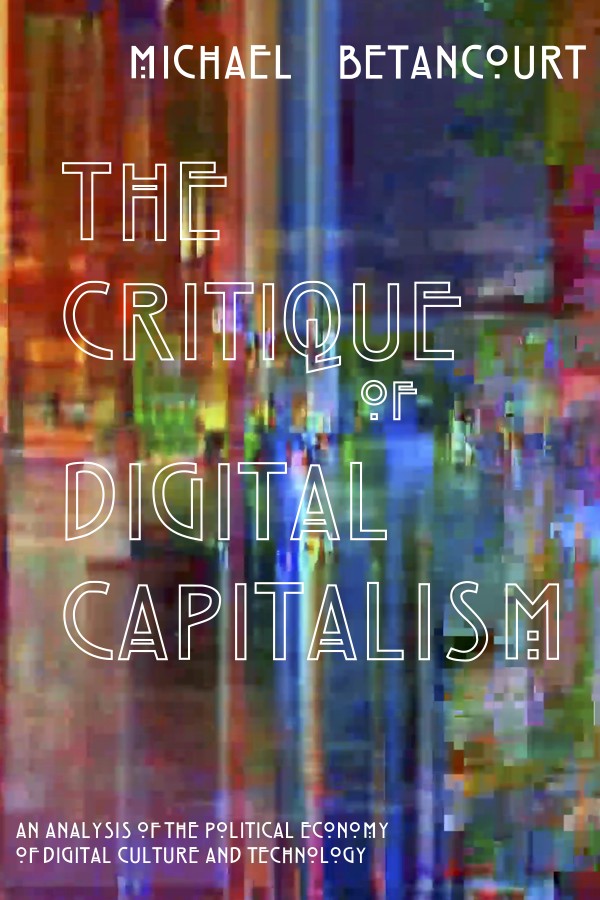
The Critique of Digital Capitalism
An Analysis of the Political Economy of Digital Culture and Technology
Book information
- Publisher
- punctum books
- Publication
- Published 7 January 2016
- Place
- Brooklyn, NY
- Catalogue record
- View in the catalogue
Abstract
Anything that can be automated, will be. The “magic” that digital technology has brought us — self-driving cars, Bitcoin, high frequency trading, internet of things, social networking, mass surveillance, the 2009 housing bubble — has not been considered ideologically. The Critique of Digital Capitalism identifies how digital technology has captured contemporary society in a reification of capitalist priorities. The theory proposed in this book is the description of how digital capitalism as an ideologically “invisible” framework is realized in technology. Written as a series of articles between 2003 and 2015, it provides a broad critical scope for understanding the inherent demands of capitalist protocols for expansion without constraint (regardless of social, legal or ethical limits) that are increasingly being realized as autonomous systems no longer dependent on human labor or oversight and implemented without social discussion of their impacts. The digital illusion of infinite resources, infinite production, and no costs appears as an “end to scarcity,” whereby digital production supposedly eliminates costs and makes everything equally available to everyone. This fantasy of production without consumption hides the physical costs and real-world impacts of these technologies.
The critique introduced in this book develops from basic questions about how digital technologies directly change the structure of society: why is “Digital Rights Management” not only the dominant “solution” for distributing digital information, but also the only option being considered? During the burst of the “Housing Bubble” in 2009, why were the immaterial commodities being traded of primary concern, but the actual physical assets and the impacts on the people living in them generally ignored? How do surveillance (pervasive monitoring) and agnotology coincide as mutually reinforcing technologies of control and restraint? If technology makes the assumptions of its society manifest as instrumentality — then what ideology is being realized as the digital computer? This final question animates the critical framework this analysis proposes.
Digital capitalism is a dramatically new configuration of the historical dynamics of production, labor and consumption that results in a new variant of historical capitalism. This contemporary, globalized network of production and distribution depends on digital capitalism’s refusal of established social restraints: existing laws are an impediment to the transcendent aspects of digital technology. Its utopian claims mask its authoritarian result: the superficial “objectivity” of computer systems are supposed to replace established protections with machinic function — the uniform imposition of whatever ideology informs the design. However, machines are never impartial: they reify the ideologies they are built to enact. The critical analysis of capitalist ideologies as they become digital is essential to challenging this process. Contesting their domination depends on theoretical analysis. This critique challenges received ideas about the relationship between labor, commodity production, and value, in the process demonstrating how the historical Marxist analysis depends on assumptions that are no longer valid. This book therefore provides a unique, critical toolset for the analysis of digital capitalist hegemonics.
Where its authors and editors are based
Countries of the institutions the book's authors, editors and chapter authors were affiliated to when it was published.
- AUTHORS / EDITORS
- CITATIONS Phase 2
- USAGE Phase 3
No affiliations with a known country in these years yet.
About this data
These figures cover 1 work. Each value comes from the most trusted source that has it; a correction made by OBC staff outranks every source.
| Source | Confidence | Works |
|---|---|---|
| Thoth | 90 / 100 | 1 |
| Works with a publication date | 100% |
|---|---|
| Works with a DOI | 100% |
| Works with a funder recorded | 0% |
| Authors with an affiliation | 0% |
Countries come from the institution each author was affiliated to when they published, as recorded in ROR. A country is never guessed, so authors without a matched institution are not counted on the maps.
Funders come from OpenAlex for articles and Thoth for books, where publishers recorded them. Most works record none, so a funder's figures show what is recorded, not everything it funded.
Chapters count as works: their authors and editors, and the countries of their institutions, are in every figure where Thoth records an affiliation for them.
Citations (Phase 2) and usage (Phase 3) are not collected yet.