
Book view
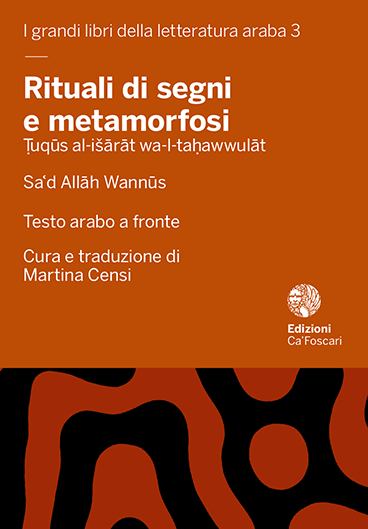
Rituals of Signs and Metamorphosis
Ṭuqūs al-išārāt wa-l-taḥawwulāt
Edited by Martina Censi; by Saʻd Allāh Wannūs
Book information
- Publisher
- Edizioni Ca' Foscari
- Publication
- Published 21 December 2020
- Place
- Venice, Italy
- Series
- I grandi libri della letteratura araba
- Catalogue record
- View in the catalogue
Abstract
Ṭuqūs al-išārāt wa-l-taḥawwulāt (Rituals of Signs and Transformations), published in 1994, is a play which can be attributed to the last phase of Saʿd Allāh Wannūs’s literary production. At this stage, the Syrian author’s political commitment is no longer expressed through the interest for the collective dimension, but it focuses on the individual, considered as a pivotal element for social change. In Ṭuqūs, Saʿd Allāh Wannūs revisits history from an individual point of view, fragmenting it into a multiplicity of micro-narratives. During the 1880s in Damascus, the muftī, the chief religious legal authority, and the leader of the ašrāf, the descendants of the Prophet, are involved in a feud that splits the city into factions and brings it on the verge of anarchy. When the chief of police arrests the leader of the ašrāf while he is engaged in lovemaking with his mistress in his semi-private garden, the muftī concocts a scheme to save his enemy’s reputation, but his real aim is to subdue him and get rid of him. This event triggers a series of transformations involving the identities of the characters. Thus, the leader of the ašrāf, a regular of prostitutes and assiduous drinker, suddenly becomes a mystic with ascetic ambitions, while the upright muftī loses his head for a high-ranking woman who leaves her respectable life to become a prostitute. The whole society is destabilized by the desires of the characters. Desire not only affects their individual identity, but it also exerts influence on their social position, undermining a system of norms based on hypocrisy and on the division between the ‘latent’ and the ‘manifest’.
Where its authors and editors are based
Countries of the institutions the book's authors, editors and chapter authors were affiliated to when it was published.
- AUTHORS / EDITORS
- CITATIONS Phase 2
- USAGE Phase 3
| Country | Authors / editors |
|---|---|
| Italy | 1 |
About this data
These figures cover 1 work. Each value comes from the most trusted source that has it; a correction made by OBC staff outranks every source.
| Source | Confidence | Works |
|---|---|---|
| Thoth | 90 / 100 | 1 |
| Works with a publication date | 100% |
|---|---|
| Works with a DOI | 100% |
| Works with a funder recorded | 0% |
| Authors with an affiliation | 50% |
| Affiliations matched to an institution (ROR) | 100% |
| Affiliations with a country | 100% |
Countries come from the institution each author was affiliated to when they published, as recorded in ROR. A country is never guessed, so authors without a matched institution are not counted on the maps.
Funders come from OpenAlex for articles and Thoth for books, where publishers recorded them. Most works record none, so a funder's figures show what is recorded, not everything it funded.
Chapters count as works: their authors and editors, and the countries of their institutions, are in every figure where Thoth records an affiliation for them.
Citations (Phase 2) and usage (Phase 3) are not collected yet.