
Book view
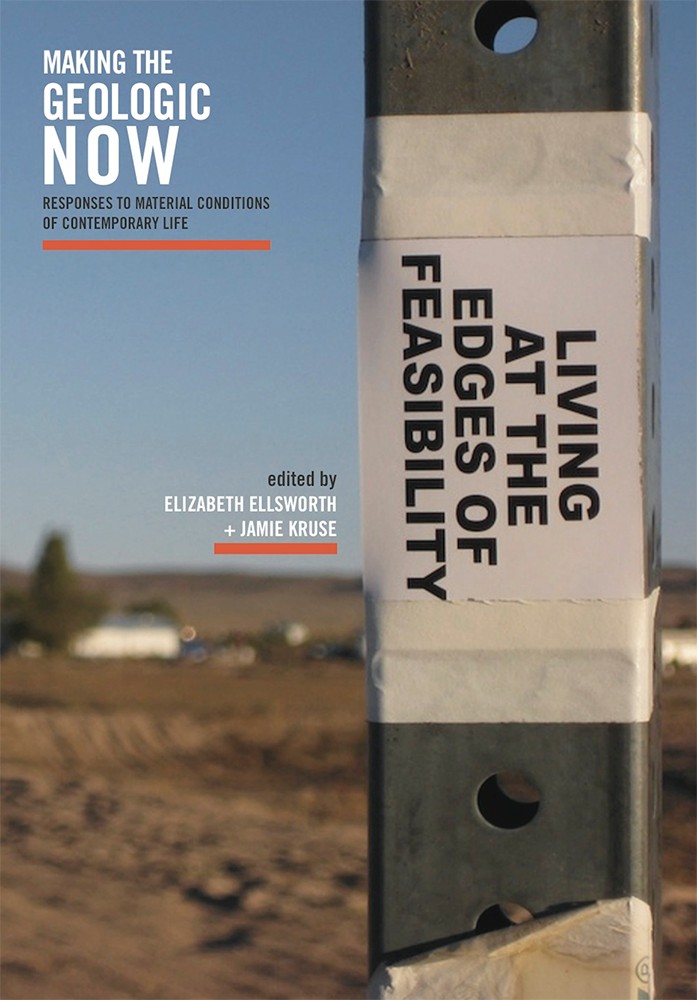
Making the Geologic Now
Responses to Material Conditions of Contemporary Life
Edited by Elisabeth Ellsworth, Jamie Kruse
Book information
- Publisher
- punctum books
- Publication
- Published 4 December 2012
- Place
- Brooklyn, NY
- Catalogue record
- View in the catalogue
Abstract
Making the Geologic Now announces shifts in cultural sensibilities and practices. It offers early sightings of an increasingly widespread turn toward the geologic as source of explanation, motivation, and inspiration for creative responses to conditions of the present moment. In the spirit of a broadside, this edited collection circulates images and short essays from over 40 artists, designers, architects, scholars, and journalists who are actively exploring and creatively responding to the geologic depth of “now.” Contributors’ ideas and works are drawn from architecture, design, contemporary philosophy and art. They are offered as test sites for what might become thinkable or possible if humans were to collectively take up the geologic as our instructive co-designer—as a partner in designing thoughts, objects, systems, and experiences.
Recent natural and human-made events triggered by or triggering the geologic have made volatile earth forces sense-able and relevant with new levels of intensity. As a condition of contemporary life in 2012, the geologic “now” is lived as a cascade of events. Humans and what we build participate in their unfolding. Today, and unlike the environmental movements of the 1970s, the geologic counts as “the environment” and invites us to extend our active awareness of inhabitation out to the cosmos and down to the Earth’s iron core.
*Image from Trace — cameraless records of radioactive contamination: Shimpei Takeda, 2012 (photo by Keisuke Hiei)
A new cultural sensibility is emerging. As we struggle to understand and meet new material realities of earth and life on earth, it becomes increasingly obvious that the geologic is not just about rocks. We now cohabit with the geologic in unprecedented ways, in teeming assemblages of exchange and interaction among geologic materials and forces and the bio, cosmo, socio, political, legal, economic, strategic, and imaginary. As a reading and viewing experience, Making the Geologic Now is designed to move through culture, sounding an alert from the unfolding edge of the “geologic turn” that is now propagating through contemporary ideas and practices.
Chapters
Where its authors and editors are based
Countries of the institutions the book's authors, editors and chapter authors were affiliated to when it was published.
- AUTHORS / EDITORS
- CITATIONS Phase 2
- USAGE Phase 3
| Country | Authors / editors |
|---|---|
| United States | 22 |
| United Kingdom | 2 |
| Canada | 1 |
| Hong Kong | 1 |
| Italy | 1 |
| Norway | 1 |
About this data
These figures cover 43 works. Each value comes from the most trusted source that has it; a correction made by OBC staff outranks every source.
| Source | Confidence | Works |
|---|---|---|
| Thoth | 90 / 100 | 43 |
| Works with a publication date | 100% |
|---|---|
| Works with a DOI | 100% |
| Works with a funder recorded | 0% |
| Authors with an affiliation | 59% |
| Affiliations matched to an institution (ROR) | 100% |
| Affiliations with a country | 100% |
Countries come from the institution each author was affiliated to when they published, as recorded in ROR. A country is never guessed, so authors without a matched institution are not counted on the maps.
Funders come from OpenAlex for articles and Thoth for books, where publishers recorded them. Most works record none, so a funder's figures show what is recorded, not everything it funded.
Chapters count as works: their authors and editors, and the countries of their institutions, are in every figure where Thoth records an affiliation for them.
Citations (Phase 2) and usage (Phase 3) are not collected yet.