
Book view
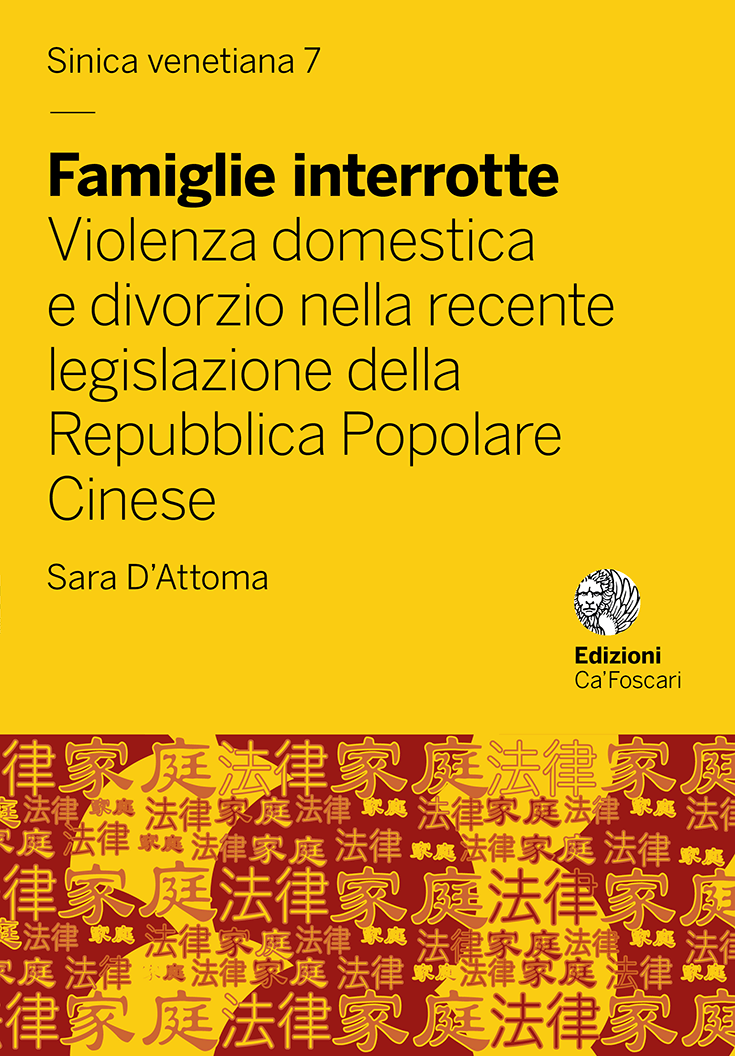
Interrupted Families
Domestic Violence and Divorce in Recent PRC Legislation
Book information
- Publisher
- Edizioni Ca' Foscari
- Publication
- Published 12 May 2022
- Place
- Venice, Italy
- Series
- Sinica venetiana
- Catalogue record
- View in the catalogue
Abstract
Gender-based violence perpetrated within the family is an issue of global importance. It is no coincidence that the statistics on domestic violence committed during the ongoing pandemic have shown it as a worrying phenomenon crossing national borders and social levels. In China the consideration of domestic violence as an element of destabilisation of the family unit is rather recent. In fact, the traditional patriarchal values on which the Chinese family based its relations considered intra-family violence – particularly towards women – an accepted and fully integrated component in the normal course of relations among people belonging to the same lineage. The Pandora’s Box, which for centuries has concealed and neglected the problem, has only been uncovered since the Fourth World Conference on Women held in Beijing in 1995, which started the debate on the issue of gender-based violence and brought China to draw up annual reports on the female condition. The inclusion of the category “domestic violence” in a national law dates back to 2001 (Marriage Law) and the first ad hoc legislation to 2016. The relationship between domestic violence, social and family stability was the leitmotif that accompanied the official documents of the legislative process that led to the drafting of the Law against Domestic Violence of the PRC. This latter has focused on a prevention network aiming primarily to empower civil society, but overshadowing mere legal instruments. By analysing all the phases of this legislative process, the book aims to reflect on the regulatory instruments – in particular, divorce and the system of protection orders – and on the features of these institutions created to limit and control the problem of family violence. Furthermore, this analysis will provide insights into the social and linguistic implications that the issue of domestic violence has determined in China in the past up to nowadays.
Where its authors and editors are based
Countries of the institutions the book's authors, editors and chapter authors were affiliated to when it was published.
- AUTHORS / EDITORS
- CITATIONS Phase 2
- USAGE Phase 3
| Country | Authors / editors |
|---|---|
| Italy | 1 |
About this data
These figures cover 1 work. Each value comes from the most trusted source that has it; a correction made by OBC staff outranks every source.
| Source | Confidence | Works |
|---|---|---|
| Thoth | 90 / 100 | 1 |
| Works with a publication date | 100% |
|---|---|
| Works with a DOI | 100% |
| Works with a funder recorded | 0% |
| Authors with an affiliation | 100% |
| Affiliations matched to an institution (ROR) | 100% |
| Affiliations with a country | 100% |
Countries come from the institution each author was affiliated to when they published, as recorded in ROR. A country is never guessed, so authors without a matched institution are not counted on the maps.
Funders come from OpenAlex for articles and Thoth for books, where publishers recorded them. Most works record none, so a funder's figures show what is recorded, not everything it funded.
Chapters count as works: their authors and editors, and the countries of their institutions, are in every figure where Thoth records an affiliation for them.
Citations (Phase 2) and usage (Phase 3) are not collected yet.