
Book information
- Publisher
- Open Book Publishers
- Publication
- Published 20 August 2025
- Place
- Cambridge, UK
- Series
- Semitic Languages and Cultures
- Catalogue record
- View in the catalogue
Abstract
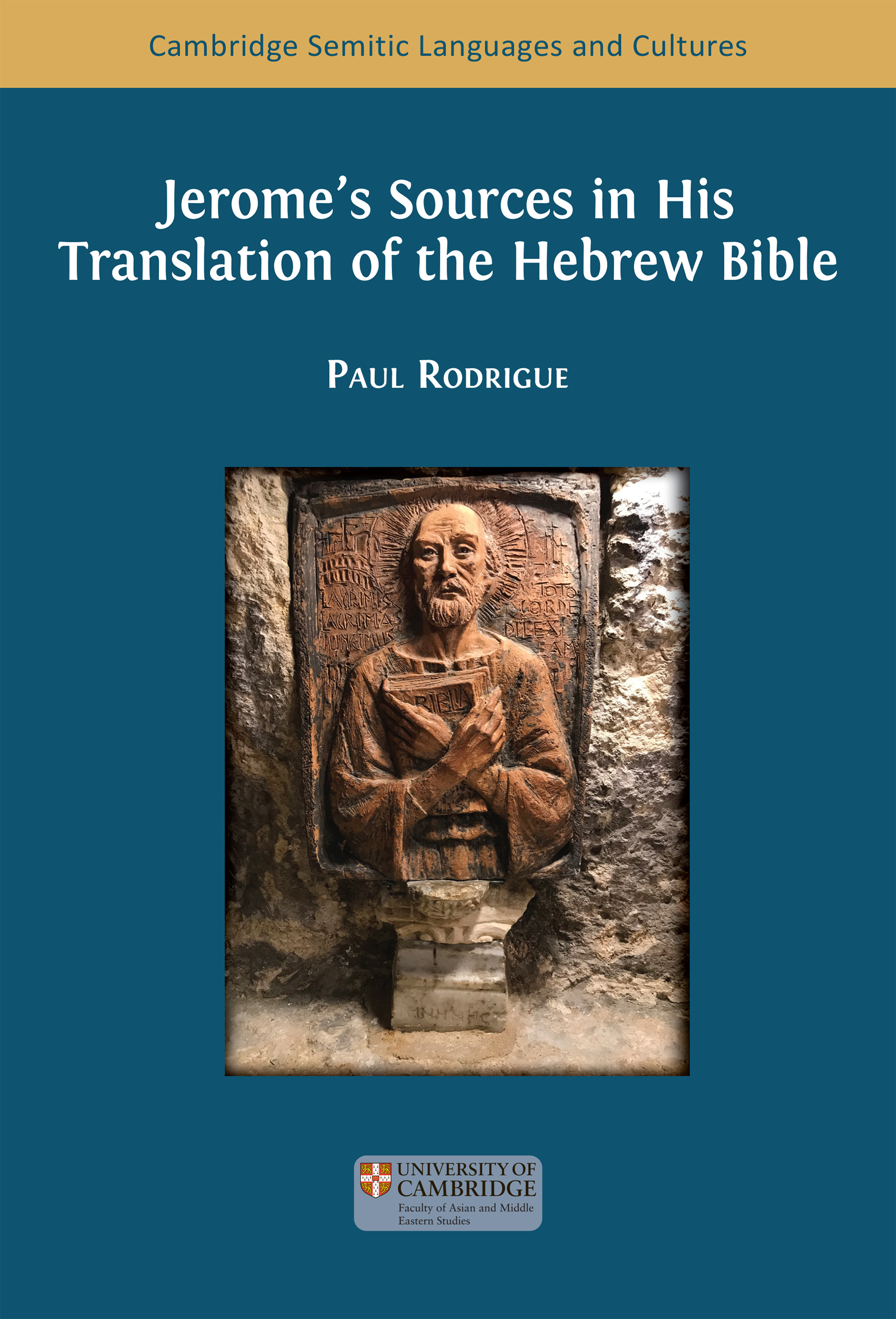
At the close of the fourth century CE, Jerome of Stridon—renowned Latin scholar, theologian, and priest—undertook the monumental task of translating the Hebrew-Aramaic Bible into Latin. The result of this effort, now known as the Vulgate, has long been regarded as a foundational text of Western Christianity. In this volume, Paul Rodrigue investigates the sources that Jerome may have drawn upon in the process of translation.
Far from being just a rendering of the Hebrew-Aramaic Bible, the Vulgate emerges as a layered and multifaceted translation, shaped not only by the Hebrew-Aramaic text but also by a broad array of additional sources. Through a series of carefully chosen case studies, Rodrigue analyses a number of verses from the Joseph narrative in Genesis, as well as from Daniel and Esther. Each Vulgate passage is meticulously compared with its equivalents in the Hebrew-Aramaic Bible, the Septuagint, the Latin translations of the Septuagint, the Greek versions of Aquila, Symmachus, and Theodotion, and—where applicable—the Targumim and rabbinic writings.
This comparative approach reveals Jerome’s engagement with texts in four languages—Hebrew, Aramaic, Greek, and Latin—and highlights his responses to both Jewish and Christian exegetical traditions. Importantly, the selected translations span Jerome’s career as a translator of the Hebrew-Aramaic Bible: Daniel at its outset (392–393), Genesis mid-career (late 390s), and Esther at its close (404–405). As such, Rodrigue’s analysis offers a chronologically nuanced study of Jerome’s evolving translation method (sensus de sensu), providing invaluable insight for scholars of biblical studies, late antiquity, translation theory, and the transmission of sacred texts.
Chapters
Where its authors and editors are based
Countries of the institutions the book's authors, editors and chapter authors were affiliated to when it was published.
- AUTHORS / EDITORS
- CITATIONS Phase 2
- USAGE Phase 3
No affiliations with a known country in these years yet.
About this data
These figures cover 6 works. Each value comes from the most trusted source that has it; a correction made by OBC staff outranks every source.
| Source | Confidence | Works |
|---|---|---|
| Thoth | 90 / 100 | 6 |
| Works with a publication date | 100% |
|---|---|
| Works with a DOI | 100% |
| Works with a funder recorded | 0% |
| Authors with an affiliation | 0% |
Countries come from the institution each author was affiliated to when they published, as recorded in ROR. A country is never guessed, so authors without a matched institution are not counted on the maps.
Funders come from OpenAlex for articles and Thoth for books, where publishers recorded them. Most works record none, so a funder's figures show what is recorded, not everything it funded.
Chapters count as works: their authors and editors, and the countries of their institutions, are in every figure where Thoth records an affiliation for them.
Citations (Phase 2) and usage (Phase 3) are not collected yet.