
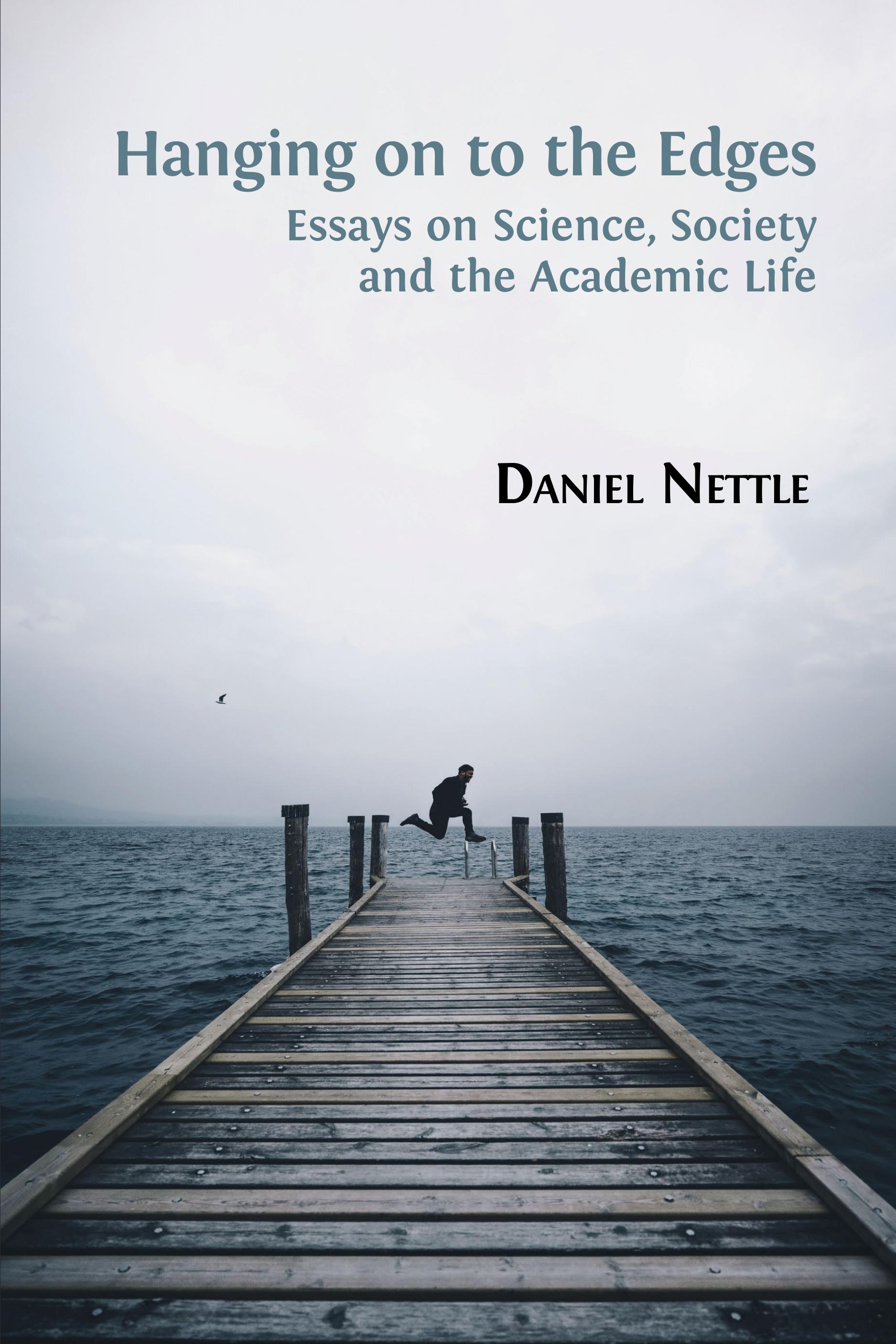
Book information
- Publisher
- Open Book Publishers
- Publication
- Published 15 October 2018
- Place
- Cambridge, UK
- Catalogue record
- View in the catalogue
Abstract
What does it mean to be a scientist working today; specifically, a scientist whose subject matter is human life? Scientists often overstate their claim to certainty, sorting the world into categorical distinctions that obstruct rather than clarify its complexities. In this book Daniel Nettle urges the reader to unpick such distinctions—biological versus social sciences, mind versus body, and nature versus nurture—and look instead for the for puzzles and anomalies, the points of connection and overlap. These essays, converted from often humorous, sometimes autobiographical blog posts, form an extended meditation on the possibilities and frustrations of the life scientific. Pragmatically arguing from the intersection between social and biological sciences, Nettle reappraises the virtues of policy initiatives such as Universal Basic Income and income redistribution, highlighting the traps researchers and politicians are liable to encounter. This provocative, intelligent and self-critical volume is a testament to the possibilities of interdisciplinary study—whose virtues Nettle stridently defends—drawing from and having implications for a wide cross-section of academic inquiry. This will appeal to anybody curious about the implications of social and biological sciences for increasingly topical political concerns. It comes particularly recommended to Sciences and Social Sciences students and to scholars seeking to extend the scope of their field in collaboration with other disciplines.
Chapters
Where its authors and editors are based
Countries of the institutions the book's authors, editors and chapter authors were affiliated to when it was published.
- AUTHORS / EDITORS
- CITATIONS Phase 2
- USAGE Phase 3
| Country | Authors / editors |
|---|---|
| United Kingdom | 1 |
About this data
These figures cover 16 works. Each value comes from the most trusted source that has it; a correction made by OBC staff outranks every source.
| Source | Confidence | Works |
|---|---|---|
| Thoth | 90 / 100 | 16 |
| Works with a publication date | 100% |
|---|---|
| Works with a DOI | 100% |
| Works with a funder recorded | 0% |
| Authors with an affiliation | 100% |
| Affiliations matched to an institution (ROR) | 100% |
| Affiliations with a country | 100% |
Countries come from the institution each author was affiliated to when they published, as recorded in ROR. A country is never guessed, so authors without a matched institution are not counted on the maps.
Funders come from OpenAlex for articles and Thoth for books, where publishers recorded them. Most works record none, so a funder's figures show what is recorded, not everything it funded.
Chapters count as works: their authors and editors, and the countries of their institutions, are in every figure where Thoth records an affiliation for them.
Citations (Phase 2) and usage (Phase 3) are not collected yet.