
Book view
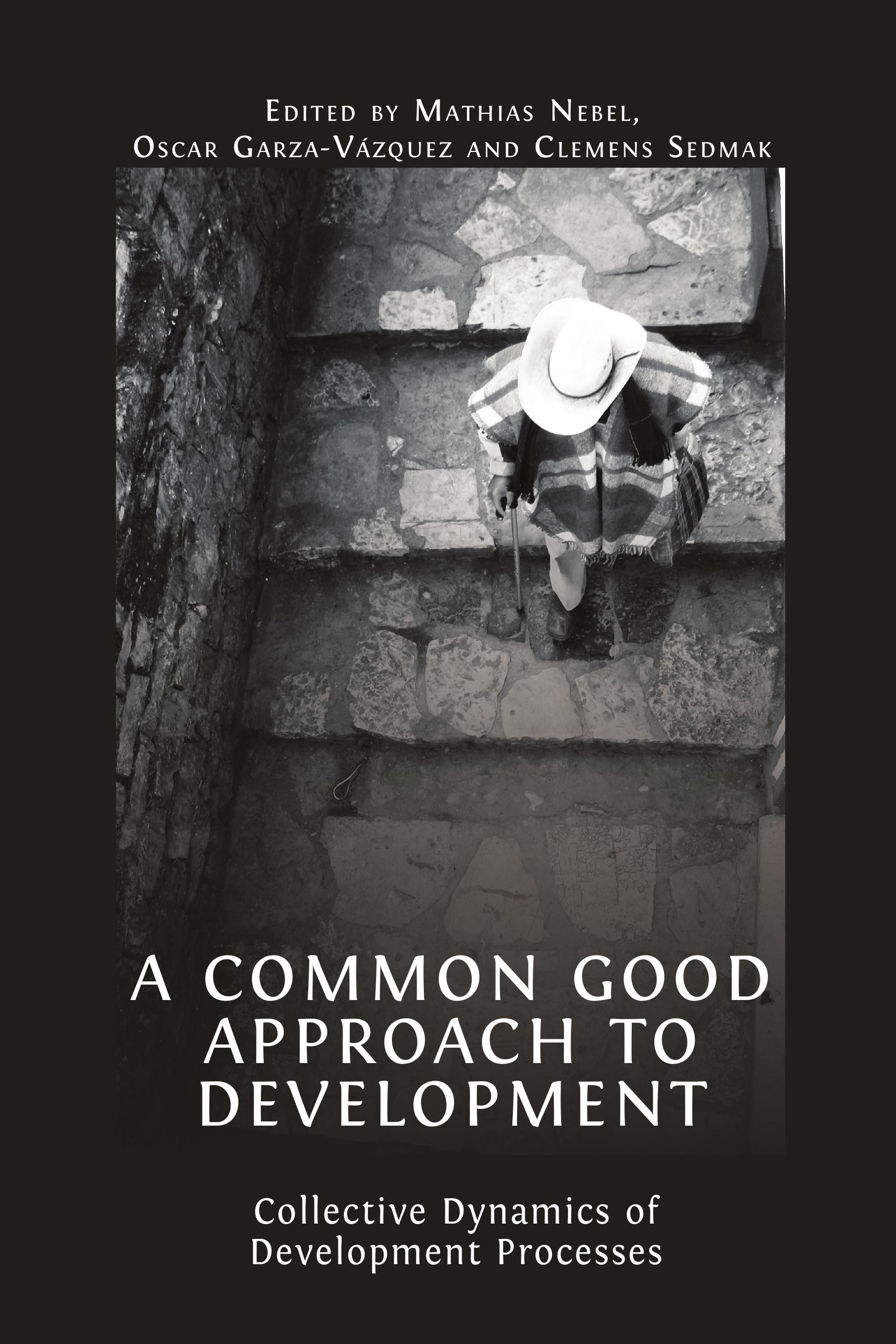
A Common Good Approach to Development
Collective Dynamics of Development Processes
Edited by Mathias Nebel, Oscar Garza-Vázquez, Clemens Sedmak
Book information
- Publisher
- Open Book Publishers
- Publication
- Published 26 April 2022
- Place
- Cambridge, UK
- Catalogue record
- View in the catalogue
Abstract
This edited collection proposes a common good approach to development theory and practice. Rather than focusing on the outcomes or conditions of development, the contributors concentrate on the quality of development processes, suggesting that a common good dynamic is key in order to trigger development.
Resulting from more than three years of research by an international group of over fifty scholars, the volume advocates for a modern understanding of the common good—rather than a theological or metaphysical good—in societies by emphasising the social practice of ‘commoning’ at its core. It suggests that the dynamic equilibrium of common goods in a society should be at the centre of development efforts. For this purpose, it develops a matrix of common good dynamics, accounting for how institutions, social norms and common practices interconnect by identifying five key drivers not only of development, but human development (agency, governance, justice, stability, humanity). Based on this matrix, the contributors suggest a possible metric for measuring the quality of these dynamics. The last section of the book highlights the possibilities enabled by this approach through a series of case studies.
The concept of the common good has recently enjoyed a revival and inspired practitioners keen to look beyond the shortcomings of political and economic liberalism. This book builds on those efforts to think beyond the agenda of twentieth-century development policies, and will be of interest to those working in the fields of development, economics, sociology, philosophy and political science.
Chapters
Where its authors and editors are based
Countries of the institutions the book's authors, editors and chapter authors were affiliated to when it was published.
- AUTHORS / EDITORS
- CITATIONS Phase 2
- USAGE Phase 3
| Country | Authors / editors |
|---|---|
| Mexico | 5 |
| Belgium | 2 |
| Italy | 2 |
| United States | 2 |
| Spain | 1 |
| United Kingdom | 1 |
About this data
These figures cover 17 works. Each value comes from the most trusted source that has it; a correction made by OBC staff outranks every source.
| Source | Confidence | Works |
|---|---|---|
| Thoth | 90 / 100 | 17 |
| Works with a publication date | 100% |
|---|---|
| Works with a DOI | 100% |
| Works with a funder recorded | 0% |
| Authors with an affiliation | 96% |
| Affiliations matched to an institution (ROR) | 100% |
| Affiliations with a country | 100% |
Countries come from the institution each author was affiliated to when they published, as recorded in ROR. A country is never guessed, so authors without a matched institution are not counted on the maps.
Funders come from OpenAlex for articles and Thoth for books, where publishers recorded them. Most works record none, so a funder's figures show what is recorded, not everything it funded.
Chapters count as works: their authors and editors, and the countries of their institutions, are in every figure where Thoth records an affiliation for them.
Citations (Phase 2) and usage (Phase 3) are not collected yet.