
Book view
Cicero, On Pompey's Command (De Imperio), 27-49
Latin Text, Study Aids with Vocabulary, Commentary, and Translation
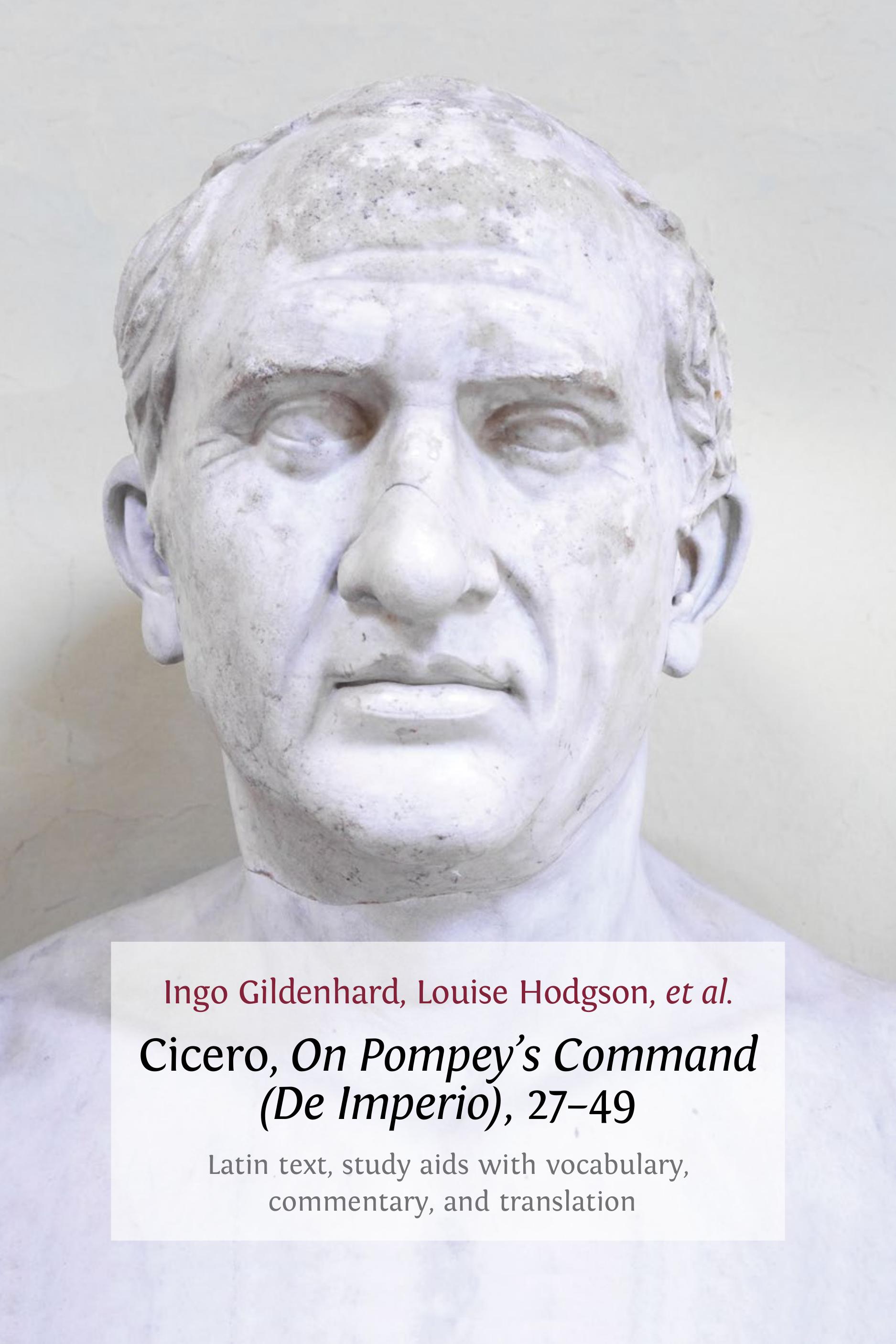
Book information
- Publisher
- Open Book Publishers
- Publication
- Published 3 September 2014
- Place
- Cambridge, UK
- Series
- Classics Textbooks
- Catalogue record
- View in the catalogue
Abstract
In republican times, one of Rome's deadliest enemies was King Mithridates of Pontus. In 66 BCE, after decades of inconclusive struggle, the tribune Manilius proposed a bill that would give supreme command in the war against Mithridates to Pompey the Great, who had just swept the Mediterranean clean of another menace: the pirates. While powerful aristocrats objected to the proposal, which would endow Pompey with unprecedented powers, the bill proved hugely popular among the people, and one of the praetors, Marcus Tullius Cicero, also hastened to lend it his support. In his first ever political speech, variously entitled pro lege Manilia or de imperio Gnaei Pompei, Cicero argues that the war against Mithridates requires the appointment of a perfect general and that the only man to live up to such lofty standards is Pompey. In the section under consideration here, Cicero defines the most important hallmarks of the ideal military commander and tries to demonstrate that Pompey is his living embodiment. This course book offers a portion of the original Latin text, study aids with vocabulary, and a commentary. Designed to stretch and stimulate readers, the incisive commentary will be of particular interest to students of Latin at both AS and undergraduate level. It extends beyond detailed linguistic analysis and historical background to encourage critical engagement with Cicero's prose and discussion of the most recent scholarly thought.
Chapters
| Chapter | Author | Institution at publication |
|---|---|---|
| Introduction: why does the set text matter? | Ingo Gildenhard, Louise Hodgson | University of Cambridge |
| Commentary | Ingo Gildenhard, Louise Hodgson | University of Cambridge |
| Further Resources | Ingo Gildenhard, Louise Hodgson | University of Cambridge |
| Latin text with study questions and vocabulary aid | Ingo Gildenhard, Louise Hodgson | University of Cambridge |
Where its authors and editors are based
Countries of the institutions the book's authors, editors and chapter authors were affiliated to when it was published.
- AUTHORS / EDITORS
- CITATIONS Phase 2
- USAGE Phase 3
| Country | Authors / editors |
|---|---|
| United Kingdom | 1 |
About this data
These figures cover 5 works. Each value comes from the most trusted source that has it; a correction made by OBC staff outranks every source.
| Source | Confidence | Works |
|---|---|---|
| Thoth | 90 / 100 | 5 |
| Works with a publication date | 100% |
|---|---|
| Works with a DOI | 100% |
| Works with a funder recorded | 0% |
| Authors with an affiliation | 50% |
| Affiliations matched to an institution (ROR) | 100% |
| Affiliations with a country | 100% |
Countries come from the institution each author was affiliated to when they published, as recorded in ROR. A country is never guessed, so authors without a matched institution are not counted on the maps.
Funders come from OpenAlex for articles and Thoth for books, where publishers recorded them. Most works record none, so a funder's figures show what is recorded, not everything it funded.
Chapters count as works: their authors and editors, and the countries of their institutions, are in every figure where Thoth records an affiliation for them.
Citations (Phase 2) and usage (Phase 3) are not collected yet.