
Book view
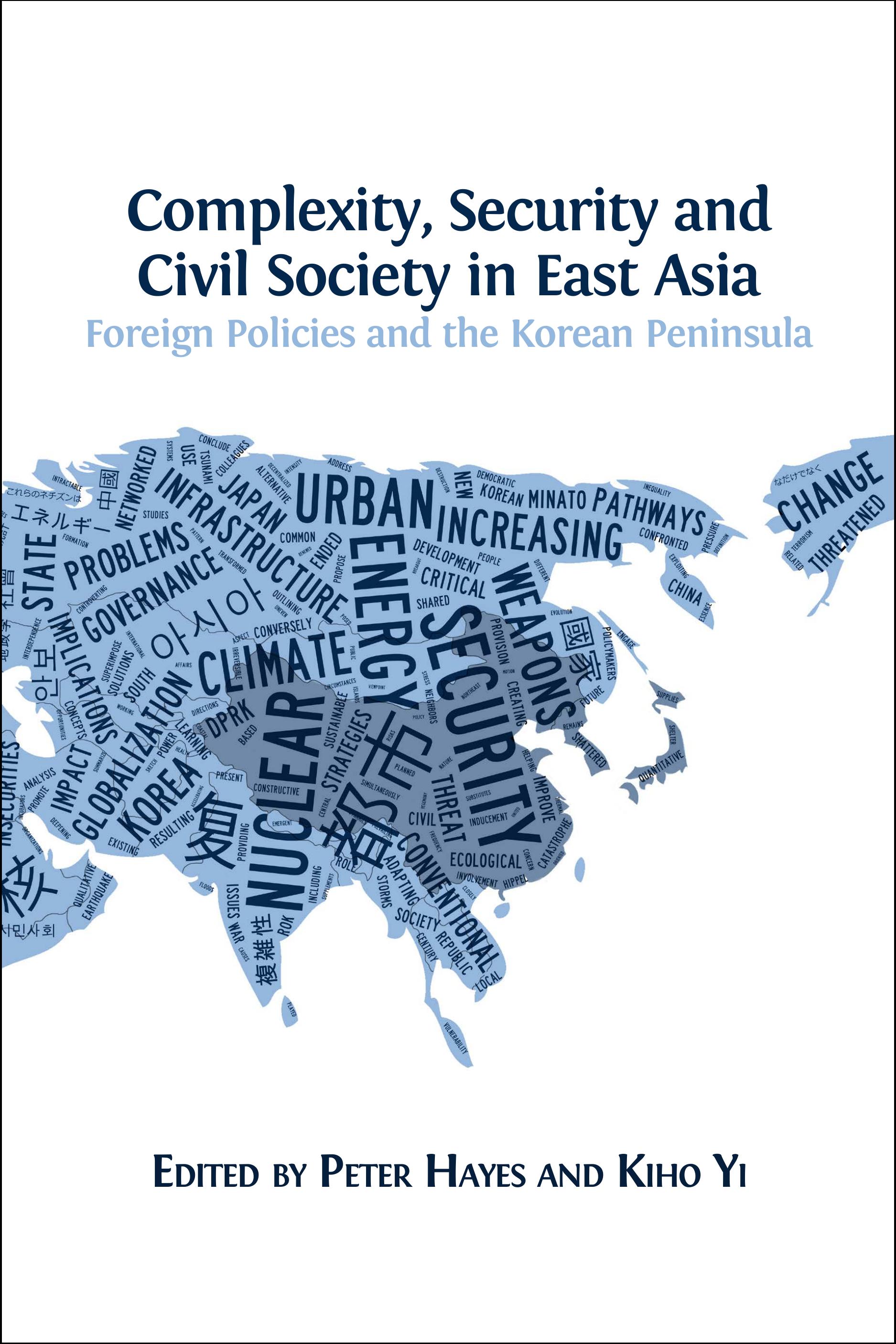
Complexity, Security and Civil Society in East Asia
Foreign Policies and the Korean Peninsula
Edited by Peter Hayes, Kiho Yi
Book information
- Publisher
- Open Book Publishers
- Publication
- Published 22 June 2015
- Place
- Cambridge, UK
- Catalogue record
- View in the catalogue
Abstract
Complexity, Security and Civil Society in East Asia offers the latest understanding of complex global problems including nuclear weapons, urban insecurity, energy, and climate change in the region. Detailed case studies in China, North and South Korea, and Japan demonstrate the importance of civil society and 'civic diplomacy' in reaching shared solutions to these problems in East Asia and beyond. Each chapter describes regional civil society initiatives that tackle complex challenges to East Asia’s security. In so doing the book presents key pressure points at which civil society can push for constructive changes ― especially ones that reduce the North Korean threat to its neighbors. Unusually, this book is both theoretical and practical. Complexity, Security and Civil Society in East Asia identifies strategies that can be led by civil society and negotiated by its diplomats to realize peace, security and sustainability worldwide. It shows that networked civic diplomacy offers solutions to these urgent issues in ways that official ‘complex diplomacy’ cannot. By providing a new theoretical framework based on empirical observation, the book is a must read for diplomats, scholars, students, journalists, activists and individual readers seeking insight into how to solve the crucial issues of our time.
Chapters
| Chapter | Author | Institution at publication |
|---|---|---|
| 1. Introduction | Peter Hayes, Kiho Yi, Joan Diamond | The University of Sydney; Nautilus Institute; Hanshin University |
| 2. Global Problems, Complexity, and Civil Society in East Asia | Peter Hayes, Richard Tanter | The University of Sydney; Nautilus Institute; The University of Melbourne |
| 3. Energy Security and the Role of Green Economies in East Asia | David von Hippel, Yi Wang, Kae Takase, Tetsunari Iida, Myungrae Cho, Sun-Jin Yun | Nautilus Institute; Chinese Academy of Sciences; The University of Tokyo; Dankook University; Seoul National University |
| 4. Urban Security and Complexity in Northeast Asia | Sanghun Lee, Takayuki Minato, Peter Hayes | Hanshin University; The University of Tokyo; The University of Sydney; Nautilus Institute |
| 5. Complexity and Weapons of Mass Destruction in Northeast Asia | Peter Hayes, Roger Cavazos | The University of Sydney; Nautilus Institute |
| 6. The Implications of Civic Diplomacy for ROK Foreign Policy | Kiho Yi, Peter Hayes, Joan Diamond, Steven Denney, Christopher Green, Jungmin Seo | Hanshin University; The University of Sydney; Nautilus Institute; University of Toronto; Leiden University; Yonsei University |
| 7. Anticipating Complex Northeast Asian Futures | Peter Hayes, Joan Diamond, Kiho Yi | The University of Sydney; Nautilus Institute; Hanshin University |
Where its authors and editors are based
Countries of the institutions the book's authors, editors and chapter authors were affiliated to when it was published.
- AUTHORS / EDITORS
- CITATIONS Phase 2
- USAGE Phase 3
| Country | Authors / editors |
|---|---|
| South Korea | 5 |
| United States | 4 |
| Australia | 2 |
| Japan | 2 |
| Canada | 1 |
| China | 1 |
| The Netherlands | 1 |
About this data
These figures cover 8 works. Each value comes from the most trusted source that has it; a correction made by OBC staff outranks every source.
| Source | Confidence | Works |
|---|---|---|
| Thoth | 90 / 100 | 8 |
| Works with a publication date | 100% |
|---|---|
| Works with a DOI | 100% |
| Works with a funder recorded | 12% |
| Authors with an affiliation | 93% |
| Affiliations matched to an institution (ROR) | 100% |
| Affiliations with a country | 100% |
Countries come from the institution each author was affiliated to when they published, as recorded in ROR. A country is never guessed, so authors without a matched institution are not counted on the maps.
Funders come from OpenAlex for articles and Thoth for books, where publishers recorded them. Most works record none, so a funder's figures show what is recorded, not everything it funded.
Chapters count as works: their authors and editors, and the countries of their institutions, are in every figure where Thoth records an affiliation for them.
Citations (Phase 2) and usage (Phase 3) are not collected yet.