
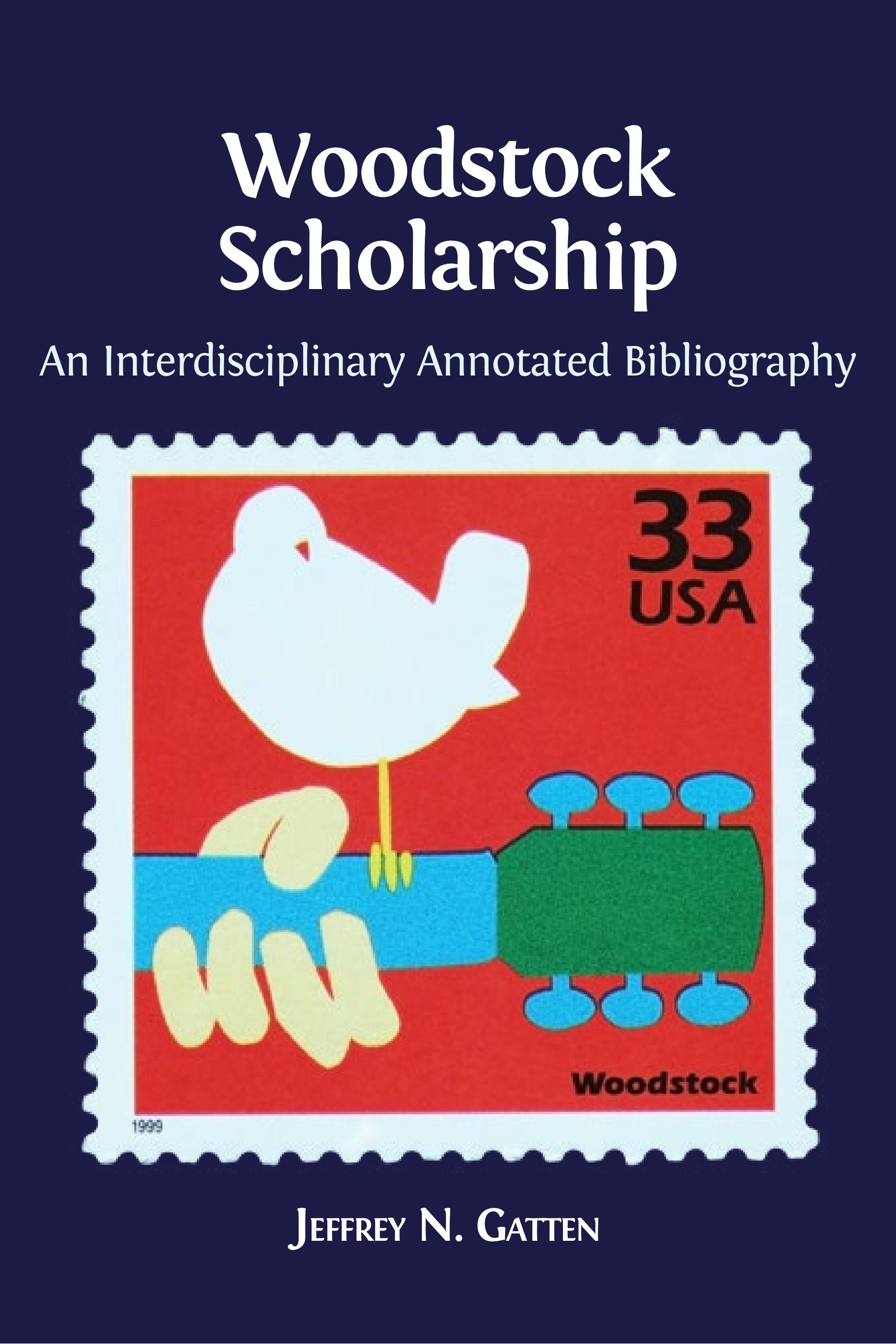
Book information
- Publisher
- Open Book Publishers
- Publication
- Published 11 November 2016
- Place
- Cambridge, UK
- Catalogue record
- View in the catalogue
Abstract
Since August 1969, the Woodstock Music and Art Fair looms large when recounting the history and impact of the baby boom generation and the societal upheavals of the Sixties. Scholars study the sociological, political, musical, and artistic impact of the event and use it as a cultural touchstone when exploring alternative perspectives or seeking clarity. This interdisciplinary annotated bibliography records the details of over 400 English-language resources on the Festival, including books, chapters, articles, websites, transcriptions and videos. Divided into six main subsections―Culture & Society, History, Biography, Music, Film, Arts & Literature―for ease of consultation Woodstock Scholarship sheds light on all facets of a key happening in our collective history.
Throughout the 1960s, popular music became increasingly reflective and suggestive of the rising political and social consciousness of the youth culture. Examples can be seen in the development of the protest song genre within the folk music boom of the early Sixties and the marriage of lifestyle to music first reflected by The Beatles with fashion, followed by psychedelic music with the emerging drug culture. Woodstock was where these themes coalesced, thus becoming the defining and last great moment of the 1960s. However, Woodstock also represented an abundant amount of experiences and ideas and moments. Thus, when exploring the complicated accounts and numerous facets of America during the turbulent Sixties one discovers scholarship on the key subjects, such as the Vietnam War or the Civil Rights Movement, often considering and debating the importance, relevance, and epic nature of Woodstock. Multiple narratives emerge: a radical engagement of the hippie movement, an overt commercial exploitation of youth culture, a political statement. Woodstock scholarship does not stand alone as field of study, but it is at the cross-road of a number of disciplines―music history, cultural studies, sociology, arts and literature, media studies, politics and economics.
Providing full bibliographical details and concise, informative annotation for each entry, Woodstock Scholarship is an essential tool for students, scholars, teachers, and librarians in all these areas, as well as for anyone seeking a deeper understanding of both the Woodstock Music and Art Fair phenomenon and of the confluence of music, commerce and politics.
Chapters
| Chapter | Author | Institution at publication |
|---|---|---|
| Introduction | Jeffrey N. Gatten | Loyola Marymount University |
| Arts & Literature | Jeffrey N. Gatten | Loyola Marymount University |
| Biography | Jeffrey N. Gatten | Loyola Marymount University |
| Culture & Society | Jeffrey N. Gatten | Loyola Marymount University |
| Film | Jeffrey N. Gatten | Loyola Marymount University |
| History | Jeffrey N. Gatten | Loyola Marymount University |
| Music | Jeffrey N. Gatten | Loyola Marymount University |
Where its authors and editors are based
Countries of the institutions the book's authors, editors and chapter authors were affiliated to when it was published.
- AUTHORS / EDITORS
- CITATIONS Phase 2
- USAGE Phase 3
| Country | Authors / editors |
|---|---|
| United States | 1 |
About this data
These figures cover 8 works. Each value comes from the most trusted source that has it; a correction made by OBC staff outranks every source.
| Source | Confidence | Works |
|---|---|---|
| Thoth | 90 / 100 | 8 |
| Works with a publication date | 100% |
|---|---|
| Works with a DOI | 100% |
| Works with a funder recorded | 12% |
| Authors with an affiliation | 100% |
| Affiliations matched to an institution (ROR) | 100% |
| Affiliations with a country | 100% |
Countries come from the institution each author was affiliated to when they published, as recorded in ROR. A country is never guessed, so authors without a matched institution are not counted on the maps.
Funders come from OpenAlex for articles and Thoth for books, where publishers recorded them. Most works record none, so a funder's figures show what is recorded, not everything it funded.
Chapters count as works: their authors and editors, and the countries of their institutions, are in every figure where Thoth records an affiliation for them.
Citations (Phase 2) and usage (Phase 3) are not collected yet.