
Book view
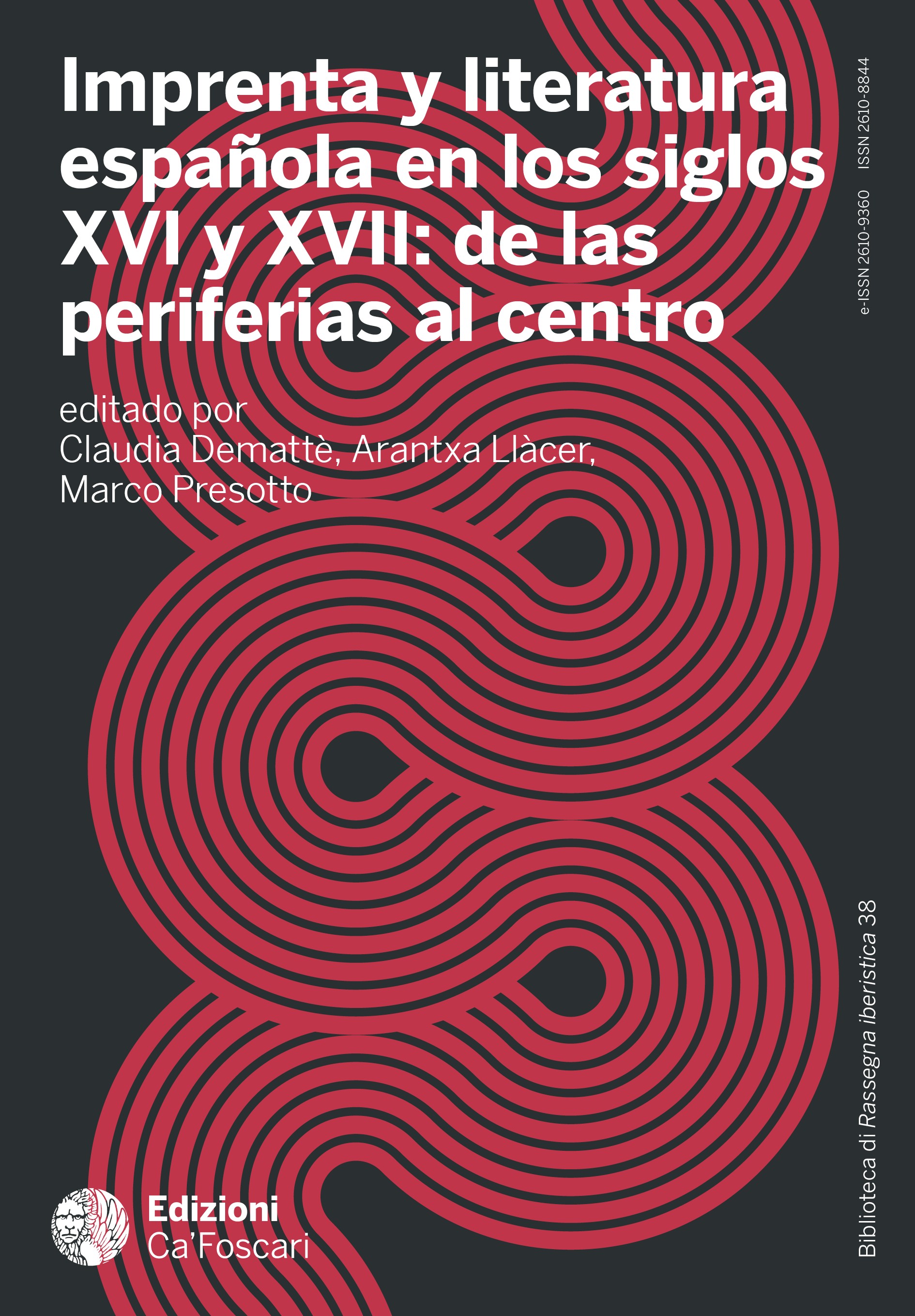
Imprenta y literatura española en los siglos XVI y XVII: de las periferias al centro
Edited by Claudia Demattè, Arantxa Llàcer, Marco Presotto
Book information
- Publisher
- Edizioni Ca' Foscari
- Publication
- Published 9 December 2024
- Place
- Venice, Italy
- Series
- Library of <i>Rassegna iberistica</i>
- Catalogue record
- View in the catalogue
Abstract
The aim of this volume is to delve into the peculiarities of the commercial circuit that fed the cultural system of the Spanish Empire during the Golden Age through an overwhelming publishing production of literary texts. The relationship between center and periphery defined by political power did not necessarily correspond to the reality of social networks, business projects, the evolution of technical competence, and the development of a demand that was difficult to establish a priori. We propose an open approach from different methodological perspectives that contribute to the definition of the artistic and literary phenomenon, and which can explain the development of certain publishing practices in particular economic, linguistic, and geographical contexts. An overall picture is offered of the great book marketing networks in Europe and New Spain (Pedro Rueda Ramírez), which multiply the focuses of analysis from family sagas, publishing agents, and hawkers, to land-based circulation and the potential of maritime routes or the transfer of books between the main printing capitals of the time. Benedetta Belloni examines the publishing center of Milan, Arantxa Llàcer Martorell studies the inventory of the assets of the Cormellas printing house in Barcelona, and Giada Blasut reviews the printed production of chivalric books in Seville. Laura Fernández García provides detailed insights into the work of printers in the preparation and publication of Lope de Vega’s Partes de comedias from 1617 to 1625 and in 1635. Guillermo Gómez Sánchez-Ferrer analyses the context that favoured the publishing success of the Viaje entretenido by Agustín de Rojas, the relationship between reprints and the transformations in the world of printing. The volume concludes with a contribution by Alejandra Ulla, who presents the ISTAE project (Impresos sueltos del teatro antiguo español) aimed at the recovery and revision of those plays that were considered lost or written by invisibilised playwrights among the noise of larger miscellaneous volumes.
Where its authors and editors are based
Countries of the institutions the book's authors, editors and chapter authors were affiliated to when it was published.
- AUTHORS / EDITORS
- CITATIONS Phase 2
- USAGE Phase 3
About this data
These figures cover 1 work. Each value comes from the most trusted source that has it; a correction made by OBC staff outranks every source.
| Source | Confidence | Works |
|---|---|---|
| Thoth | 90 / 100 | 1 |
| Works with a publication date | 100% |
|---|---|
| Works with a DOI | 100% |
| Works with a funder recorded | 0% |
| Authors with an affiliation | 100% |
| Affiliations matched to an institution (ROR) | 100% |
| Affiliations with a country | 100% |
Countries come from the institution each author was affiliated to when they published, as recorded in ROR. A country is never guessed, so authors without a matched institution are not counted on the maps.
Funders come from OpenAlex for articles and Thoth for books, where publishers recorded them. Most works record none, so a funder's figures show what is recorded, not everything it funded.
Chapters count as works: their authors and editors, and the countries of their institutions, are in every figure where Thoth records an affiliation for them.
Citations (Phase 2) and usage (Phase 3) are not collected yet.