
Book view
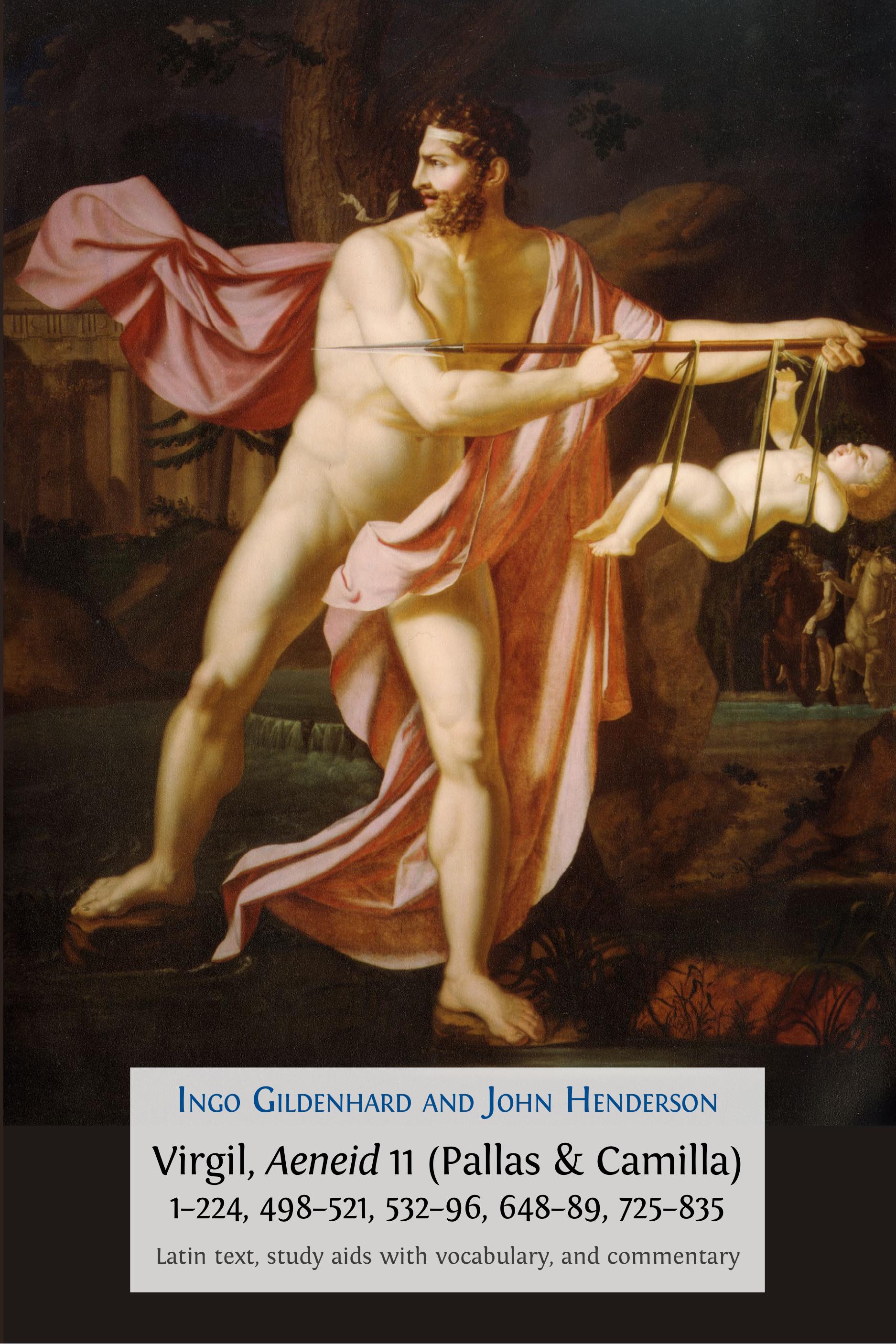
Virgil, Aeneid 11, Pallas and Camilla, 1–224, 498–521, 532–596, 648–689, 725–835
Latin Text, Study Aids with Vocabulary, and Commentary
Book information
- Publisher
- Open Book Publishers
- Publication
- Published 5 December 2018
- Place
- Cambridge, UK
- Series
- Classics Textbooks
- Catalogue record
- View in the catalogue
Abstract
A dead boy (Pallas) and the death of a girl (Camilla) loom over the opening and the closing part of the eleventh book of the Aeneid. Following the savage slaughter in Aeneid 10, the book opens in a mournful mood as the warring parties revisit yesterday’s killing fields to attend to their dead. One casualty in particular commands attention: Aeneas’ protégé Pallas, killed and despoiled by Turnus in the previous book. His death plunges his father Evander and his surrogate father Aeneas into heart-rending despair – and helps set up the foundational act of sacrificial brutality that caps the poem, when Aeneas seeks to avenge Pallas by slaying Turnus in wrathful fury. Turnus’ departure from the living is prefigured by that of his ally Camilla, a maiden schooled in the martial arts, who sets the mold for warrior princesses such as Xena and Wonder Woman. In the final third of Aeneid 11, she wreaks havoc not just on the battlefield but on gender stereotypes and the conventions of the epic genre, before she too succumbs to a premature death. In the portions of the book selected for discussion here, Virgil offers some of his most emotive (and disturbing) meditations on the tragic nature of human existence – but also knows how to lighten the mood with a bit of drag.
This course book offers the original Latin text, vocabulary aids, study questions, and an extensive commentary. Designed to stretch and stimulate readers, Ingo Gildenhard’s volume will be of particular interest to students of Latin studying for A-Level or on undergraduate courses. It extends beyond detailed linguistic analysis to encourage critical engagement with Virgil’s poetry and the most recent scholarly thought.
King's College, Cambridge, has generously contributed to this publication.
Chapters
| Chapter | Author | Institution at publication |
|---|---|---|
| Introduction | Ingo Gildenhard, John Henderson | University of Cambridge |
| Camilla | Ingo Gildenhard, John Henderson | University of Cambridge |
| Commentary | Ingo Gildenhard, John Henderson | University of Cambridge |
| Text | Ingo Gildenhard, John Henderson | University of Cambridge |
Where its authors and editors are based
Countries of the institutions the book's authors, editors and chapter authors were affiliated to when it was published.
- AUTHORS / EDITORS
- CITATIONS Phase 2
- USAGE Phase 3
| Country | Authors / editors |
|---|---|
| United Kingdom | 2 |
About this data
These figures cover 5 works. Each value comes from the most trusted source that has it; a correction made by OBC staff outranks every source.
| Source | Confidence | Works |
|---|---|---|
| Thoth | 90 / 100 | 5 |
| Works with a publication date | 100% |
|---|---|
| Works with a DOI | 100% |
| Works with a funder recorded | 20% |
| Authors with an affiliation | 100% |
| Affiliations matched to an institution (ROR) | 100% |
| Affiliations with a country | 100% |
Countries come from the institution each author was affiliated to when they published, as recorded in ROR. A country is never guessed, so authors without a matched institution are not counted on the maps.
Funders come from OpenAlex for articles and Thoth for books, where publishers recorded them. Most works record none, so a funder's figures show what is recorded, not everything it funded.
Chapters count as works: their authors and editors, and the countries of their institutions, are in every figure where Thoth records an affiliation for them.
Citations (Phase 2) and usage (Phase 3) are not collected yet.