
Book view
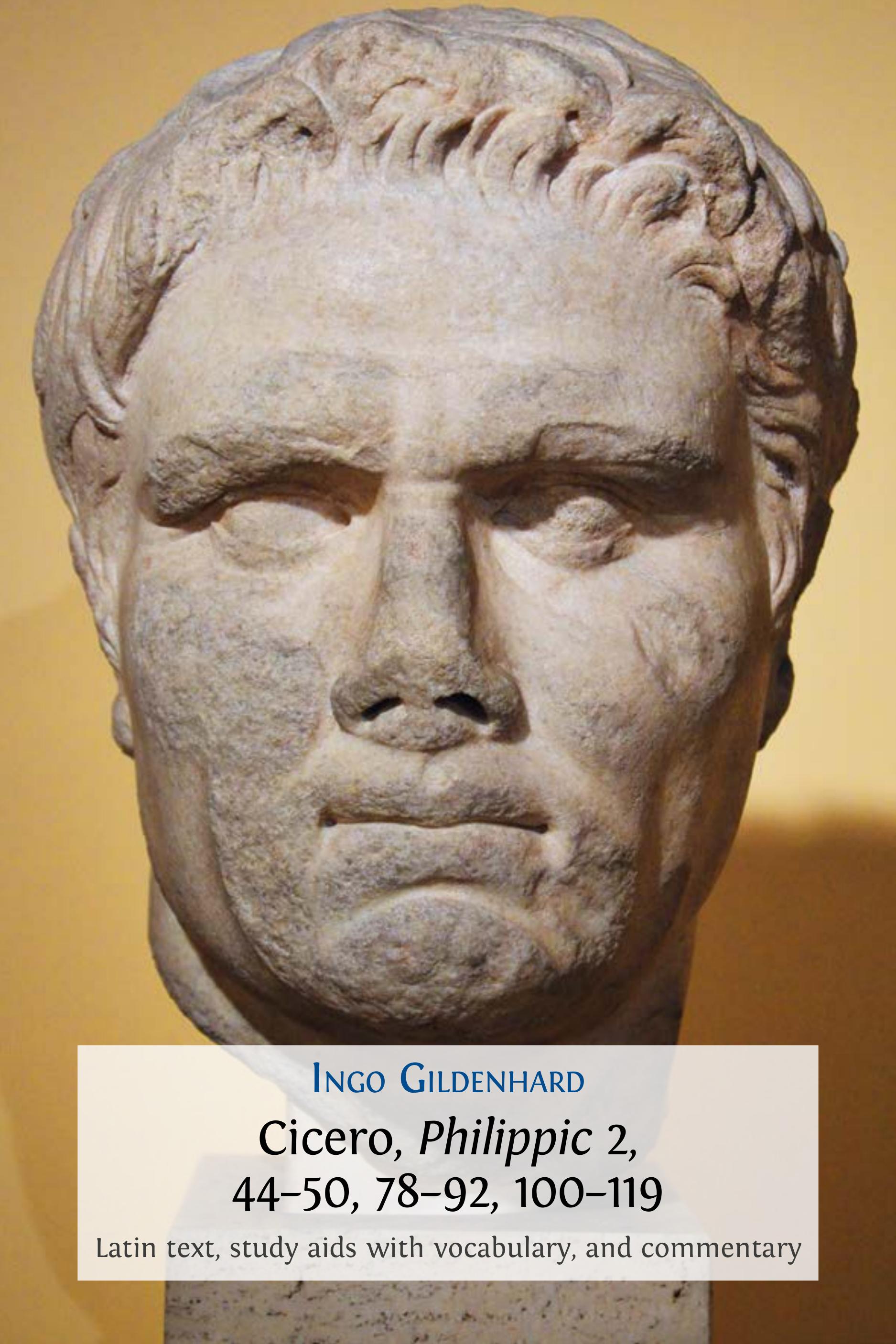
Cicero, Philippic 2, 44–50, 78–92, 100–119
Latin Text, Study Aids with Vocabulary, and Commentary
Book information
- Publisher
- Open Book Publishers
- Publication
- Published 3 September 2018
- Place
- Cambridge, UK
- Series
- Classics Textbooks
- Catalogue record
- View in the catalogue
Abstract
Cicero composed his incendiary Philippics only a few months after Rome was rocked by the brutal assassination of Julius Caesar. In the tumultuous aftermath of Caesar’s death, Cicero and Mark Antony found themselves on opposing sides of an increasingly bitter and dangerous battle for control. Philippic 2 was a weapon in that war.
Conceived as Cicero’s response to a verbal attack from Antony in the Senate, Philippic 2 is a rhetorical firework that ranges from abusive references to Antony’s supposedly sordid sex life to a sustained critique of what Cicero saw as Antony’s tyrannical ambitions. Vituperatively brilliant and politically committed, it is both a carefully crafted literary artefact and an explosive example of crisis rhetoric. It ultimately led to Cicero’s own gruesome death.
This course book offers a portion of the original Latin text, vocabulary aids, study questions, and an extensive commentary. Designed to stretch and stimulate readers, Ingo Gildenhard’s volume will be of particular interest to students of Latin studying for A-Level or on undergraduate courses. It extends beyond detailed linguistic analysis to encourage critical engagement with Cicero, his oratory, the politics of late-republican Rome, and the transhistorical import of Cicero’s politics of verbal (and physical) violence.
Chapters
| Chapter | Author | Institution at publication |
|---|---|---|
| Introduction | Ingo Gildenhard | University of Cambridge |
| Preface and Acknowledgements | Ingo Gildenhard | University of Cambridge |
| Commentary | Ingo Gildenhard | University of Cambridge |
| Text | Ingo Gildenhard | University of Cambridge |
Where its authors and editors are based
Countries of the institutions the book's authors, editors and chapter authors were affiliated to when it was published.
- AUTHORS / EDITORS
- CITATIONS Phase 2
- USAGE Phase 3
| Country | Authors / editors |
|---|---|
| United Kingdom | 1 |
About this data
These figures cover 5 works. Each value comes from the most trusted source that has it; a correction made by OBC staff outranks every source.
| Source | Confidence | Works |
|---|---|---|
| Thoth | 90 / 100 | 5 |
| Works with a publication date | 100% |
|---|---|
| Works with a DOI | 100% |
| Works with a funder recorded | 20% |
| Authors with an affiliation | 100% |
| Affiliations matched to an institution (ROR) | 100% |
| Affiliations with a country | 100% |
Countries come from the institution each author was affiliated to when they published, as recorded in ROR. A country is never guessed, so authors without a matched institution are not counted on the maps.
Funders come from OpenAlex for articles and Thoth for books, where publishers recorded them. Most works record none, so a funder's figures show what is recorded, not everything it funded.
Chapters count as works: their authors and editors, and the countries of their institutions, are in every figure where Thoth records an affiliation for them.
Citations (Phase 2) and usage (Phase 3) are not collected yet.