
Book view
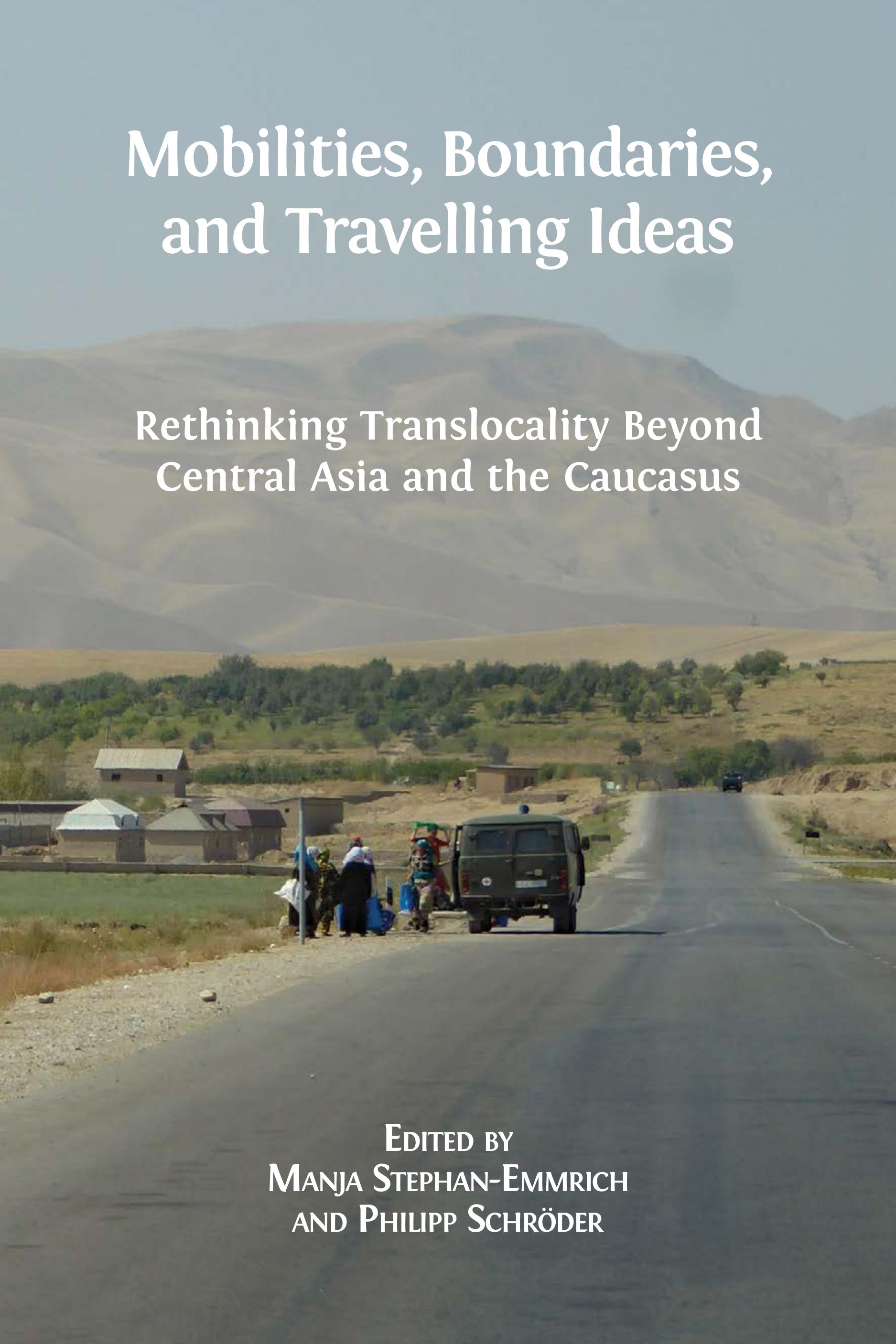
Mobilities, Boundaries, and Travelling Ideas
Rethinking Translocality Beyond Central Asia and the Caucasus
Edited by Manja Stephan-Emmrich, Philipp Schröder
Book information
- Publisher
- Open Book Publishers
- Publication
- Published 17 April 2018
- Place
- Cambridge, UK
- Catalogue record
- View in the catalogue
Abstract
This collection brings together a variety of anthropological, historical and sociological case studies from Central Asia and the Caucasus to examine the concept of translocality. The chapters scrutinize the capacity of translocality to describe, in new ways, the multiple mobilities, exchange practices and globalizing processes that link places, people and institutions in Central Asia and the Caucasus with others in Russia, China and the United Arab Emirates.
Illuminating translocality as a productive concept for studying cross‐regional connectivities and networks, this volume is an important contribution to a lively field of academic discourse. Following new directions in Area Studies, the chapters aim to overcome ‘territorial containers’ such as the nation‐state or local community, and instead emphasize the significance of processes of translation and negotiation for understanding how meaningful localities emerge beyond conventional boundaries.
Structured by the four themes ‘crossing boundaries’, ‘travelling ideas’, ‘social and economic movements’ and ‘pious endeavours’, this volume proposes three conceptual approaches to translocality: firstly, to trace how it is embodied, narrated, virtualized or institutionalized within or in reference to physical or imagined localities; secondly, to understand locality as a relational concept rather than a geographically bounded unit; and thirdly, to consider cross‐border traders, travelling students, business people and refugees as examples of non-elite mobilities that provide alternative ways to think about what ‘global’ means today.
Mobilities, Boundaries, and Travelling Ideas will be of interest to students and scholars of the anthropology, history and sociology of Central Asia and the Caucasus, as well as for those interested in new approaches to Area Studies.
Chapters
Where its authors and editors are based
Countries of the institutions the book's authors, editors and chapter authors were affiliated to when it was published.
- AUTHORS / EDITORS
- CITATIONS Phase 2
- USAGE Phase 3
| Country | Authors / editors |
|---|---|
| Germany | 5 |
| Kyrgyzstan | 3 |
| Sweden | 1 |
| The Netherlands | 1 |
| Uzbekistan | 1 |
About this data
These figures cover 15 works. Each value comes from the most trusted source that has it; a correction made by OBC staff outranks every source.
| Source | Confidence | Works |
|---|---|---|
| Thoth | 90 / 100 | 15 |
| Works with a publication date | 100% |
|---|---|
| Works with a DOI | 100% |
| Works with a funder recorded | 7% |
| Authors with an affiliation | 95% |
| Affiliations matched to an institution (ROR) | 100% |
| Affiliations with a country | 100% |
Countries come from the institution each author was affiliated to when they published, as recorded in ROR. A country is never guessed, so authors without a matched institution are not counted on the maps.
Funders come from OpenAlex for articles and Thoth for books, where publishers recorded them. Most works record none, so a funder's figures show what is recorded, not everything it funded.
Chapters count as works: their authors and editors, and the countries of their institutions, are in every figure where Thoth records an affiliation for them.
Citations (Phase 2) and usage (Phase 3) are not collected yet.