
Book view
Carles Riba and the Literary Language During the Franco Regime
Exercises in Simplicity
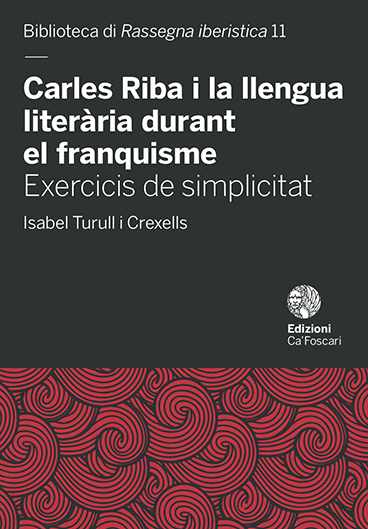
Book information
- Publisher
- Edizioni Ca' Foscari
- Publication
- Published 17 December 2018
- Place
- Venice, Italy
- Series
- Library of <i>Rassegna iberistica</i>
- Catalogue record
- View in the catalogue
Abstract
Carles Riba, one of the most relevant personalities in Catalan letters, not only as a poet but also as a linguist, has been considered a difficult writer. This book aims to examine how his theoretical preparation and his ideas in linguistics influenced his work in the particular case of some early stories in which he tries “uns utilíssims exercicis de simplicitat”. Carles Riba did not present his linguistic theories in a single text in a complete and articulated way but we can evaluate them in various papers he wrote and published up until his death in 1959. The first part of this work, after an introduction which sets the author in the context of European linguistics, is a review of the ideas that can be found in the collections of essays: Escolis i altres articles (1921), Els marges (1927), Per comprendre (1937), ... més els poemes (1957), and in a few other particularly interesting papers.This part focuses also on some of the controversies in which Carles Riba is involved as a linguist during the spanish dictatorship: especially his role on the publication of the second edition of Pompeu Fabra’s dictionary in 1954 and the consequences of the prologue he wrote for the volume. Joan Coromines considers an attack on the linguist Pompeu Fabra the negative comparison Riba proposes with the honnête homme: in our research we re-evaluate this consideration and analyse the historical and semantic value of this expression belonging to 17th-century French culture.The second part of this paper is a strictly linguistic analysis of three texts, chosen among Carles Riba’s works for children. The interest of those texts is in the author’s deliberate intent of using the most simple language, which enables us to determine what he considers the basic aspects of linguistic quality. Furthermore, the existence of different editions of those texts permits a philological analysis of those versions showing Carles Riba’s ‘simple’ language in three very representative moments, from the beginning of his career as a writer to the difficult situation during the dictatorship.
Where its authors and editors are based
Countries of the institutions the book's authors, editors and chapter authors were affiliated to when it was published.
- AUTHORS / EDITORS
- CITATIONS Phase 2
- USAGE Phase 3
| Country | Authors / editors |
|---|---|
| Italy | 1 |
About this data
These figures cover 1 work. Each value comes from the most trusted source that has it; a correction made by OBC staff outranks every source.
| Source | Confidence | Works |
|---|---|---|
| Thoth | 90 / 100 | 1 |
| Works with a publication date | 100% |
|---|---|
| Works with a DOI | 100% |
| Works with a funder recorded | 0% |
| Authors with an affiliation | 100% |
| Affiliations matched to an institution (ROR) | 100% |
| Affiliations with a country | 100% |
Countries come from the institution each author was affiliated to when they published, as recorded in ROR. A country is never guessed, so authors without a matched institution are not counted on the maps.
Funders come from OpenAlex for articles and Thoth for books, where publishers recorded them. Most works record none, so a funder's figures show what is recorded, not everything it funded.
Chapters count as works: their authors and editors, and the countries of their institutions, are in every figure where Thoth records an affiliation for them.
Citations (Phase 2) and usage (Phase 3) are not collected yet.