
Book view
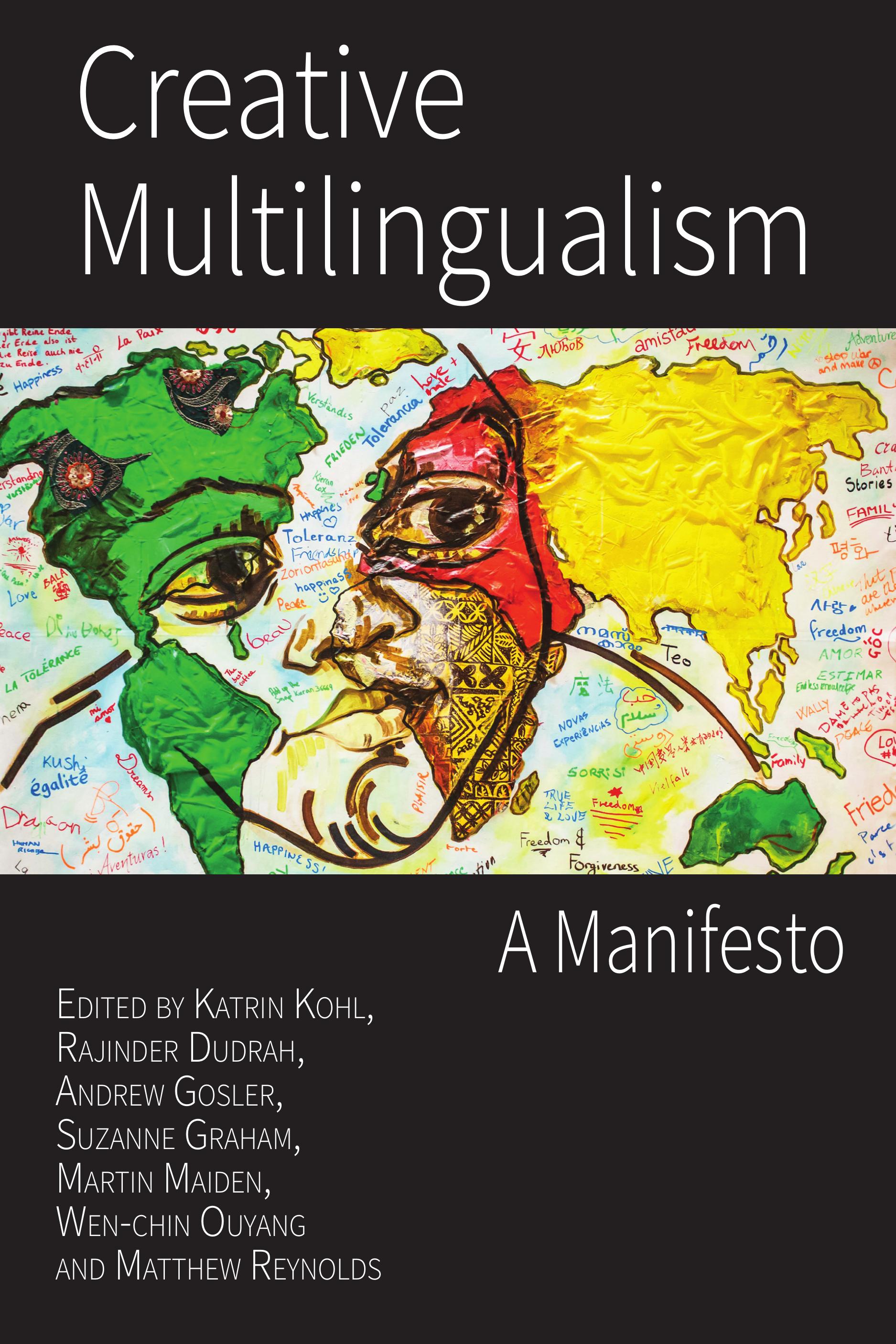
Creative Multilingualism
A Manifesto
Edited by Katrin Kohl, Rajinder Dudrah, Andrew Gosler, Suzanne Graham, Martin Maiden, Wen-chin Ouyang
Book information
- Publisher
- Open Book Publishers
- Publication
- Published 20 May 2020
- Place
- Cambridge, UK
- Catalogue record
- View in the catalogue
Abstract
Multilingualism is integral to the human condition. Hinging on the concept of Creative Multilingualism – the idea that language diversity and creativity are mutually enriching – this timely and thought-provoking volume shows how the concept provides a matrix for experimentation with ideas, approaches and methods.
The book presents four years of joint research on Creative Multilingualism conducted across disciplines, from the humanities through to the social and natural sciences. It is structured as a manifesto, comprising ten major statements which are unpacked and explored through various case studies across ten chapters. They encompass areas including the rich relationship between language diversity and diversity of identity, thought and expression; the interaction between language diversity and biodiversity; the ‘prismatic’ unfolding of meaning in translation; the benefits of linguistic creativity in a classroom-setting; and the ingenuity underpinning ‘conlangs’ (‘constructed languages’) such as Tolkien’s Quenya and Sindarin, designed to give imagined peoples a distinctive medium capable of expressing their cultural identity.
Creative Multilingualism: A Manifesto is a welcome contribution to the field of modern languages, highlighting the intricate relationship between multilingualism and creativity, and, crucially, reaching beyond an Anglo-centric view of the world. Intended to spark further research and discussion, this book appeals to young people interested in languages, language learning and cultural exchange. It will be a valuable resource for academics, educators, policy makers and parents of bilingual or multilingual children. Its accessible style also speaks to general readers interested in the role of language diversity in our everyday lives, and the untapped creative potential of multilingualism.
Chapters
Where its authors and editors are based
Countries of the institutions the book's authors, editors and chapter authors were affiliated to when it was published.
- AUTHORS / EDITORS
- CITATIONS Phase 2
- USAGE Phase 3
| Country | Authors / editors |
|---|---|
| United Kingdom | 16 |
| United States | 2 |
| Croatia | 1 |
| Italy | 1 |
About this data
These figures cover 13 works. Each value comes from the most trusted source that has it; a correction made by OBC staff outranks every source.
| Source | Confidence | Works |
|---|---|---|
| Thoth | 90 / 100 | 13 |
| Works with a publication date | 100% |
|---|---|
| Works with a DOI | 100% |
| Works with a funder recorded | 8% |
| Authors with an affiliation | 84% |
| Affiliations matched to an institution (ROR) | 97% |
| Affiliations with a country | 100% |
Countries come from the institution each author was affiliated to when they published, as recorded in ROR. A country is never guessed, so authors without a matched institution are not counted on the maps.
Funders come from OpenAlex for articles and Thoth for books, where publishers recorded them. Most works record none, so a funder's figures show what is recorded, not everything it funded.
Chapters count as works: their authors and editors, and the countries of their institutions, are in every figure where Thoth records an affiliation for them.
Citations (Phase 2) and usage (Phase 3) are not collected yet.