
Book view
The Civil Society Guide to Regional Economic Communities in Africa
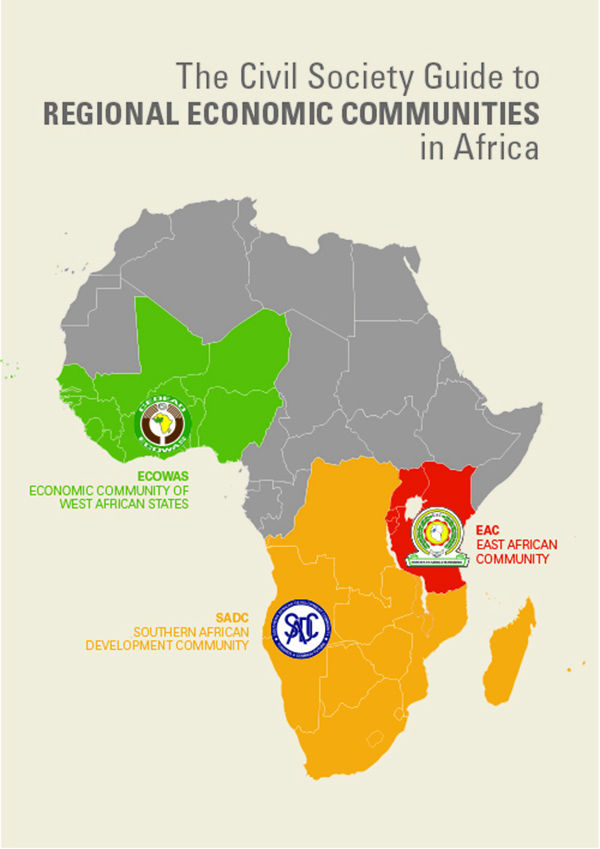
Book information
- Publisher
- African Minds
- Publication
- Published 25 January 2016
- Place
- Cape Town, South Africa
- Catalogue record
- View in the catalogue
Abstract
Since 1963, when the African integration project was born, regional Economic Communities (RECs) have been an indispensable part of the continents deeper socioeconomic and political integration. More than half a century later, such regional institutions continue to evolve, keeping pace with an Africa that is transforming itself amid challenges and opportunities. RECs represent a huge potential to be the engines that drive the continents economic growth and development as well as being vehicles through which a sense of a continental community is fostered. It is critical therefore that citizens understand the multi-faceted and bureaucratic operations of regional institutions in order to use them to advance their collective interests.
Where its authors and editors are based
Countries of the institutions the book's authors, editors and chapter authors were affiliated to when it was published.
- AUTHORS / EDITORS
- CITATIONS Phase 2
- USAGE Phase 3
No affiliations with a known country in these years yet.
About this data
These figures cover 1 work. Each value comes from the most trusted source that has it; a correction made by OBC staff outranks every source.
| Source | Confidence | Works |
|---|---|---|
| Thoth | 90 / 100 | 1 |
| Works with a publication date | 100% |
|---|---|
| Works with a DOI | 100% |
| Works with a funder recorded | 0% |
| Authors with an affiliation | 0% |
Countries come from the institution each author was affiliated to when they published, as recorded in ROR. A country is never guessed, so authors without a matched institution are not counted on the maps.
Funders come from OpenAlex for articles and Thoth for books, where publishers recorded them. Most works record none, so a funder's figures show what is recorded, not everything it funded.
Chapters count as works: their authors and editors, and the countries of their institutions, are in every figure where Thoth records an affiliation for them.
Citations (Phase 2) and usage (Phase 3) are not collected yet.