
Book information
- Publisher
- Edizioni Ca' Foscari
- Publication
- Published 22 April 2020
- Place
- Venice, Italy
- Series
- Diaspore
- Catalogue record
- View in the catalogue
Abstract
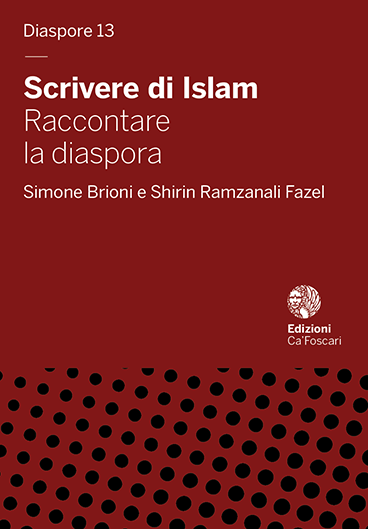
Scrivere di Islam. Raccontare la diaspora (Writing About Islam. Narrating a Diaspora) is a meditation on our multireligious, multicultural, and multilingual reality. It is the result of a personal and collaborative exploration of the necessity to rethink national culture and identity in a more diverse, inclusive, and anti-racist way. The central part of this volume – both symbolically and physically – includes Shirin Ramzanali Fazel’s reflections on the discrimination of Muslims, and especially Muslim women, in Italy and the UK. Looking at school textbooks, newspapers, TV programs, and sharing her own personal experience, this section invites us to change the way Muslim immigrants are narrated in scholarly research and news reports. Most importantly, this section urges us to consider minorities not just as ‘topics’ of cultural analysis, but as audiences and cultural agents. Following Shirin’s invitation to question prevailing modes of representations of immigrants, the volume continues with a dialogue between the co-authors and discusses how collaboration can be a way to avoid reproducing a ‘colonial model’ of knowledge production, in which the white male scholar takes as object of analysis the work of an African female writer. The last chapter also asserts that immigration literature cannot be approached with the same expectations and questions readers would have when reading ‘canonised’ texts. A new critical terminology is needed in order to understand the innovative linguistic choices and narrative forms that immigrant writers have invented in order to describe a reality that has lacked representation or which has frequently been misrepresented, especially in the discourse around the contemporary Muslim diaspora.
Where its authors and editors are based
Countries of the institutions the book's authors, editors and chapter authors were affiliated to when it was published.
- AUTHORS / EDITORS
- CITATIONS Phase 2
- USAGE Phase 3
| Country | Authors / editors |
|---|---|
| United States | 1 |
About this data
These figures cover 1 work. Each value comes from the most trusted source that has it; a correction made by OBC staff outranks every source.
| Source | Confidence | Works |
|---|---|---|
| Thoth | 90 / 100 | 1 |
| Works with a publication date | 100% |
|---|---|
| Works with a DOI | 100% |
| Works with a funder recorded | 0% |
| Authors with an affiliation | 50% |
| Affiliations matched to an institution (ROR) | 100% |
| Affiliations with a country | 100% |
Countries come from the institution each author was affiliated to when they published, as recorded in ROR. A country is never guessed, so authors without a matched institution are not counted on the maps.
Funders come from OpenAlex for articles and Thoth for books, where publishers recorded them. Most works record none, so a funder's figures show what is recorded, not everything it funded.
Chapters count as works: their authors and editors, and the countries of their institutions, are in every figure where Thoth records an affiliation for them.
Citations (Phase 2) and usage (Phase 3) are not collected yet.