
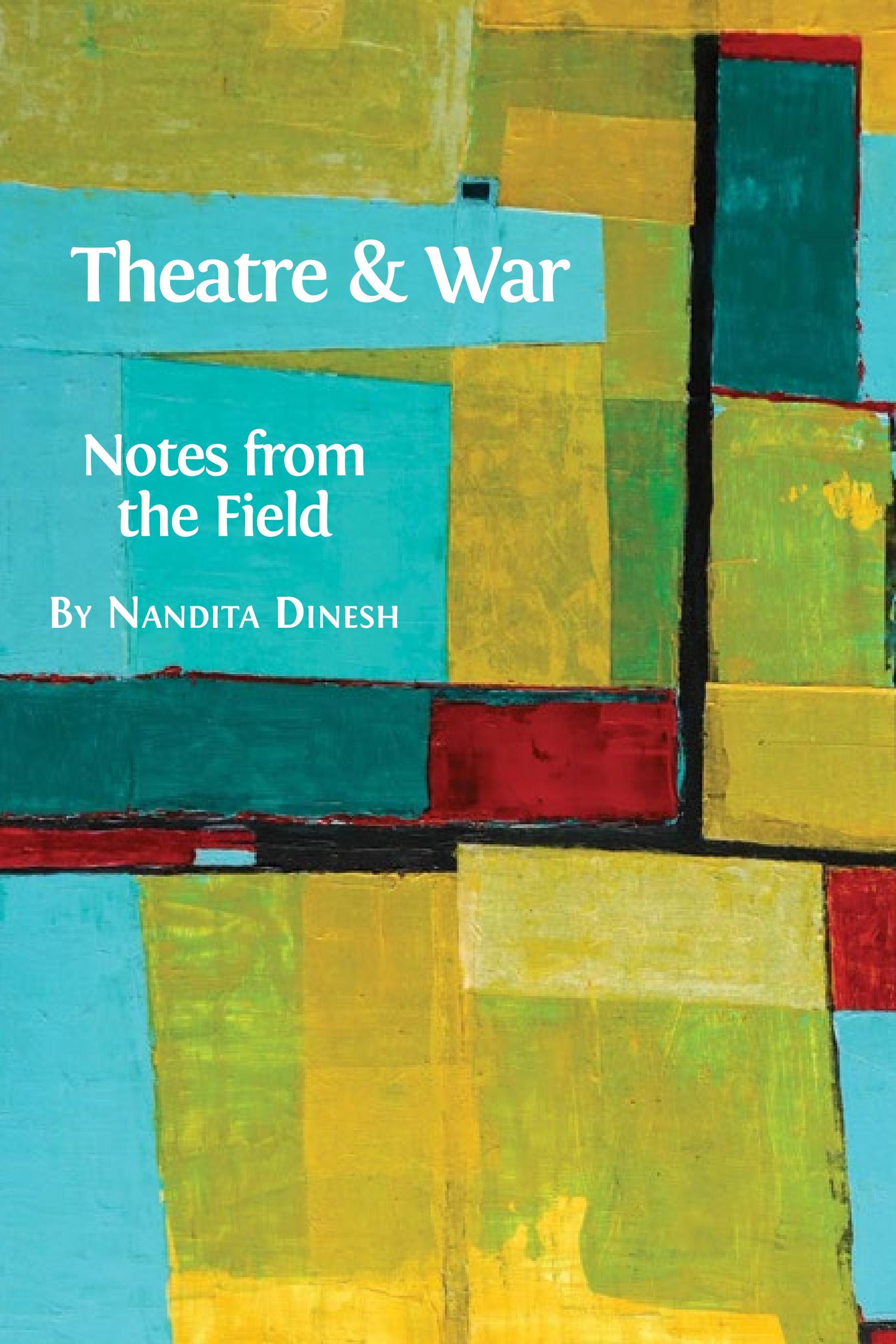
Book information
- Publisher
- Open Book Publishers
- Publication
- Published 27 July 2016
- Place
- Cambridge, UK
- Series
- Applied Theatre Praxis
- Catalogue record
- View in the catalogue
Abstract
Nandita Dinesh places Kipling’s "six honest serving-men" (who, what, when, where, why, how) in productive conversation with her own experiences in conflict zones across the world to offer a theoretical and practical reflection on making theatre in times of war. This timely and important book weaves together Dinesh’s personal narrative with the public story of modern conflict, illustrating as it does, the importance of theatre as a force for ethical deliberation and social justice. In it Dinesh asks how theatre might intervene in times and places of conflict and how we might reflect on such interventions. In pursuit of answers, Theatre and War adopts the methods of auto-ethnography, positioning the theatrical practitioner at the heart of conflict zones in northern Uganda, Guatemala, Northern Ireland, Mexico, Rwanda, Kenya, Nagaland, and Kashmir. No longer a detached observer, the researcher and practitioner has to be able to meld theory with practice; to speak to ‘doing’, without undervaluing the importance of ‘thinking about doing’.
Each chapter approaches the need for a synthesis of theory and practice by way of a term of inquiry―Why, Where, Who, What, When―and each is equipped with a set of unflinchingly honest field notes that are designed to reveal some of the ‘hows’ from the author’s own repertoire: questions and issues that were encountered during her own theatrical undertakings, along with first hand reflection on the complexities, potential, and challenges that attended her global work in community theatre. Within these notes are strategies that give the reader a practical insight into how the discussion might find its footing on the ground of war.
The range and scope of this book make it required reading for those interested in theatre―practitioners, researchers, and students alike—as well as those seeking to understand the applications of the arts for ethics, politics, and education.
Chapters
| Chapter | Author | Institution at publication |
|---|---|---|
| Introduction | Nandita Dinesh | |
| 1. Why | Nandita Dinesh | |
| 2. Where | Nandita Dinesh | |
| 3. Who | Nandita Dinesh | |
| 4. What | Nandita Dinesh | |
| 5. When | Nandita Dinesh | |
| Conclusions | Nandita Dinesh |
Where its authors and editors are based
Countries of the institutions the book's authors, editors and chapter authors were affiliated to when it was published.
- AUTHORS / EDITORS
- CITATIONS Phase 2
- USAGE Phase 3
No affiliations with a known country in these years yet.
About this data
These figures cover 8 works. Each value comes from the most trusted source that has it; a correction made by OBC staff outranks every source.
| Source | Confidence | Works |
|---|---|---|
| Thoth | 90 / 100 | 8 |
| Works with a publication date | 100% |
|---|---|
| Works with a DOI | 100% |
| Works with a funder recorded | 0% |
| Authors with an affiliation | 0% |
Countries come from the institution each author was affiliated to when they published, as recorded in ROR. A country is never guessed, so authors without a matched institution are not counted on the maps.
Funders come from OpenAlex for articles and Thoth for books, where publishers recorded them. Most works record none, so a funder's figures show what is recorded, not everything it funded.
Chapters count as works: their authors and editors, and the countries of their institutions, are in every figure where Thoth records an affiliation for them.
Citations (Phase 2) and usage (Phase 3) are not collected yet.