
Book view

The Field Guide to Mixing Social and Biophysical Methods in Environmental Research

Edited by Rebecca Lave, Stuart Lane
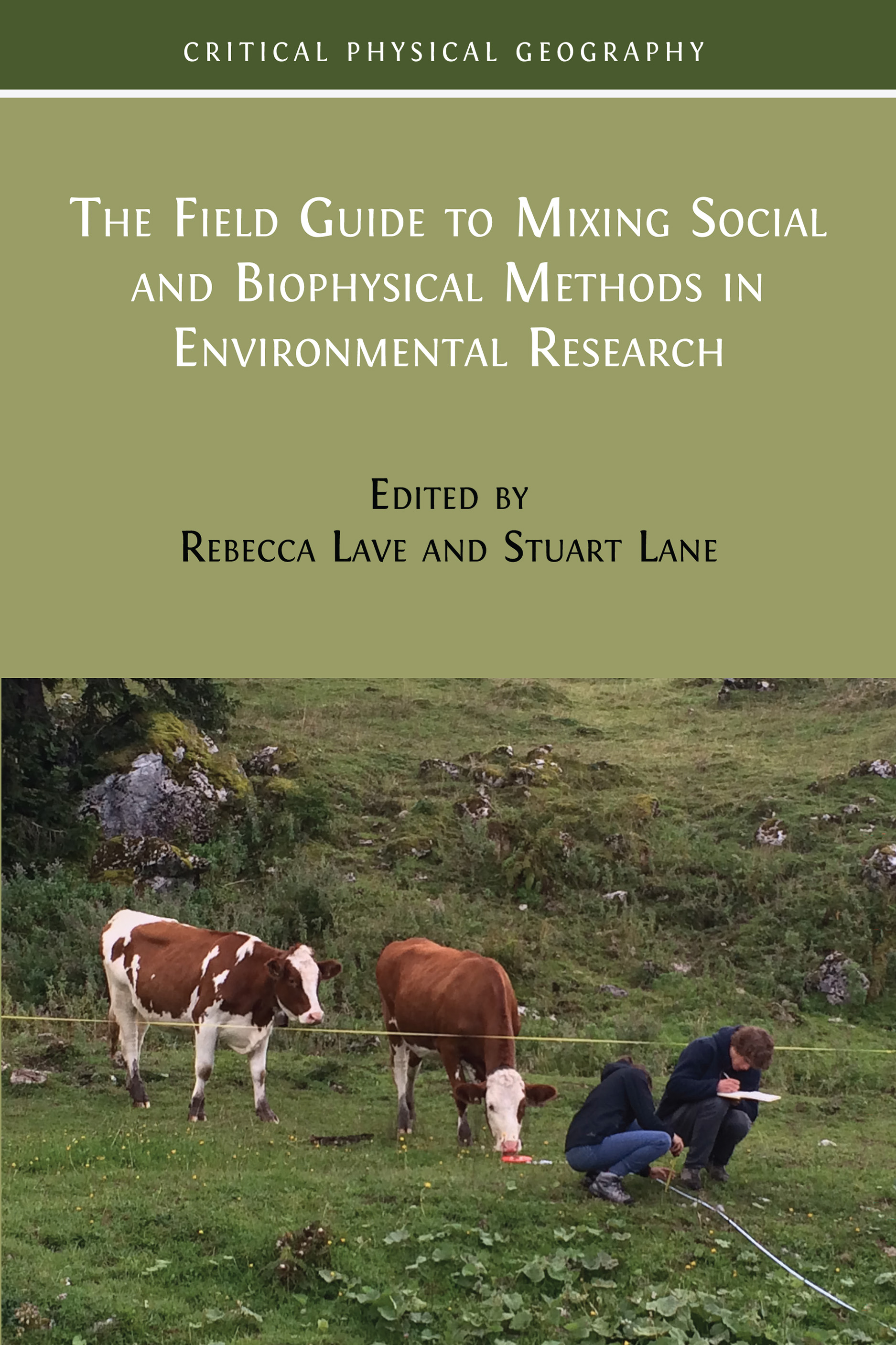
Cover of The Field Guide to Mixing Social and Biophysical Methods in Environmental Research

Book information

Publication
Published 25 February 2025
Place
Cambridge, UK
Series
Critical Physical Geography: Interdisciplinary Approaches to Nature, Power and Politics
Catalogue record
View in the catalogue
45 Chapters FULL LIST: Chapters
Total citations Phase 2: not collected yet
Total usage Phase 3: not collected yet

Abstract

Despite ongoing debates about its origins, the Anthropocene—a new epoch characterized by significant human impact on the Earth's geology and ecosystems—is widely acknowledged. Our environment is increasingly a product of interacting biophysical and social forces, shaped by climate change, colonial legacies, gender norms, hydrological processes, and more. Understanding these intricate interactions requires a mixed-methods approach that combines qualitative and quantitative, biophysical and social research.

However, mixed-methods environmental research remains rare, hindered by academic boundaries, limited training, and the challenges of interdisciplinary collaboration. Time, funding, and the integration of diverse data further complicate this research, whilst the dynamics and ethics of interdisciplinary teams add another layer of complexity.

Despite these challenges, mixed-methods research offers a more robust and ultimately transformative understanding of environmental questions. This Field Guide aims to inspire and equip researchers to undertake such studies. Organized like a recipe book, it assists researchers in the preparation of their field work, as well as offering entry points to key methods and providing examples of successful mixed-methods projects.

This book will be of interest to scholars wishing to tackle environmental research in a more holistic manner, spanning ‘sister’ disciplines such as anthropology, statistics, political science, public health, archaeology, geography, history, ecology, and Earth science.

Chapters

ChapterAuthorInstitution at publication
1. Introduction to the Field Guide Rebecca Lave, Stuart Lane Indiana University; University of Lausanne
2. Introduction to building your research 'kitchen' Stuart Lane, Rebecca Lave University of Lausanne; Indiana University
3. Framing, disciplines and mixing methods in environmental research Stuart Lane, Rebecca Lave University of Lausanne; Indiana University
4. Mixed methods in tension Christine Biermann, Cerian Gibbes University of Colorado Colorado Springs
5. Expanding research ethics for inclusive and transdisciplinary research Alison M. Meadow, Hailey Wilmer, Daniel B. Ferguson University of Arizona
6. Embracing and enacting critical and constructive approaches to teaching Critical Physical Geography Jennifer Salmond, Gary Brierley University of Auckland
7. Integrating ethnographic and physical science methods in interdisciplinary research projects Amy Leigh Johnson, Katie Oven, Nick Rosser, Dipak Basnet, Nyima Dorjee Bhotia, Tek Bahadur Dong, Anuradha Puri, Sunil Tamang, Mark Kincey Georgia College & State University; Northumbria University; Durham University; Social Science Baha; University of Canterbury; Newcastle University
8. The environmental impacts of fieldwork Stuart Lane University of Lausanne
9. Inclusive practices in fieldwork Floreana Miesen, Marjolein Gevers University of Lausanne
10. Fieldwork safety planning and risk management Floreana Miesen University of Lausanne
11. Introduction to the research recipes Stuart Lane, Rebecca Lave University of Lausanne; Indiana University
12. On the dialogue between ethnographic field work and statistical modelling Karen Lebek, Tobias Krueger University of Potsdam; Humboldt-Universität zu Berlin
13. Revealing the social histories of ancient savannas and intact forests using a historical ecology approach in Central Africa Gretchen Walters, Olivier Hymas, Stevens Touladjan, Kevin Ndong University of Lausanne; National Agency for National Parks
14. The interface between hydrological modelling and political ecology Maria Rusca, Maurizio Mazzoleni University of Manchester; Vrije Universiteit Amsterdam
15. ‘A hydrologist and a rhetorician walk into a workshop,’ or How we learned to collaborate on a decade of mixed-methods river research across the humanities and biophysical sciences Eric G. Booth, Caroline Gottschalk Druschke University of Wisconsin–Madison
16. Using mixed methods to confront disparities in public health interventions in urban community gardens Melanie Malone University of Washington
17. Space and place in participatory arts-based research Javier Arce-Nazario University of North Carolina at Chapel Hill
18. Antarctic mosaic Stephen M. Chignell, Adrian Howkins, Andrew Fountain University of Bristol; Portland State University
19. Engaging remote sensing and ethnography to seed alternative landscape stories and scripts Lisa C. Kelley University of Colorado Denver
20. Mixing geoarchaeology, geohistory and ethnology to reconstruct landscape changes on the longue durée Ninon Blond École Normale Supérieure de Lyon
21. Introduction to the list of ingredients Rebecca Lave, Stuart Lane Indiana University; University of Lausanne
22. Archival methods Meghan Cope University of Vermont
23. Arts-based environmental research Mrill Ingram Michael Fields Agricultural Institute
24. Case studies Stuart Lane University of Lausanne
25. Descriptive statistics Stuart Lane University of Lausanne
26. Environmental modelling Tobias Krueger
27. Focus groups Robyn Longhurst, Lynda Johnston Victoria University of Wellington; University of Waikato
28. Geochronological Methods Georgina E. King, Peter M. Abbott University of Lausanne; University of Bern
29. Historical ecology Diana K. Davis University of California, Davis
30. Hydraulic modelling Stuart Lane University of Lausanne
31. Hydrological modelling Lieke Melsen Wageningen University & Research
32. Interviews Lynda Johnston, Robyn Longhurst University of Waikato; Victoria University of Wellington
33. Oral history Alexandra Chakov, Tom Chang, Henry Covey, Taylor Dickson, Sydney Goggins, Nora Harris, Sujash Purna, Sydney Widell, Caroline Gottschalk Druschke University of Wisconsin–Madison
34. Participant observation and ethnography Nathan F. Sayre University of California, Berkeley
35. Participatory modelling Catharina Landström Chalmers University of Technology
36. Participatory methods Jennifer Mokos Coastal Carolina University
37. Q method Eric Nost University of Guelph
38. Sampling Nicolena vonHedemann Northern Arizona University
39. (Critical) Satellite Remote Sensing Andreas Ch. Braun University of Kassel
40. Social network analysis Stephen M. Chignell University of Bristol
41. Soil toxicological analysis Salvatore Engel-Di Mauro SUNY New Paltz
42. Statistical inference Stuart Lane University of Lausanne
43. Survey and questionnaire methods Fikriyah Winata, Sara L. McLafferty Texas A&M University; University of Illinois Urbana-Champaign
44. Textual analysis Marcus A. Doel Swansea University
45. Uncrewed airborne systems Elina Kasvi University of Turku

Where its authors and editors are based

Countries of the institutions the book's authors, editors and chapter authors were affiliated to when it was published.

  • AUTHORS / EDITORS
  • CITATIONS Phase 2
  • USAGE Phase 3
Authors / editors by country
CountryAuthors / editors
United States28
Switzerland7
United Kingdom7
New Zealand5
Nepal4
Germany3
Gabon2
The Netherlands2
All 12 countries
Authors / editors in every country
CountryAuthors / editors
United States28
Switzerland7
United Kingdom7
New Zealand5
Nepal4
Germany3
Gabon2
The Netherlands2
Canada1
Finland1
France1
Sweden1
About this data

These figures cover 46 works. Each value comes from the most trusted source that has it; a correction made by OBC staff outranks every source.

Sources
SourceConfidenceWorks
Thoth90 / 10046
Completeness
Works with a publication date100%
Works with a DOI100%
Works with a funder recorded0%
Authors with an affiliation95%
Affiliations matched to an institution (ROR)99%
Affiliations with a country100%

Countries come from the institution each author was affiliated to when they published, as recorded in ROR. A country is never guessed, so authors without a matched institution are not counted on the maps.

Funders come from OpenAlex for articles and Thoth for books, where publishers recorded them. Most works record none, so a funder's figures show what is recorded, not everything it funded.

Chapters count as works: their authors and editors, and the countries of their institutions, are in every figure where Thoth records an affiliation for them.

Citations (Phase 2) and usage (Phase 3) are not collected yet.