
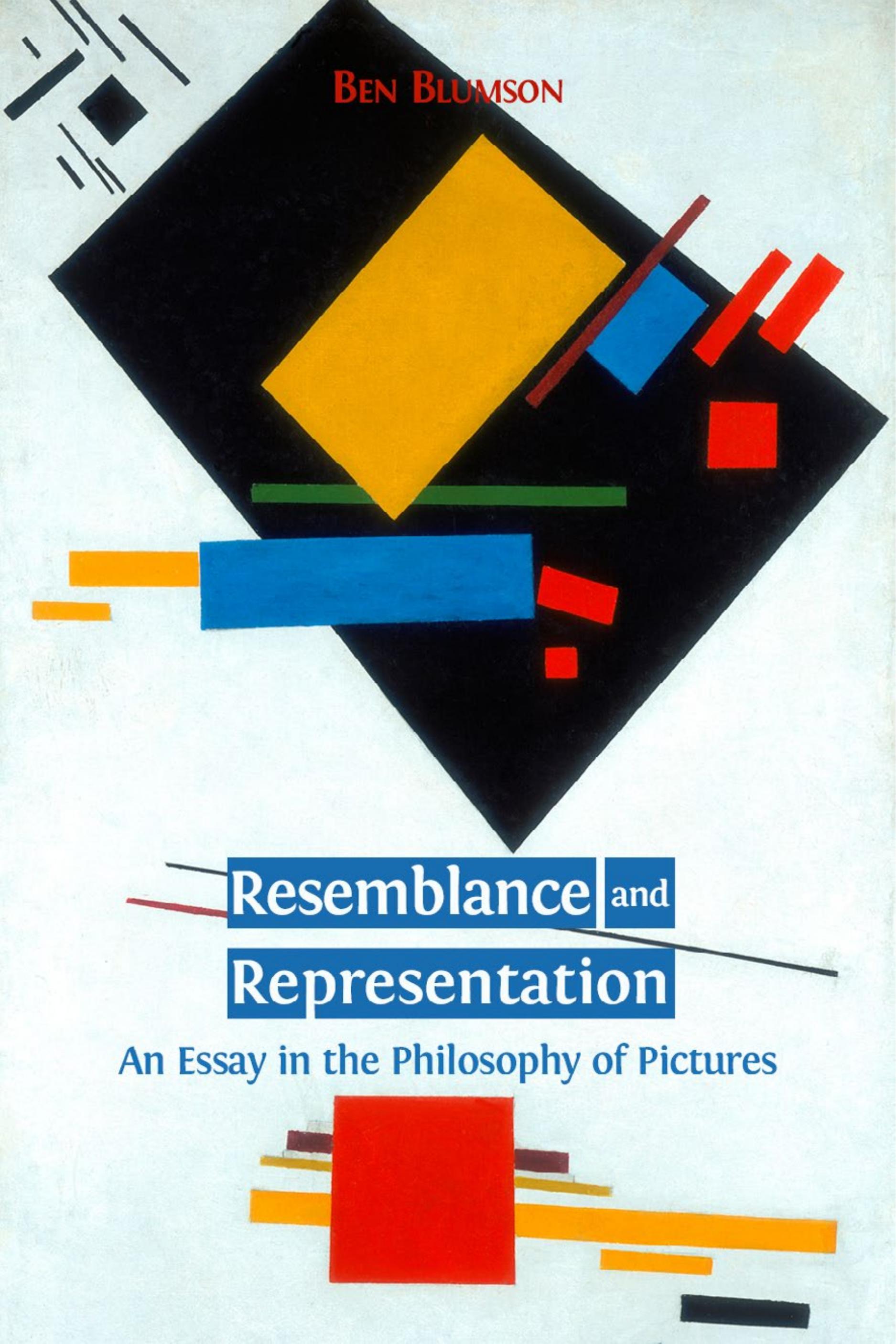
Book information
- Publisher
- Open Book Publishers
- Publication
- Published 21 September 2014
- Place
- Cambridge, UK
- Catalogue record
- View in the catalogue
Abstract
It’s a platitude – which only a philosopher would dream of denying – that whereas words are connected to what they represent merely by arbitrary conventions, pictures are connected to what they represent by resemblance. The most important difference between my portrait and my name, for example, is that whereas my portrait and I are connected by my portrait’s resemblance to me, my name and I are connected merely by an arbitrary convention. The first aim of this book is to defend this platitude from the apparently compelling objections raised against it, by analysing depiction in a way which reveals how it is mediated by resemblance. It’s natural to contrast the platitude that depiction is mediated by resemblance, which emphasises the differences between depictive and descriptive representation, with an extremely close analogy between depiction and description, which emphasises the similarities between depictive and descriptive representation. Whereas the platitude emphasises that the connection between my portrait and me is natural in a way the connection between my name and me is not, the analogy emphasises the contingency of the connection between my portrait and me. Nevertheless, the second aim of this book is to defend an extremely close analogy between depiction and description. The strategy of the book is to argue that the apparently compelling objections raised against the platitude that depiction is mediated by resemblance are manifestations of more general problems, which are familiar from the philosophy of language. These problems, it argues, can be resolved by answers analogous to their counterparts in the philosophy of language, without rejecting the platitude. So the combination of the platitude that depiction is mediated by resemblance with a close analogy between depiction and description turns out to be a compelling theory of depiction, which combines the virtues of common sense with the insights of its detractors.
Chapters
| Chapter | Author | Institution at publication |
|---|---|---|
| 1. Introduction | Ben Blumson | National University of Singapore |
| 2. Defining Depiction | Ben Blumson | National University of Singapore |
| 3. Depiction and Intention | Ben Blumson | National University of Singapore |
| 4. Depiction and Convention | Ben Blumson | National University of Singapore |
| 5. Symbol Systems | Ben Blumson | National University of Singapore |
| 6. Depiction and Composition | Ben Blumson | National University of Singapore |
| 7. Interpreting Images | Ben Blumson | National University of Singapore |
| 8. Intentionality and Inexistence | Ben Blumson | National University of Singapore |
| 9. Perspective and Possibility | Ben Blumson | National University of Singapore |
| 10. Pictures and Properties | Ben Blumson | National University of Singapore |
Where its authors and editors are based
Countries of the institutions the book's authors, editors and chapter authors were affiliated to when it was published.
- AUTHORS / EDITORS
- CITATIONS Phase 2
- USAGE Phase 3
| Country | Authors / editors |
|---|---|
| Singapore | 1 |
About this data
These figures cover 11 works. Each value comes from the most trusted source that has it; a correction made by OBC staff outranks every source.
| Source | Confidence | Works |
|---|---|---|
| Thoth | 90 / 100 | 11 |
| Works with a publication date | 100% |
|---|---|
| Works with a DOI | 100% |
| Works with a funder recorded | 9% |
| Authors with an affiliation | 100% |
| Affiliations matched to an institution (ROR) | 100% |
| Affiliations with a country | 100% |
Countries come from the institution each author was affiliated to when they published, as recorded in ROR. A country is never guessed, so authors without a matched institution are not counted on the maps.
Funders come from OpenAlex for articles and Thoth for books, where publishers recorded them. Most works record none, so a funder's figures show what is recorded, not everything it funded.
Chapters count as works: their authors and editors, and the countries of their institutions, are in every figure where Thoth records an affiliation for them.
Citations (Phase 2) and usage (Phase 3) are not collected yet.