
Book view
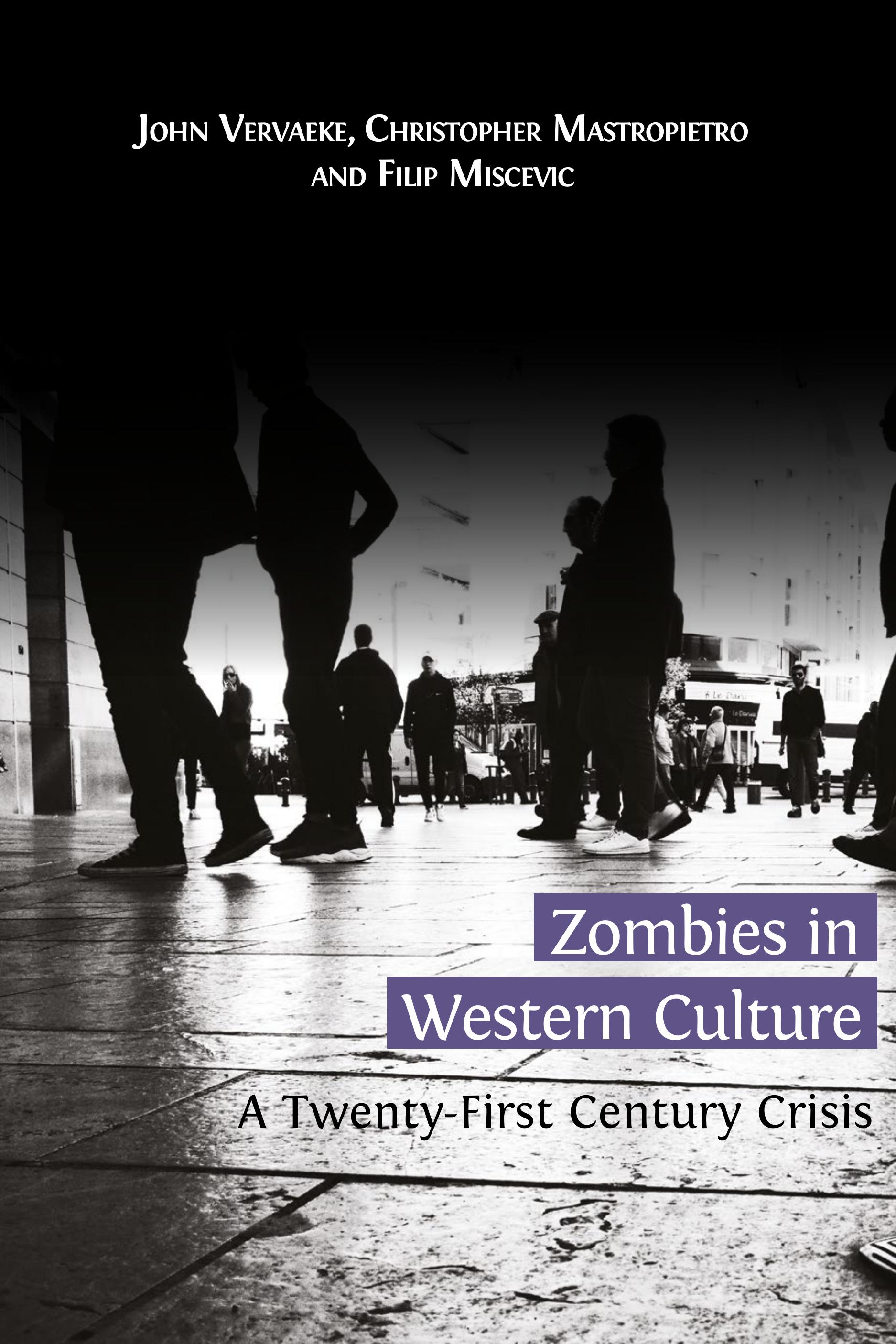
Zombies in Western Culture
A Twenty-First Century Crisis
Book information
- Publisher
- Open Book Publishers
- Publication
- Published 15 June 2017
- Place
- Cambridge, UK
- Catalogue record
- View in the catalogue
Abstract
Why has the zombie become such a pervasive figure in twenty-first-century popular culture? John Vervaeke, Christopher Mastropietro and Filip Miscevic seek to answer this question by arguing that particular aspects of the zombie, common to a variety of media forms, reflect a crisis in modern Western culture.
The authors examine the essential features of the zombie, including mindlessness, ugliness and homelessness, and argue that these reflect the outlook of the contemporary West and its attendant zeitgeists of anxiety, alienation, disconnection and disenfranchisement. They trace the relationship between zombies and the theme of secular apocalypse, demonstrating that the zombie draws its power from being a perversion of the Christian mythos of death and resurrection. Symbolic of a lost Christian worldview, the zombie represents a world that can no longer explain itself, nor provide us with instructions for how to live within it.
The concept of 'domicide' or the destruction of home is developed to describe the modern crisis of meaning that the zombie both represents and reflects. This is illustrated using case studies including the relocation of the Anishinaabe of the Grassy Narrows First Nation, and the upheaval of population displacement in the Hellenistic period. Finally, the authors invoke and reformulate symbols of the four horseman of the apocalypse as rhetorical analogues to frame those aspects of contemporary collapse that elucidate the horror of the zombie.
Zombies in Western Culture: A Twenty-First Century Crisis is required reading for anyone interested in the phenomenon of zombies in contemporary culture. It will also be of interest to an interdisciplinary audience including students and scholars of culture studies, semiotics, philosophy, religious studies, eschatology, anthropology, Jungian studies, and sociology.
Chapters
Where its authors and editors are based
Countries of the institutions the book's authors, editors and chapter authors were affiliated to when it was published.
- AUTHORS / EDITORS
- CITATIONS Phase 2
- USAGE Phase 3
| Country | Authors / editors |
|---|---|
| Canada | 2 |
| United States | 1 |
About this data
These figures cover 8 works. Each value comes from the most trusted source that has it; a correction made by OBC staff outranks every source.
| Source | Confidence | Works |
|---|---|---|
| Thoth | 90 / 100 | 8 |
| Works with a publication date | 100% |
|---|---|
| Works with a DOI | 100% |
| Works with a funder recorded | 0% |
| Authors with an affiliation | 100% |
| Affiliations matched to an institution (ROR) | 100% |
| Affiliations with a country | 100% |
Countries come from the institution each author was affiliated to when they published, as recorded in ROR. A country is never guessed, so authors without a matched institution are not counted on the maps.
Funders come from OpenAlex for articles and Thoth for books, where publishers recorded them. Most works record none, so a funder's figures show what is recorded, not everything it funded.
Chapters count as works: their authors and editors, and the countries of their institutions, are in every figure where Thoth records an affiliation for them.
Citations (Phase 2) and usage (Phase 3) are not collected yet.