
Book view
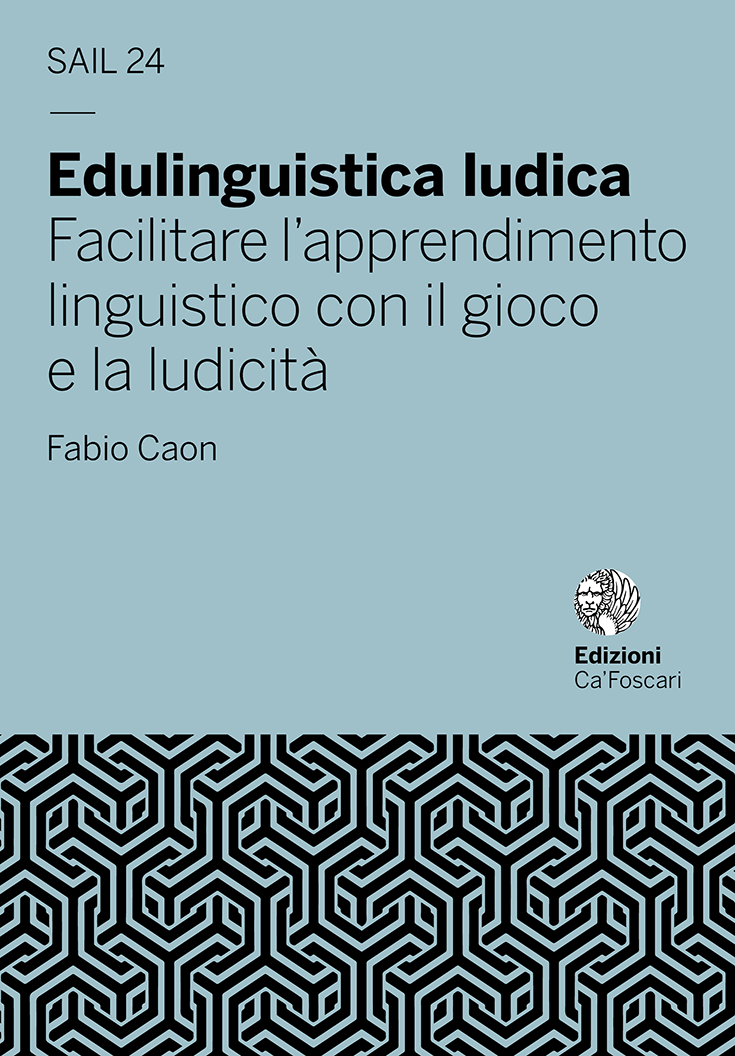
Ludic Edulinguistics
Facilitating Linguistic Learning with Games and Playfulness
By Fabio Caon
Book information
- Publisher
- Edizioni Ca' Foscari
- Publication
- Published 2 December 2022
- Place
- Venice, Italy
- Series
- SAIL
- Catalogue record
- View in the catalogue
Abstract
Playful methodology for language education still finds some prejudice at school, especially when it targets students of the secondary school or adults. The book aims at discrediting such prejudices, considered the most recent neuroscientific and psychopedagogical theories, and at being a contribution for researchers of educational linguistics and for language teachers. The book has a theoretical approach but it offers operational indications for those who wish to use this methodology, which goes far beyond the simple presentation of games. The book is composed by two parts: the first part focuses on the concept of linguistic facilitation (and on the role of the teacher as a facilitator), the second one presents the playful methodology for language learning. The epistemological framework is Humanistic Language Teaching, which refers to the psychological and educational ‘revolution’ of the 1960s and 1970s, i.e., to the works of Chomsky, Arnold, Maslow, Bruner, Rogers, Neisser and many other researchers who claimed that knowledge, experience and education were the result of the way the human brain works and of the personal characteristics of each mind. The slogan used for this edulinguistic revolution was Focus on the Learner. In fact, the communicative approach used today includes a humanistic component as far as the role and nature of the learner are concerned. Yet, this debt to the humanistic revolution is more and more an implicit one, as the awareness of the role played by Humanistic Language Teaching is taken for granted. Within this framework, the book introduces the concept of ‘meaningful learning’, the difference between game and play; the difference between free play and didactic play; the use of play to enhance intercultural communication (fundamental in non-native language teaching) and intercultural education (which involves all humanistic parameters). The book also presents five methodologies that can be used to put the playful methodology into practice: Asher’s Total Physical Response, Gattegno’s Silent Way, Lozanov’s Suggestopedia, Di Pietro’s Scenario, and the use of drama.
Where its authors and editors are based
Countries of the institutions the book's authors, editors and chapter authors were affiliated to when it was published.
- AUTHORS / EDITORS
- CITATIONS Phase 2
- USAGE Phase 3
| Country | Authors / editors |
|---|---|
| Italy | 1 |
About this data
These figures cover 1 work. Each value comes from the most trusted source that has it; a correction made by OBC staff outranks every source.
| Source | Confidence | Works |
|---|---|---|
| Thoth | 90 / 100 | 1 |
| Works with a publication date | 100% |
|---|---|
| Works with a DOI | 100% |
| Works with a funder recorded | 0% |
| Authors with an affiliation | 100% |
| Affiliations matched to an institution (ROR) | 100% |
| Affiliations with a country | 100% |
Countries come from the institution each author was affiliated to when they published, as recorded in ROR. A country is never guessed, so authors without a matched institution are not counted on the maps.
Funders come from OpenAlex for articles and Thoth for books, where publishers recorded them. Most works record none, so a funder's figures show what is recorded, not everything it funded.
Chapters count as works: their authors and editors, and the countries of their institutions, are in every figure where Thoth records an affiliation for them.
Citations (Phase 2) and usage (Phase 3) are not collected yet.