
Book view
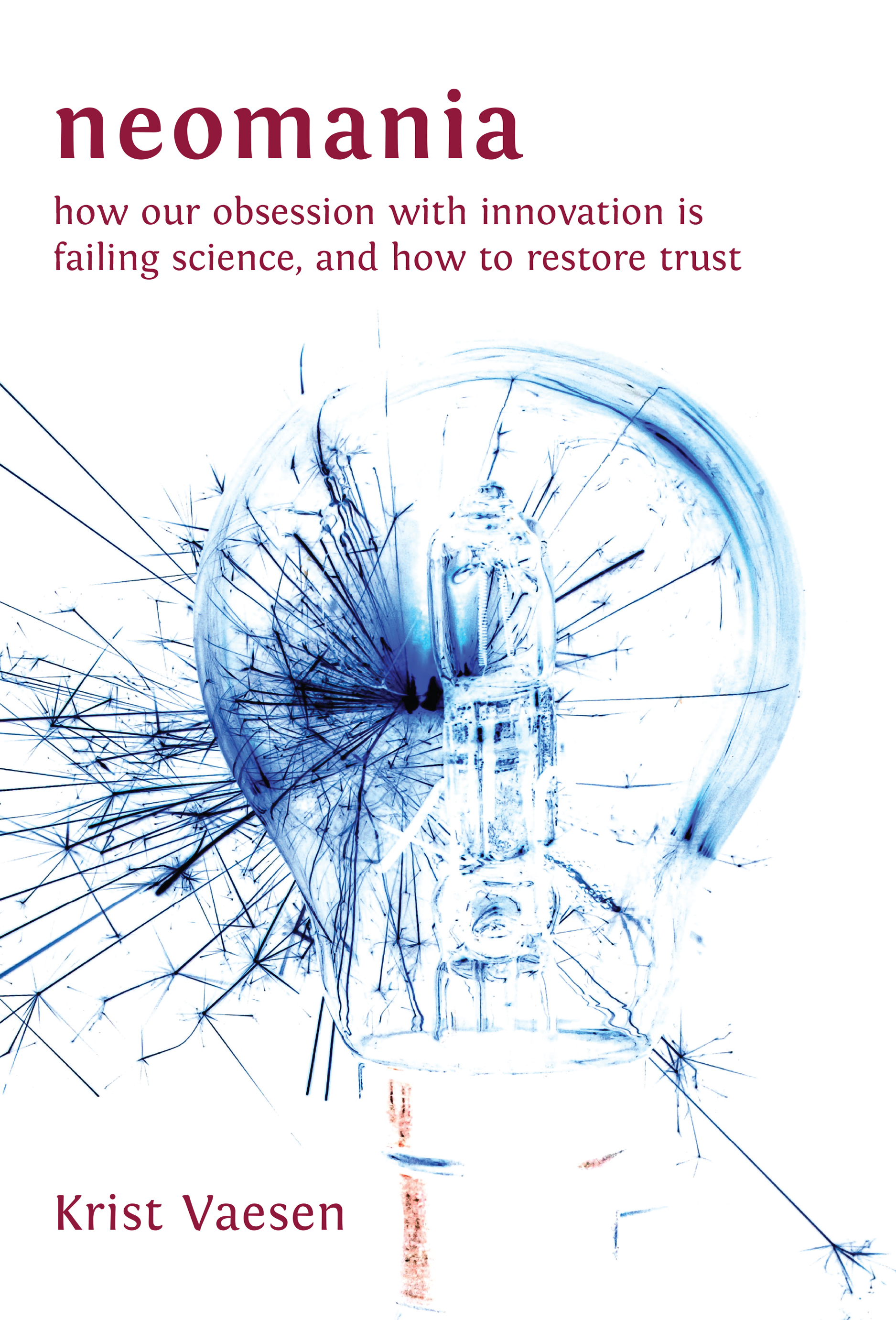
Neomania
How Our Obsession With Innovation is Failing Science, and How to Restore Trust
By Krist Vaesen
Book information
- Publisher
- Open Book Publishers
- Publication
- Published 6 February 2026
- Place
- Cambridge, UK
- Catalogue record
- View in the catalogue
Abstract
Contemporary science faces a profound poly-crisis: replication failures, weak theories, poor generalizability, and declining public trust. Neomania contends that these symptoms stem not merely from flawed practices or institutional pressures, but from a deeper cultural pathology—our collective obsession with innovation. This valorization of the new for its own sake has reshaped the scientific enterprise, privileging novelty over reliability and fragmentation over coordination.
Drawing on metascience as well as the philosophy and sociology of science, Neomania offers a critical analysis of how this ethos has permeated the norms and institutions of modern science. The book traces its historical emergence, diagnoses its systemic consequences, and articulates a reform agenda centered on coordination, shared research programs, and epistemic integrity—an agenda that goes well beyond the principles of Open Science.
Neomania advances a constructive vision for rebuilding science as a coherent and truth-oriented system. Combining philosophical depth with institutional analysis, it addresses students, scholars, policymakers, and practitioners concerned with the organization of knowledge production in an era of epistemic crisis. It is both a critique of contemporary scientific culture and a normative proposal for its renewal.
Chapters
| Chapter | Author | Institution at publication |
|---|---|---|
| Introduction | Krist Vaesen | Eindhoven University of Technology |
| 1. Science in poly-crisis | Krist Vaesen | Eindhoven University of Technology |
| 2. Neomania as an explanation of the poly-crisis | Krist Vaesen | Eindhoven University of Technology |
| 3. Neomania: A short history of the obsession | Krist Vaesen | Eindhoven University of Technology |
| 4. Open science: Necessary but not enough | Krist Vaesen | Eindhoven University of Technology |
| 5. Coordinating our way out of the poly-crisis | Krist Vaesen | Eindhoven University of Technology |
| 6. Towards a science organized around research programmes | Krist Vaesen | Eindhoven University of Technology |
| 7. Epilogue | Krist Vaesen | Eindhoven University of Technology |
Where its authors and editors are based
Countries of the institutions the book's authors, editors and chapter authors were affiliated to when it was published.
- AUTHORS / EDITORS
- CITATIONS Phase 2
- USAGE Phase 3
| Country | Authors / editors |
|---|---|
| The Netherlands | 1 |
About this data
These figures cover 9 works. Each value comes from the most trusted source that has it; a correction made by OBC staff outranks every source.
| Source | Confidence | Works |
|---|---|---|
| Thoth | 90 / 100 | 9 |
| Works with a publication date | 100% |
|---|---|
| Works with a DOI | 100% |
| Works with a funder recorded | 11% |
| Authors with an affiliation | 100% |
| Affiliations matched to an institution (ROR) | 100% |
| Affiliations with a country | 100% |
Countries come from the institution each author was affiliated to when they published, as recorded in ROR. A country is never guessed, so authors without a matched institution are not counted on the maps.
Funders come from OpenAlex for articles and Thoth for books, where publishers recorded them. Most works record none, so a funder's figures show what is recorded, not everything it funded.
Chapters count as works: their authors and editors, and the countries of their institutions, are in every figure where Thoth records an affiliation for them.
Citations (Phase 2) and usage (Phase 3) are not collected yet.