
Book view
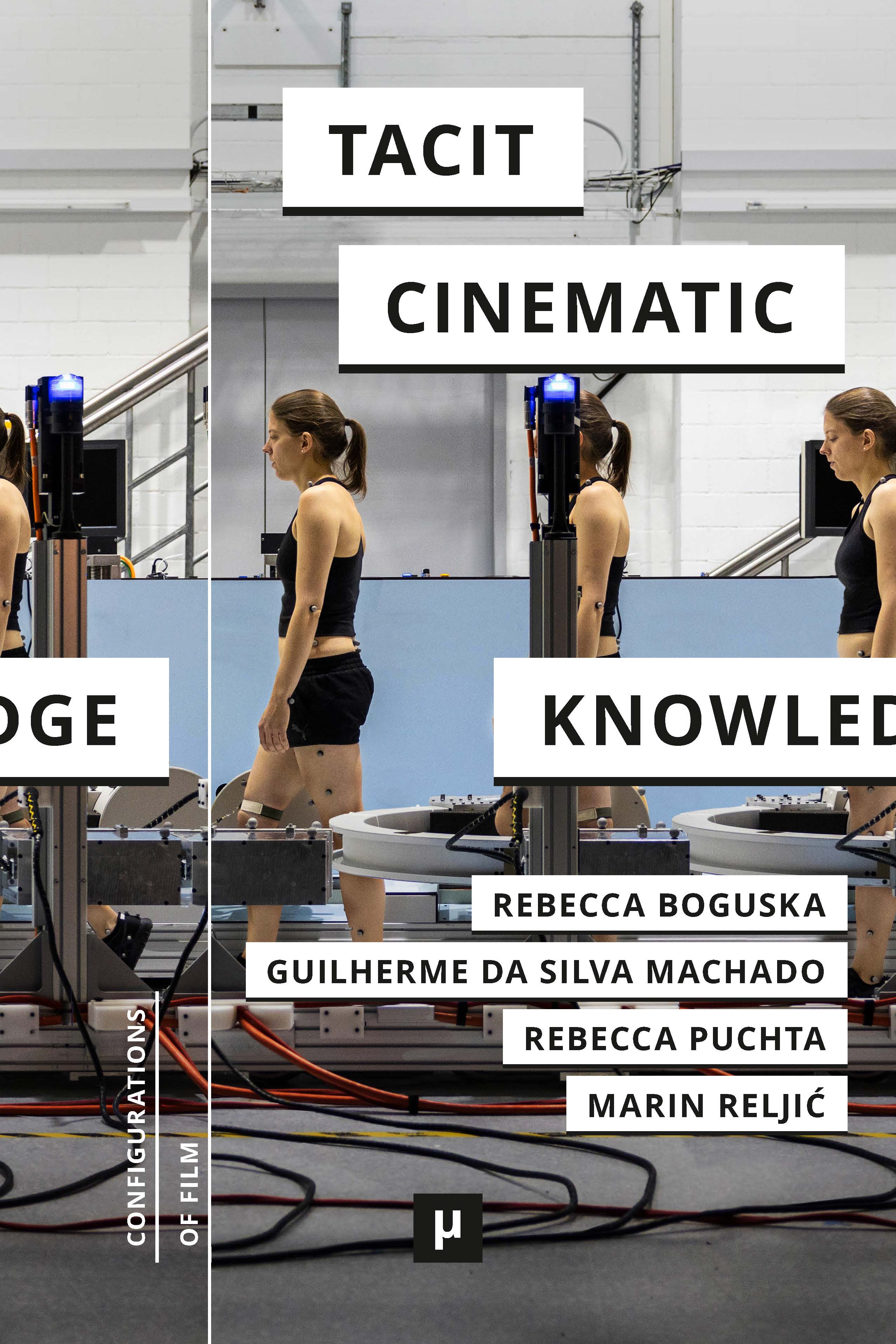
Tacit Cinematic Knowledge
Approaches and Practices
Edited by Rebecca Boguska, Guilherme da Silva Machado, Rebecca Puchta, Marin Reljić; by Larissa Fischer, Veena Hariharan, Vinzenz Hediger, Andrea Mariani, Bettina Paul, Jelena Rakin, Haritha R., Claire Salles, Henning Schmidgen, Felix M. Simon, Felipe Soares, Benoît Turquety
Book information
- Publisher
- meson press
- Publication
- Published 22 May 2024
- Place
- Lüneburg
- Series
- Configurations of Film
- Catalogue record
- View in the catalogue
Abstract
Moving images are increasingly finding their way into laboratories, dentist offices, clinics, airports and gyms. In these places and institutions film and moving image technologies serve to advance knowledge, to show how things are done, to train, teach, educate, mobilize people, as well as to imagine complex social facts and visualize dynamic models and schemes through data visualizations, pattern recognition software, and in social graphs. But what these moving images do goes beyond instruction, illustration and visual education. This publication introduces the concept of tacit cinematic knowledge to designate a broad variety of epistemic environments in which knowledge is configured in and through cinematic practices, and in the interaction with moving images. The concept thus describes a challenge not only for film and media scholars, but also for social scientists, economists, data analysts and artists.
Covering areas of study beyond the cinema and non-theatrical films which have recently become a focus of inquiry, the contributions analyze the operations of tacit cinematic knowledge in objects ranging from political campaigns, medical and scientific devices, corporate communications, devices for the study of animal behavior and more.
Chapters
| Chapter | Author | Institution at publication |
|---|---|---|
| Bio-Logs and Non-Humans | Veena Hariharan | Jawaharlal Nehru University |
| Crafty Cinephilia | Andrea Mariani | University of Udine |
| From the Construction Site via the Highway to the Guided Tour | Rebecca Boguska | |
| Iconic Materiality, or the Ambivalent Fascination of Cinematic Lie Detection Depictions (in Germany) | Bettina Paul, Larissa Fischer | Universität Hamburg; RWTH Aachen University |
| Minoring Machines | Henning Schmidgen | Bauhaus-Universität Weimar |
| New Media(tions) | Haritha R. | |
| Old Modes, New Moods, or How Soundtracks Can Experiment | Felipe Soares | Universidade Federal de Santa Catarina |
| Phantasms of the Sun and Venus | Jelena Rakin | University of Zurich |
| Scripting Organizations | Guilherme da Silva Machado | |
| Tacit Cinematic Knowledge | Rebecca Boguska, Guilherme da Silva Machado, Rebecca Puchta, Marin Reljić | |
| Unauthorized Fictions | Vinzenz Hediger, Felix M. Simon | Goethe University Frankfurt; University of Oxford |
| “Implicit Conceptual Structures” | Benoît Turquety | Université Paris 8 |
| “When Pregnancy Becomes a Moving Picture” | Claire Salles |
Where its authors and editors are based
Countries of the institutions the book's authors, editors and chapter authors were affiliated to when it was published.
- AUTHORS / EDITORS
- CITATIONS Phase 2
- USAGE Phase 3
| Country | Authors / editors |
|---|---|
| Germany | 4 |
| Brazil | 1 |
| France | 1 |
| India | 1 |
| Italy | 1 |
| Switzerland | 1 |
| United Kingdom | 1 |
About this data
These figures cover 14 works. Each value comes from the most trusted source that has it; a correction made by OBC staff outranks every source.
| Source | Confidence | Works |
|---|---|---|
| Thoth | 90 / 100 | 14 |
| Works with a publication date | 100% |
|---|---|
| Works with a DOI | 7% |
| Works with a funder recorded | 7% |
| Authors with an affiliation | 59% |
| Affiliations matched to an institution (ROR) | 100% |
| Affiliations with a country | 100% |
Countries come from the institution each author was affiliated to when they published, as recorded in ROR. A country is never guessed, so authors without a matched institution are not counted on the maps.
Funders come from OpenAlex for articles and Thoth for books, where publishers recorded them. Most works record none, so a funder's figures show what is recorded, not everything it funded.
Chapters count as works: their authors and editors, and the countries of their institutions, are in every figure where Thoth records an affiliation for them.
Citations (Phase 2) and usage (Phase 3) are not collected yet.