
Book view
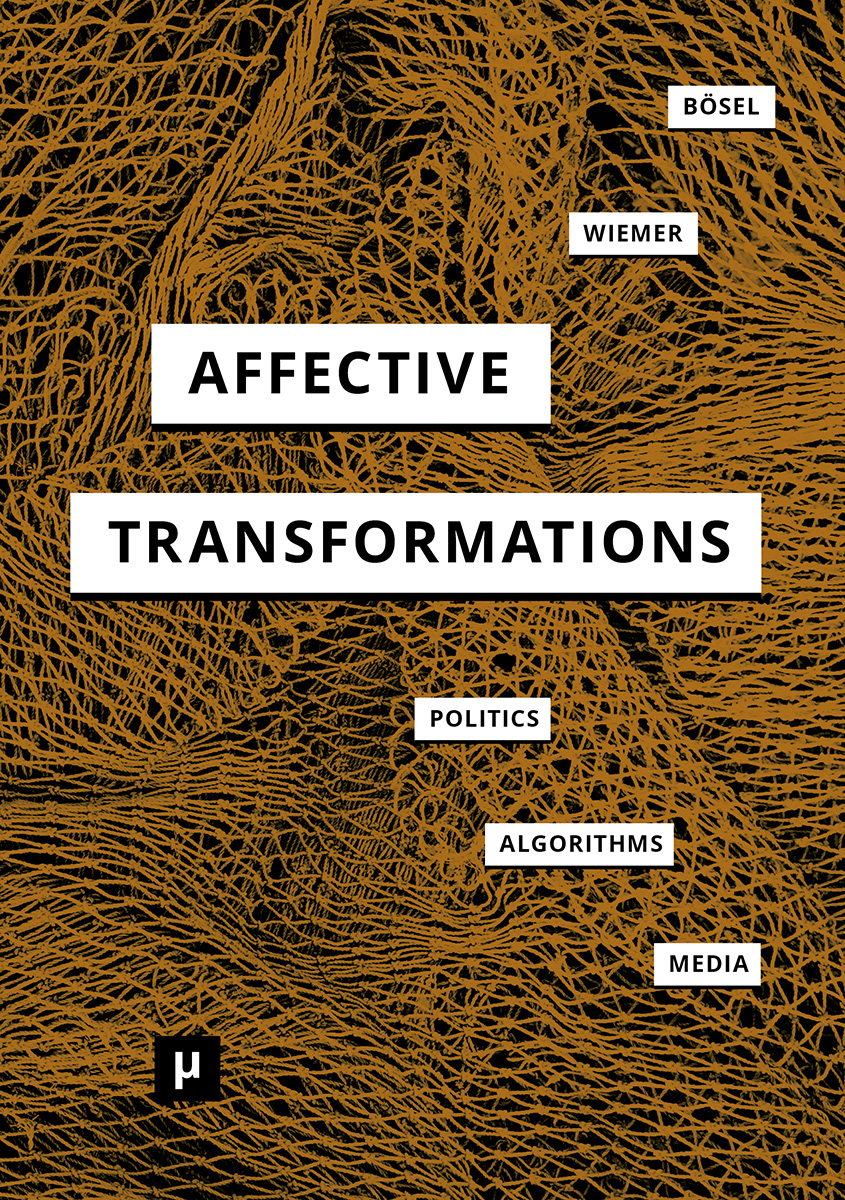
Affective Transformations
Politics – Algorithms – Media
Edited by Bernd Bösel, Serjoscha Wiemer; by Marie-Luise Angerer, Pierre Cassou-Noguès, Jean Clam, Mathias Fuchs, Gabriele Gramelsberger, Irina Kaldrack, Dawid Kasprowicz, Oliver Leistert, Michaela Ott, Markus Rautzenberg, Andrew Ross, Paul Stenner
Book information
- Publisher
- meson press
- Publication
- Published 9 November 2020
- Place
- Lüneburg
- Catalogue record
- View in the catalogue
Abstract
The Affective Turn has lost its former innocence and euphoria. Affect Studies and its adjacent disciplines have now to prove that they can cope with the return of the affective real that technology, economy, and politics entail.
Two seemingly contradictory developments serve as starting points for this volume. First, technological innovations such as affective computing, mood tracking, sentiment analysis, and social robotics all share a focus on the recognition and modulation of human affectivity. Affect gets measured, calculated, controlled. Secondly, recent developments in politics, social media usage, and right-wing journalism have contributed to a conspicuous rise of hate speech, cybermobbing, public shaming, “felt truths,” and resentful populisms. In a very specific way, politics as well as power have become affective.
Affect gets mobilized, fomented, unleashed. When the ways we deal with our affectivity get unsettled in such a dramatic fashion, we have to rethink our ethical, aesthetical, political as well as legal regimes of affect organization.
Chapters
| Chapter | Author | Institution at publication |
|---|---|---|
| Affect | Paul Stenner | The Open University |
| Affection and Dividuation | Michaela Ott | Hochschule für bildende Künste |
| Affective Media Regulation | Bernd Bösel | University of Potsdam |
| Affective Milieus | Marie-Luise Angerer | University of Potsdam |
| Affective Transformations | Bernd Bösel | University of Potsdam |
| Algorithm Awareness | Gabriele Gramelsberger | RWTH Aachen University |
| Alien Thinking | Markus Rautzenberg | Folkwang University of the Arts |
| Attuning to What? | Mathias Fuchs | Leuphana University of Lüneburg |
| Autonomous Dwelling | Irina Kaldrack | Braunschweig University of Art |
| Encoding Proximity | Dawid Kasprowicz | RWTH Aachen University |
| From Social Data to Body Data to Psy Data | Oliver Leistert | Leuphana University of Lüneburg |
| Happy, Happy, Sad, SadDo You Feel Me? | Serjoscha Wiemer | Paderborn University |
| Mediated Humanitarian Affect | Andrew Ross | Ohio University |
| Synhaptic Sensibility | Pierre Cassou-Noguès | Université Paris 8 |
| Witnessing the Dismantlement of a Proven Structure of Belief | Jean Clam | Centre National pour la Recherche Scientifique et Technique (CNRST) |
Where its authors and editors are based
Countries of the institutions the book's authors, editors and chapter authors were affiliated to when it was published.
- AUTHORS / EDITORS
- CITATIONS Phase 2
- USAGE Phase 3
| Country | Authors / editors |
|---|---|
| Germany | 10 |
| France | 1 |
| Morocco | 1 |
| United Kingdom | 1 |
| United States | 1 |
About this data
These figures cover 16 works. Each value comes from the most trusted source that has it; a correction made by OBC staff outranks every source.
| Source | Confidence | Works |
|---|---|---|
| Thoth | 90 / 100 | 16 |
| Works with a publication date | 100% |
|---|---|
| Works with a DOI | 6% |
| Works with a funder recorded | 6% |
| Authors with an affiliation | 100% |
| Affiliations matched to an institution (ROR) | 100% |
| Affiliations with a country | 100% |
Countries come from the institution each author was affiliated to when they published, as recorded in ROR. A country is never guessed, so authors without a matched institution are not counted on the maps.
Funders come from OpenAlex for articles and Thoth for books, where publishers recorded them. Most works record none, so a funder's figures show what is recorded, not everything it funded.
Chapters count as works: their authors and editors, and the countries of their institutions, are in every figure where Thoth records an affiliation for them.
Citations (Phase 2) and usage (Phase 3) are not collected yet.