
Book view
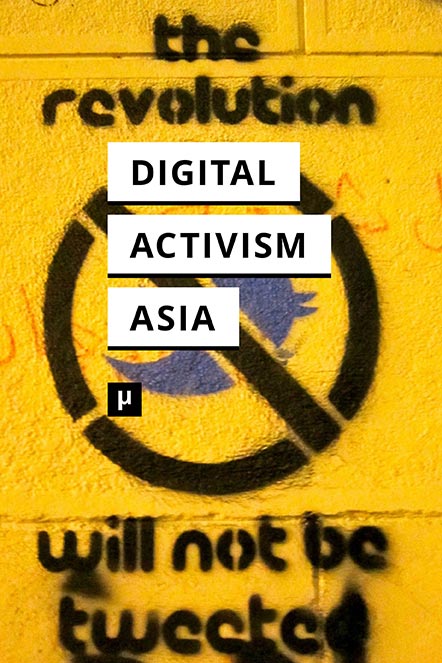
Digital Activism in Asia Reader
Edited by Nishant Shah, Puthiya Purayil Sneha, Sumandro Chattapadhyay; by Denisse Albornoz, Esra’a Al Shafei, Maesy Angelina, Htaike Htaike Aung, Anat Ben-David, Nandini Chami, Tracey Cheng, Armand Hurault, Rachael Jolley, Youngmi Kim, Merlyna Lim, Sarah McKeever, Subhashish Panigrahi, Prabhas Pokharel, Puthiya Purayil Sneha, Padmini Ray Murray, Urvashi Sarkar, Shobha S V, YiPing Zona Tsou, Hu Yong, Huma Yusuf, Weiyu Zhang
Book information
- Publisher
- meson press
- Publication
- Published 1 July 2015
- Place
- Lüneburg
- DOI
- 10.14619/013
- Catalogue record
- View in the catalogue
Abstract
The digital turn might as well be marked as an Asian turn. From flash-mobs in Taiwan to feminist mobilisations in India, from hybrid media strategies of Syrian activists to cultural protests in Thailand, we see the emergence of political acts that transform the citizen from being a beneficiary of change to becoming an agent of change. In co-shaping these changes, what the digital shall be used for, and what its consequences will be, are both up for speculation and negotiation. Digital Activism in Asia marks a particular shift where these questions are no longer being refracted through the ICT4D logic, or the West’s attempts to save Asia from itself, but shaped by multiplicity, unevenness, and urgencies of digital sites and users in Asia. This reader crowd-sources critical tools, concepts, analyses, and annotations, self-identified by a network of change makers in Asia as important in their own practices within their own contexts.
Chapters
| Chapter | Author | Institution at publication |
|---|---|---|
| Foreword | Nishant Shah | Leuphana University of Lüneburg |
| Digital Natives and the Return of the Local Cause | Anat Ben-David, Padmini Ray Murray | Open University of Israel; Srishti Institute of Art Design and Technology |
| Digital Natives in the Name of a Cause | YiPing Zona Tsou, Nandini Chami | IT for Change |
| Digital Natives' Alternative Approach to Social Change | Maesy Angelina, Sarah McKeever | King's College London |
| Digital Populism in South Korea? | Youngmi Kim, Sumandro Chattapadhyay | Central European University; Centre for Internet and Society |
| Digital Revolution in Reverse | Armand Hurault | |
| From Taboo to Beautiful | Denisse Albornoz, Nandini Chami | IT for Change |
| Greatfire.org | Sumandro Chattapadhyay | Centre for Internet and Society |
| India Calling | Rachael Jolley, Puthiya Purayil Sneha | Centre for Internet and Society |
| Keeping Our Voices Loud | Esra’a Al Shafei, Puthiya Purayil Sneha | Centre for Internet and Society |
| Many Clicks but Little Sticks | Merlyna Lim, Nishant Shah | Carleton University; Leuphana University of Lüneburg |
| Old and New Media | Huma Yusuf, Shobha S V | Woodrow Wilson International Center for Scholars |
| Redefining Youth Activism through Digital Technology in Singapore | Weiyu Zhang, Sarah McKeever | National University of Singapore |
| Rising Voices | Subhashish Panigrahi, Padmini Ray Murray | Centre for Internet and Society; Srishti Institute of Art Design and Technology |
| Taiwan's Sunflower Protest | Tracey Cheng, Puthiya Purayil Sneha | Centre for Internet and Society |
| Three Forces Acting behind the Development of the Internet | Hu Yong | Peking University |
| Towards 2 Way Participation | Prabhas Pokharel, Padmini Ray Murray | Srishti Institute of Art Design and Technology |
| We Come from an Activist Background | Htaike Htaike Aung, Sumandro Chattapadhyay | Centre for Internet and Society |
| Wikipedia, Bhanwari Devi and the Need for an Alert Feminist Public | Urvashi Sarkar, Shobha S V |
Where its authors and editors are based
Countries of the institutions the book's authors, editors and chapter authors were affiliated to when it was published.
- AUTHORS / EDITORS
- CITATIONS Phase 2
- USAGE Phase 3
About this data
These figures cover 20 works. Each value comes from the most trusted source that has it; a correction made by OBC staff outranks every source.
| Source | Confidence | Works |
|---|---|---|
| Thoth | 90 / 100 | 20 |
| Works with a publication date | 100% |
|---|---|
| Works with a DOI | 5% |
| Works with a funder recorded | 5% |
| Authors with an affiliation | 59% |
| Affiliations matched to an institution (ROR) | 100% |
| Affiliations with a country | 100% |
Countries come from the institution each author was affiliated to when they published, as recorded in ROR. A country is never guessed, so authors without a matched institution are not counted on the maps.
Funders come from OpenAlex for articles and Thoth for books, where publishers recorded them. Most works record none, so a funder's figures show what is recorded, not everything it funded.
Chapters count as works: their authors and editors, and the countries of their institutions, are in every figure where Thoth records an affiliation for them.
Citations (Phase 2) and usage (Phase 3) are not collected yet.