
Book view
African Science Granting Councils
Towards Sustainable Development in Africa
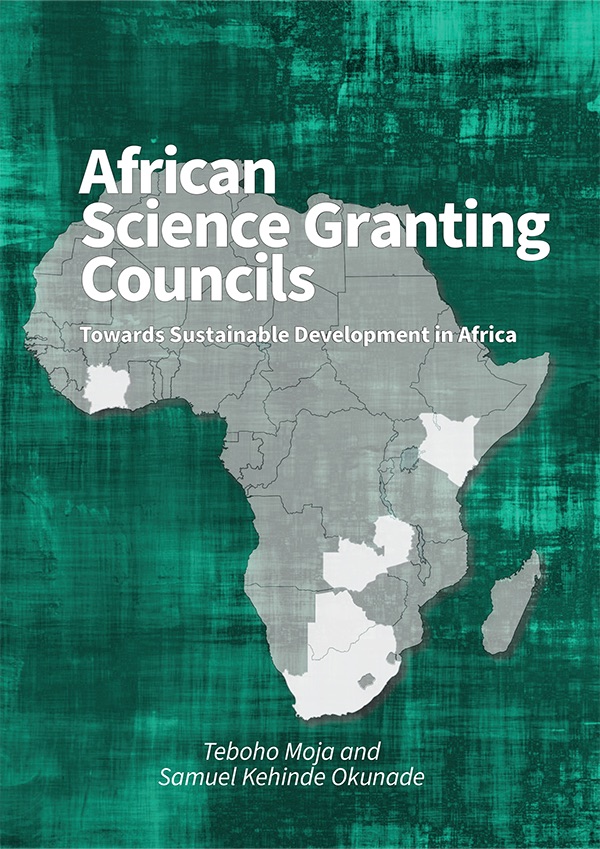
Book information
- Publisher
- African Minds
- Publication
- Published 1 October 2023
- Place
- South Africa
- Catalogue record
- View in the catalogue
Abstract
This book delves into the research-policy nexus as it relates to development in Africa. It does so by examining four country-cases – Botswana, Cote d’Ivoire, Kenya and Zambia – while referring to South Africa as a possible exemplar case.
The book reaffirms that the majority of governments in Africa spend less than one per cent of their GDP on research and development (R&D) despite the commitment to raise their research funding levels contained in the Lagos Plan of Action (1980). Hence, reliance on external funding for research persists on the continent.
To manage research engagements and public funds, Science Granting Councils (SGCs) have been established. These institutions are held account- able for how public funds are spent and how the research they fund contributes to the advancement of society.
To-date, the SGCs and researchers have demonstrated in various ways how funded research contributes to the advancement of society. However, there appear to be differences in opinion amongst key stakeholders in terms of what constitutes research priorities as well as expectations in terms of the returns on research investments made.
This book brings to the fore the importance of research and its outcome on societal development, and reveals the stake that African governments hold in the process. The book encourages African governments to show greater commitment to providing funding for research on the continent. This is critical if governments are to assume a lead role in the continent’s development agenda. It would also set the stage for partnerships with other stakeholders, including industry and funding organisations. Researchers are also encouraged to work closely with the SGCs to ensure the valorisation of research products for societal benefit. This has a potential to unlock more funding for research in Africa which, in turn, would drive the development of the continent.
Where its authors and editors are based
Countries of the institutions the book's authors, editors and chapter authors were affiliated to when it was published.
- AUTHORS / EDITORS
- CITATIONS Phase 2
- USAGE Phase 3
No affiliations with a known country in these years yet.
About this data
These figures cover 1 work. Each value comes from the most trusted source that has it; a correction made by OBC staff outranks every source.
| Source | Confidence | Works |
|---|---|---|
| Thoth | 90 / 100 | 1 |
| Works with a publication date | 100% |
|---|---|
| Works with a DOI | 100% |
| Works with a funder recorded | 0% |
| Authors with an affiliation | 0% |
Countries come from the institution each author was affiliated to when they published, as recorded in ROR. A country is never guessed, so authors without a matched institution are not counted on the maps.
Funders come from OpenAlex for articles and Thoth for books, where publishers recorded them. Most works record none, so a funder's figures show what is recorded, not everything it funded.
Chapters count as works: their authors and editors, and the countries of their institutions, are in every figure where Thoth records an affiliation for them.
Citations (Phase 2) and usage (Phase 3) are not collected yet.