
Book information
- Publisher
- mediastudies.press
- Publication
- Published 7 December 2022
- Place
- Bethlehem, PA
- Series
- Public Domain Series
- Catalogue record
- View in the catalogue
Abstract
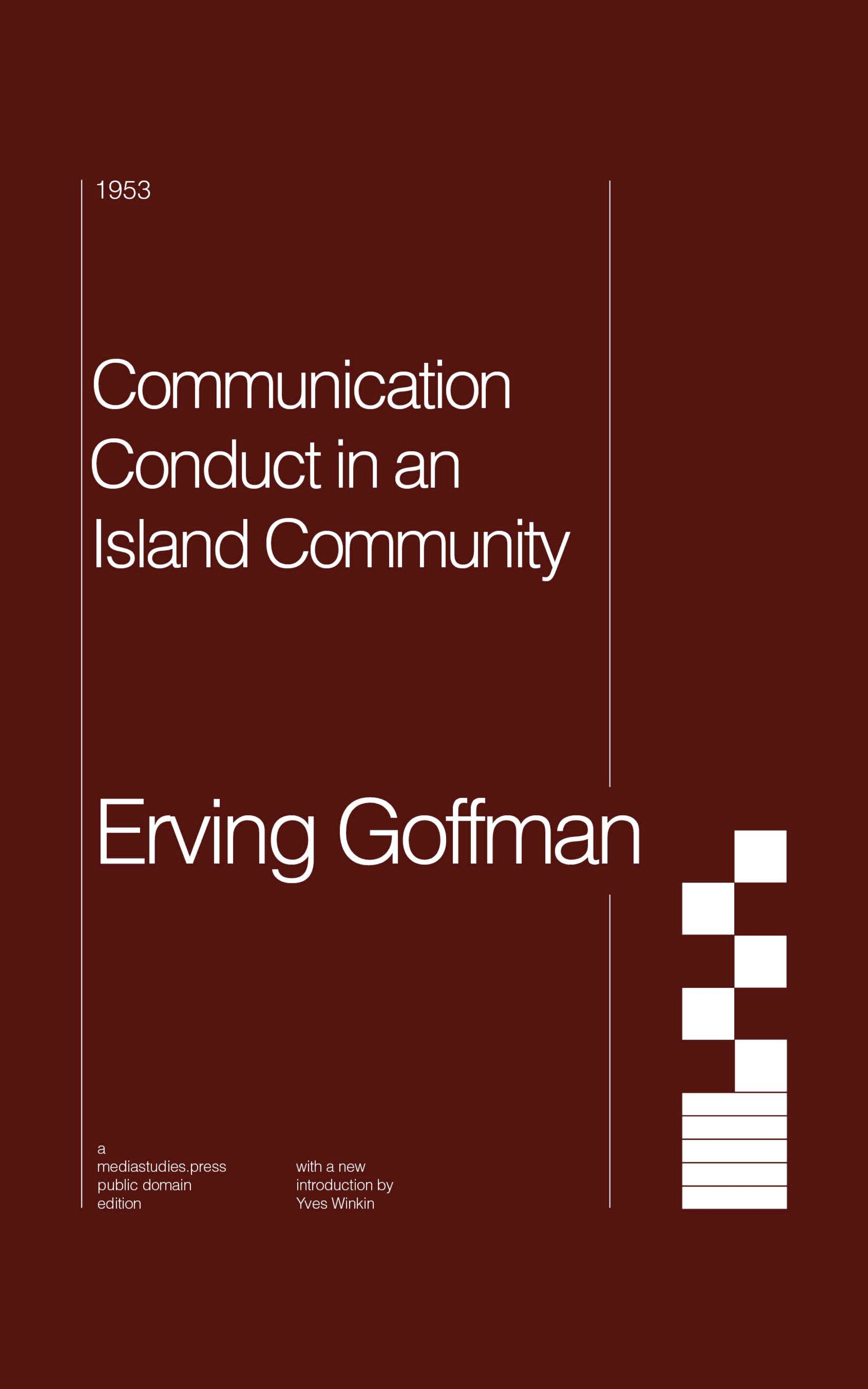
Canadian-born Erving Goffman (1922–1982) was the twentieth century’s most important sociologist writing in English. His 1953 dissertation is published here for the first time, on the hundredth anniversary of his birth. The remarkable study, based on fieldwork on a remote Scottish island, presents in embryonic form the full spread of Goffman’s thought. Framed as a “report on a study of conversational interaction,” the dissertation lingers on the modest talk of island “crofters.” It is trademark Goffman: ambitious, unconventional in form, and brimmed with big-picture insight. The thesis is that social order is made and re-made in communication—the “interaction order” he re-visited in a famous and final talk before his 1982 death. The dissertation is, as Yves Winkin writes in a new introduction, the “Rosetta stone for his entire work.” It was here that Goffman revealed, quietly, his peerless sensitivity to the invisible wireframes of everyday life.
Chapters
Where its authors and editors are based
Countries of the institutions the book's authors, editors and chapter authors were affiliated to when it was published.
- AUTHORS / EDITORS
- CITATIONS Phase 2
- USAGE Phase 3
| Country | Authors / editors |
|---|---|
| Belgium | 1 |
About this data
These figures cover 27 works. Each value comes from the most trusted source that has it; a correction made by OBC staff outranks every source.
| Source | Confidence | Works |
|---|---|---|
| Thoth | 90 / 100 | 27 |
| Works with a publication date | 100% |
|---|---|
| Works with a DOI | 100% |
| Works with a funder recorded | 0% |
| Authors with an affiliation | 7% |
| Affiliations matched to an institution (ROR) | 100% |
| Affiliations with a country | 100% |
Countries come from the institution each author was affiliated to when they published, as recorded in ROR. A country is never guessed, so authors without a matched institution are not counted on the maps.
Funders come from OpenAlex for articles and Thoth for books, where publishers recorded them. Most works record none, so a funder's figures show what is recorded, not everything it funded.
Chapters count as works: their authors and editors, and the countries of their institutions, are in every figure where Thoth records an affiliation for them.
Citations (Phase 2) and usage (Phase 3) are not collected yet.