
Book view
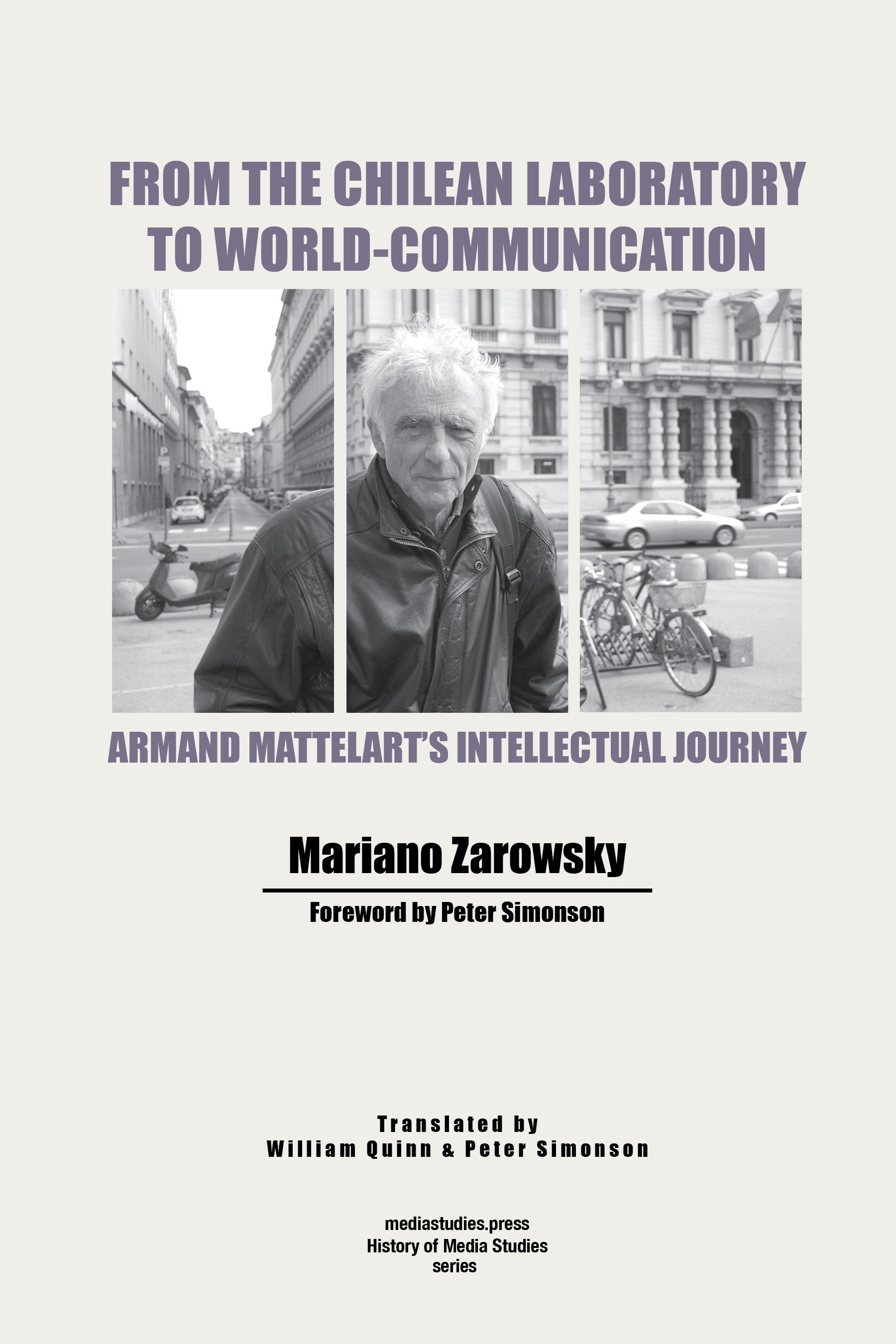
From the Chilean Laboratory to World-Communication
Armand Mattelart’s Intellectual Journey
Book information
- Publisher
- mediastudies.press
- Publication
- Published 15 October 2025
- Place
- Bethlehem, PA
- Series
- History of Media Studies Series
- Catalogue record
- View in the catalogue
Abstract
From the Chilean Laboratory to World-Communication follows Armand Mattelart’s intellectual trajectory through Cold War geopolitics and the rise of critical communication studies in Latin America and Europe. First published in Spanish, Mariano Zarowsky’s study traces Mattelart’s path from his early work in demography and law, through his political engagement in Salvador Allende’s Chile, to his later role in shaping debates in France and globally on media, cultural politics, and transnational communication.
The book offers a rich account of Mattelart’s life and work, and the shifting political, institutional, and epistemological contexts that shaped his thinking and progressive activism. Along the way, it illuminates his distinctive style of research in relation to Anglophone political economy and other strands of critical research. In doing so, Zarowsky positions Mattelart as a theorist whose work emerged from—and continues to speak to—global struggles over culture, knowledge, and power and relations between the Global North and South.
As the first English edition of Zarowsky’s landmark study, From the Chilean Laboratory to World-Communication, will appeal to scholars of critical communication studies, Latin American and transnational cultural theory, and those working on the history of the social sciences across global contexts.
Chapters
Where its authors and editors are based
Countries of the institutions the book's authors, editors and chapter authors were affiliated to when it was published.
- AUTHORS / EDITORS
- CITATIONS Phase 2
- USAGE Phase 3
| Country | Authors / editors |
|---|---|
| Argentina | 1 |
| United States | 1 |
About this data
These figures cover 15 works. Each value comes from the most trusted source that has it; a correction made by OBC staff outranks every source.
| Source | Confidence | Works |
|---|---|---|
| Thoth | 90 / 100 | 15 |
| Works with a publication date | 100% |
|---|---|
| Works with a DOI | 100% |
| Works with a funder recorded | 7% |
| Authors with an affiliation | 88% |
| Affiliations matched to an institution (ROR) | 54% |
| Affiliations with a country | 54% |
Countries come from the institution each author was affiliated to when they published, as recorded in ROR. A country is never guessed, so authors without a matched institution are not counted on the maps.
Funders come from OpenAlex for articles and Thoth for books, where publishers recorded them. Most works record none, so a funder's figures show what is recorded, not everything it funded.
Chapters count as works: their authors and editors, and the countries of their institutions, are in every figure where Thoth records an affiliation for them.
Citations (Phase 2) and usage (Phase 3) are not collected yet.