
Book view
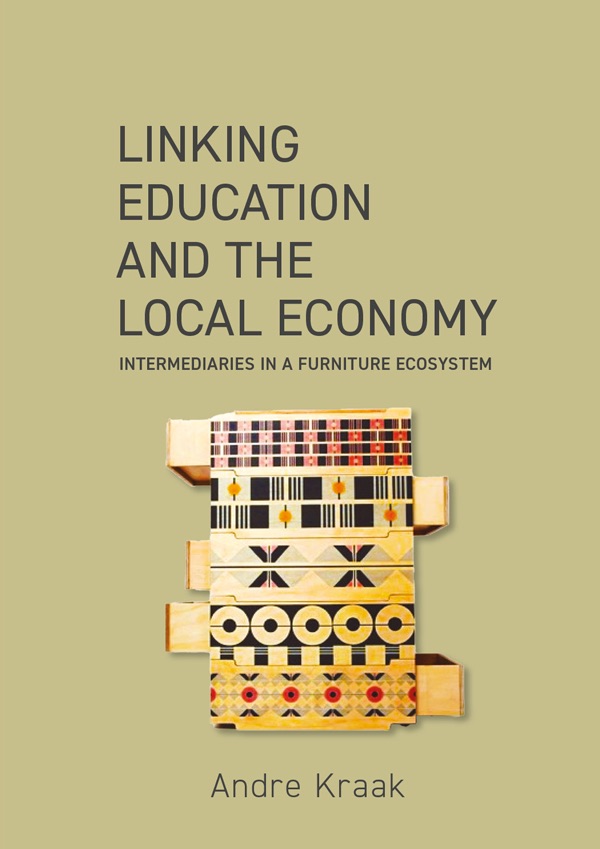
Linking Education and the Local Economy
Intermediaries in a Furniture Ecosystem
By André Kraak
Book information
- Publisher
- African Minds
- Publication
- Published 24 June 2025
- Place
- Cape Town
- Catalogue record
- View in the catalogue
Abstract
Linking Education and the Local Economy examines the collapse of linkages between South Africa’s post-school education and training system and the declining furniture industry. Using a case study approach, it explores reasons behind the erosion of the sector’s competitiveness. The book shows how intermediaries – organisations or individuals bridging gaps between fi rms, education providers and government – could revitalise the industry by fostering collaboration, knowledge exchange and innovation.
The book contends that South Africa’s furniture industry, once thriving, has suffered due to global competition, neoliberal policies and employer disengagement from public education systems which are viewed as outdated and bureaucratic. The absence of intermediaries exacerbates these challenges, leaving fi rms isolated and innovation stagnant. While the literature highlights intermediaries as key to strengthening innovation ecosystems, South Africa’s ‘ruggedly individualistic’ business culture and state inefficiencies hinder their effectiveness. The book proposes that structured intermediation – ranging from basic networking to advanced systemic coordination – could rebuild these linkages.
Most innovation research focuses on high-tech sectors and radical innovation; this book shifts attention to traditional industries reliant on incremental innovation and tacit knowledge. It proposes a novel framework of intermediation, offering a roadmap for policymakers. Any such roadmap requires sectoral differentiation, rejecting one-size-fits-all policies. In addition, there is a need for state capability-building (enhancing public-sector intermediation skills), firm engagement (encouraging large fi rms to share knowledge and small fi rms to embrace collective learning), and reforming intermediaries (shifting from bureaucratic compliance to dynamic, network-driven roles).
The insights provided by Linking Education and the Local Economy is of interest to academics and researchers, particularly those in innovation studies, industrial policy, vocational education, and development economics; policymakers, notably government officials drafting industrial and skills development strategies and policies; and industry stakeholders, including business associations, education providers, and intermediaries seeking practical solutions for sectoral renewal. Intermediation, though underutilised in South Africa, holds promise for reconnecting education systems with industry. The empirical and theoretical insights set out in this book offer a blueprint for revitalising not only furniture but other traditional sectors facing similar crises.
Where its authors and editors are based
Countries of the institutions the book's authors, editors and chapter authors were affiliated to when it was published.
- AUTHORS / EDITORS
- CITATIONS Phase 2
- USAGE Phase 3
No affiliations with a known country in these years yet.
About this data
These figures cover 1 work. Each value comes from the most trusted source that has it; a correction made by OBC staff outranks every source.
| Source | Confidence | Works |
|---|---|---|
| Thoth | 90 / 100 | 1 |
| Works with a publication date | 100% |
|---|---|
| Works with a DOI | 100% |
| Works with a funder recorded | 0% |
| Authors with an affiliation | 0% |
Countries come from the institution each author was affiliated to when they published, as recorded in ROR. A country is never guessed, so authors without a matched institution are not counted on the maps.
Funders come from OpenAlex for articles and Thoth for books, where publishers recorded them. Most works record none, so a funder's figures show what is recorded, not everything it funded.
Chapters count as works: their authors and editors, and the countries of their institutions, are in every figure where Thoth records an affiliation for them.
Citations (Phase 2) and usage (Phase 3) are not collected yet.