
Book view
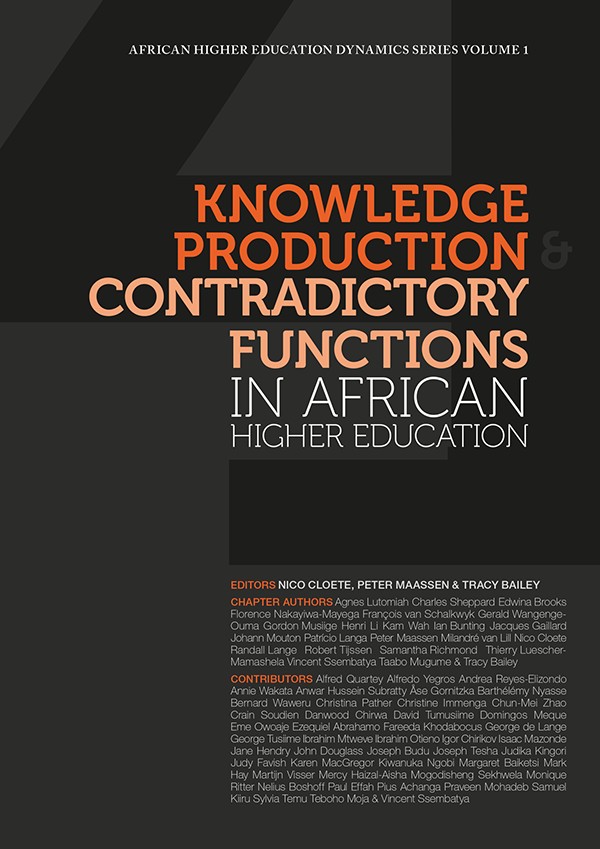
Knowledge Production and Contradictory Functions in African Higher Education
Edited by Nico Cloete, Peter Maassen, Tracy Bailey
Book information
- Publisher
- African Minds
- Publication
- Published 2 March 2015
- Place
- Cape Town
- Catalogue record
- View in the catalogue
Abstract
Currently, Africa has more than half of the 20 fastest-growing economies in the world, which has contributed to what has been called the era of ‘Africa Rising’ or a ‘New Africa’. In order to further strengthen socio-economic development, African universities need to improve their ability to produce and apply knowledge in effective and relevant ways. In OECD countries there are several public and private sites for knowledge production, but in Africa the university is the only knowledge institution, and hardly any knowledge is produced outside of the university.
However, the performance of African universities in knowledge production has not been impressive. It has generally been acknowledged by agencies such as the African Observatory for Science, Technology and Innovation and the World Bank, as well as leading development scholars, that African universities are lagging behind the rest of the world in their knowledge production function. There has been only weak empirical evidence on the actual performance of universities, with virtually no cross-institutional and cross-country comparative research on the factors that are responsible for the poor performance of universities in knowledge production across the continent.
The crossroads African universities are facing consist of, on the one hand, a familiar path of relative decoupling between the university and its nation’s socio-economic development and, on the other hand, a path that requires far-reaching changes that could make it possible for the African university to connect much more productively to the main actors in emerging national (and in some cases regional) development and innovation networks. For the latter path to become accessible, these universities and their national authorities need research-rooted information.
Where its authors and editors are based
Countries of the institutions the book's authors, editors and chapter authors were affiliated to when it was published.
- AUTHORS / EDITORS
- CITATIONS Phase 2
- USAGE Phase 3
No affiliations with a known country in these years yet.
About this data
These figures cover 1 work. Each value comes from the most trusted source that has it; a correction made by OBC staff outranks every source.
| Source | Confidence | Works |
|---|---|---|
| Thoth | 90 / 100 | 1 |
| Works with a publication date | 100% |
|---|---|
| Works with a DOI | 100% |
| Works with a funder recorded | 0% |
| Authors with an affiliation | 0% |
Countries come from the institution each author was affiliated to when they published, as recorded in ROR. A country is never guessed, so authors without a matched institution are not counted on the maps.
Funders come from OpenAlex for articles and Thoth for books, where publishers recorded them. Most works record none, so a funder's figures show what is recorded, not everything it funded.
Chapters count as works: their authors and editors, and the countries of their institutions, are in every figure where Thoth records an affiliation for them.
Citations (Phase 2) and usage (Phase 3) are not collected yet.