
Book information
- Publisher
- African Minds
- Publication
- Published 16 May 2013
- Place
- Cape Town, South Africa
- Catalogue record
- View in the catalogue
Abstract
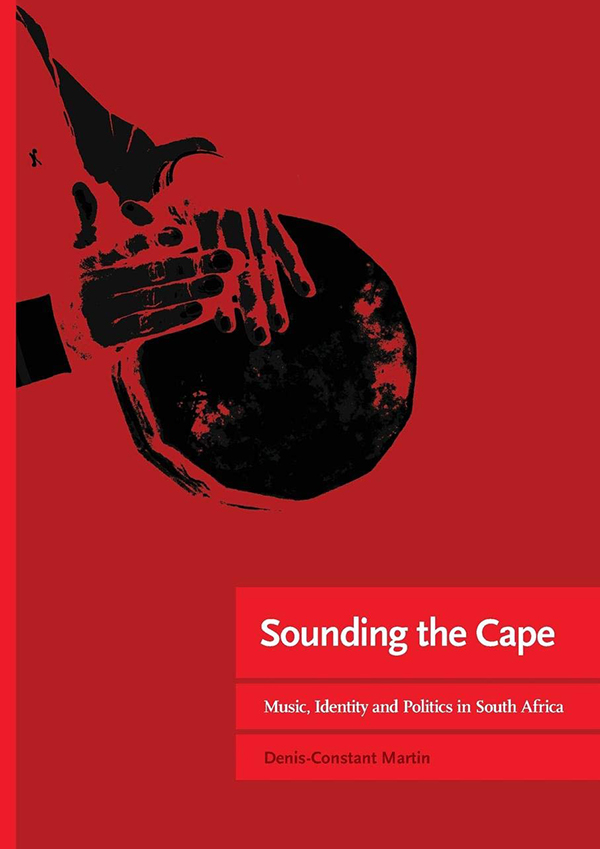
For several centuries Cape Town has accommodated a great variety of musical genres which have usually been associated with specific population groups living in and around the city. Musical styles and genres produced in Cape Town have therefore been assigned an ìidentityî which is first and foremost social. This volume tries to question the relationship established between musical styles and genres, and social --in this case pseudo-racial --identities.
In Sounding the Cape, Denis-Constant Martin recomposes and examines through the theoretical prism of creolisation the history of music in Cape Town, deploying analytical tools borrowed from the most recent studies of identity configurations. He demonstrates that musical creation in the Mother City, and in South Africa, has always been nurtured by contacts, exchanges and innovations whatever the efforts made by racist powers to separate and divide people according to their origin. Musicians interviewed at the dawn of the 21st century confirm that mixture and blending characterise all Cape Town's musics. They also emphasise the importance of a rhythmic pattern particular to Cape Town, the ghoema beat, whose origins are obviously mixed. The study of music demonstrates that the history of Cape Town, and of South Africa as a whole, undeniably fostered creole societies. Yet, twenty years after the collapse of apartheid, these societies are still divided along lines that combine economic factors and 'racial'categorisations.
Martin concludes that, were music given a greater importance in educational and cultural policies, it could contribute to fighting these divisions and promote the notion of a nation that, in spite of the violence of racism and apartheid, has managed to invent a unique common culture.
Where its authors and editors are based
Countries of the institutions the book's authors, editors and chapter authors were affiliated to when it was published.
- AUTHORS / EDITORS
- CITATIONS Phase 2
- USAGE Phase 3
No affiliations with a known country in these years yet.
About this data
These figures cover 1 work. Each value comes from the most trusted source that has it; a correction made by OBC staff outranks every source.
| Source | Confidence | Works |
|---|---|---|
| Thoth | 90 / 100 | 1 |
| Works with a publication date | 100% |
|---|---|
| Works with a DOI | 100% |
| Works with a funder recorded | 0% |
| Authors with an affiliation | 0% |
Countries come from the institution each author was affiliated to when they published, as recorded in ROR. A country is never guessed, so authors without a matched institution are not counted on the maps.
Funders come from OpenAlex for articles and Thoth for books, where publishers recorded them. Most works record none, so a funder's figures show what is recorded, not everything it funded.
Chapters count as works: their authors and editors, and the countries of their institutions, are in every figure where Thoth records an affiliation for them.
Citations (Phase 2) and usage (Phase 3) are not collected yet.