
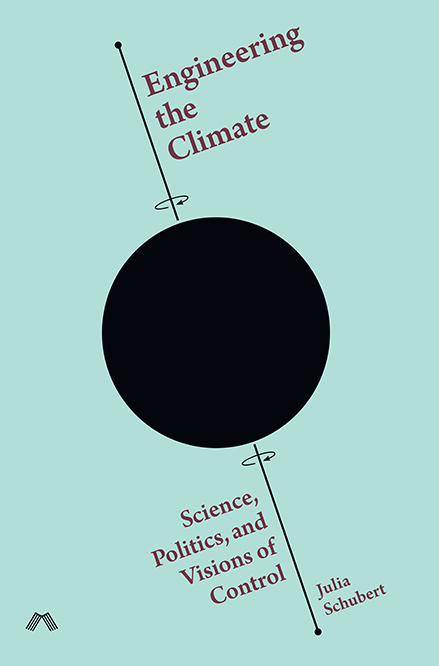
Book information
- Publisher
- Mattering Press
- Publication
- Published 15 November 2021
- Place
- Manchester, UK
- Catalogue record
- View in the catalogue
Abstract
Notions of the impending climate crisis have pushed a set of highly contested techno-scientific measures onto policy agendas around the world. Suggestions to deliberately alter, to engineer, the Earth’s climate have gained political currency in recent years not as a positive vision of techno-scientific innovation, but as a daunting measure of last resort. The controversial status of various so-called climate engineering proposals raises a simple, yet pressing question: How has it has come to this? And, more specifically, how did such contested measures earn their place on policy agendas, despite enormous scientific complexities and fierce political contestation?
This book approaches these questions by re-contextualizing the history of climate engineering within the larger history of political efforts to cultivate climate science for the state. It tells the story of climate engineering as a story of historically shifting alliances between climate science and politics. Drawing on policy records, archival material, and expert interviews, the text follows the turbulent trajectory of what we now refer to as climate engineering through U.S. policy. Instead of essentialising climate engineering, the text demonstrates how historically specific versions of climate engineering have linked scientific to political agendas from the turn of the twentieth century to the teens of the new millennium. This perspective reveals how efforts to deliberately modify and control the climate have always been couched in the political struggles of their time.
Global societal problems, such as climate change, financial crises, or pandemics have brought the political relevance of scientific expertise to the foreground. This book speaks to scholarship in sociology and science studies, seeking to illuminate the essential entanglements between efforts to understand and efforts to govern such problems. By giving climate engineering a life of its own and following its dynamic trajectory as a contested object of expert work, this book sheds light on the reflexive and historically contingent interplay of science and politics as two distinct, yet increasingly interdependent, realms of society. The text disentangles the complex web of scientific inquiry and policy making — of experts and politicians, observational devices and expert infrastructures — that have given climate engineering its particular shape over the years, challenging us to fundamentally rethink our understanding of the relationship between science and politics.
Chapters
| Chapter | Author | Institution at publication |
|---|---|---|
| Assembling an engineering problem | Julia Schubert | German University of Administrative Sciences; Center for Interdisciplinary Research, Bielefeld University |
| Confronting the crisis | Julia Schubert | German University of Administrative Sciences; Center for Interdisciplinary Research, Bielefeld University |
| Devising a project of climatological cultivation and control | ||
| The emerging politics of climate engineering | Julia Schubert | German University of Administrative Sciences; Center for Interdisciplinary Research, Bielefeld University |
| Where Does the Story Begin? | Julia Schubert | German University of Administrative Sciences; Center for Interdisciplinary Research, Bielefeld University |
| Years of Fracture | Julia Schubert | German University of Administrative Sciences; Center for Interdisciplinary Research, Bielefeld University |
| Introduction | Julia Schubert | German University of Administrative Sciences; Center for Interdisciplinary Research, Bielefeld University |
| Conclusion (Part I) | Julia Schubert | German University of Administrative Sciences; Center for Interdisciplinary Research, Bielefeld University |
| Conclusion (Part II) | Julia Schubert | German University of Administrative Sciences; Center for Interdisciplinary Research, Bielefeld University |
| Conclusion (Part III) | ||
| Conclusion: Scientific expertise and the politics of a ‘bad idea whose time has come’ |
Where its authors and editors are based
Countries of the institutions the book's authors, editors and chapter authors were affiliated to when it was published.
- AUTHORS / EDITORS
- CITATIONS Phase 2
- USAGE Phase 3
| Country | Authors / editors |
|---|---|
| Germany | 1 |
About this data
These figures cover 12 works. Each value comes from the most trusted source that has it; a correction made by OBC staff outranks every source.
| Source | Confidence | Works |
|---|---|---|
| Thoth | 90 / 100 | 12 |
| Works with a publication date | 100% |
|---|---|
| Works with a DOI | 8% |
| Works with a funder recorded | 0% |
| Authors with an affiliation | 100% |
| Affiliations matched to an institution (ROR) | 50% |
| Affiliations with a country | 100% |
Countries come from the institution each author was affiliated to when they published, as recorded in ROR. A country is never guessed, so authors without a matched institution are not counted on the maps.
Funders come from OpenAlex for articles and Thoth for books, where publishers recorded them. Most works record none, so a funder's figures show what is recorded, not everything it funded.
Chapters count as works: their authors and editors, and the countries of their institutions, are in every figure where Thoth records an affiliation for them.
Citations (Phase 2) and usage (Phase 3) are not collected yet.