
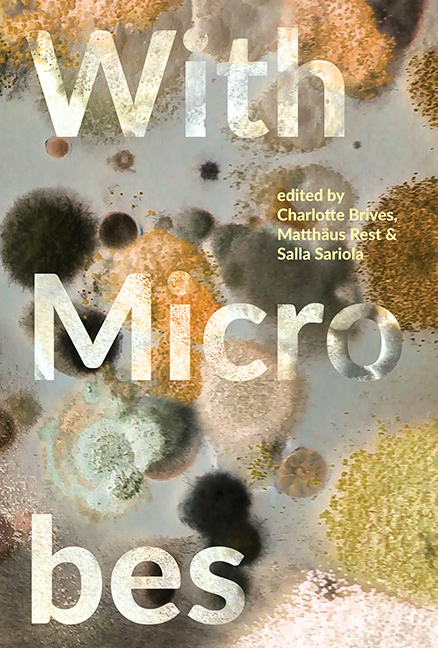
Book information
- Publisher
- Mattering Press
- Publication
- Published 6 October 2021
- Place
- Manchester, UK
- Catalogue record
- View in the catalogue
Abstract
Without microbes, no other forms of life would be possible. But what does it mean to be with microbes? With Microbes sets microbes and the multiple ways they exist around, in and on humans at center stage. In this book, 24 social scientists and artists attune to microbes and describe their complicated relationships with humans and other beings. The book shows the multiplicity of these relationships and their dynamism, through detailed ethnographies of the relationships between humans, animals, plants, and microbes. Ethnographic explorations with fermented foods, waste, faecal matter, immunity, antimicrobial resistance, phages, as well as indigenous and scientific understandings of microbes challenge ideas of them being simple entities: not just pathogenic foes, old friends or good fermentation minions, but so much more. By describing these complex, dynamic, and ever-changing entanglements between humans and microbes, the chapters raise crucial points about how microbes are ‘known’ and how social scientists can study microbes with ethnographic methods, more often than not in the absence of microscopes, models, and computations. Following these various entanglements, the book tells how these relations transform both humans and microbes in the process.
Chapters
| Chapter | Author | Institution at publication |
|---|---|---|
| Bathing in black water? | Marine Legrand, Germain Meulemans | École nationale des ponts et chaussées; Centre National pour la Recherche Scientifique et Technique (CNRST) |
| Building ‘natural’ immunities | Johanna Nurmi | University of Turku |
| Introducing With Microbes: From witnessing to withnessing | ||
| Knowing, living, and being with bokashi | Veera Kinnunen | University of Lapland |
| Micro-geographies of kombucha as methodology | A.C. Davidson, Emma Ransom-Jones | University of Huddersfield |
| Oimroas | Matthäus Rest | Max Planck Institute for Evolutionary Anthropology |
| Old anthropology’s acquaintance with human-microbial encounters: Interpretations and methods | Andrea Butcher | University of Helsinki |
| Ontologies of resistance | Nicolas Fortané | Université Paris Dauphine-PSL |
| Pluribiosis and the never-ending microgeohistories | Charlotte Brives | Centre National pour la Recherche Scientifique et Technique (CNRST) |
| Scalability and partial connections in tackling antimicrobial resistance in West Africa | Jose A. Cañada | University of Helsinki |
| Scenes from the many lives of Escherichia coli | Mark Erickson, Catherine Will | University of Brighton; University of Sussex |
| The Deplantationocene | Denis Chartier | Université Paris Cité |
| When cultures meet | Katriina Huttunen, Elina Oinas, Salla Sariola | University of Helsinki |
Where its authors and editors are based
Countries of the institutions the book's authors, editors and chapter authors were affiliated to when it was published.
- AUTHORS / EDITORS
- CITATIONS Phase 2
- USAGE Phase 3
| Country | Authors / editors |
|---|---|
| Finland | 7 |
| France | 4 |
| United Kingdom | 4 |
| Morocco | 2 |
| Germany | 1 |
About this data
These figures cover 14 works. Each value comes from the most trusted source that has it; a correction made by OBC staff outranks every source.
| Source | Confidence | Works |
|---|---|---|
| Thoth | 90 / 100 | 14 |
| Works with a publication date | 100% |
|---|---|
| Works with a DOI | 7% |
| Works with a funder recorded | 7% |
| Authors with an affiliation | 100% |
| Affiliations matched to an institution (ROR) | 95% |
| Affiliations with a country | 100% |
Countries come from the institution each author was affiliated to when they published, as recorded in ROR. A country is never guessed, so authors without a matched institution are not counted on the maps.
Funders come from OpenAlex for articles and Thoth for books, where publishers recorded them. Most works record none, so a funder's figures show what is recorded, not everything it funded.
Chapters count as works: their authors and editors, and the countries of their institutions, are in every figure where Thoth records an affiliation for them.
Citations (Phase 2) and usage (Phase 3) are not collected yet.