
Book information
- Publisher
- LSE Press
- Publication
- Published 28 November 2022
- Place
- London
- Catalogue record
- View in the catalogue
Abstract
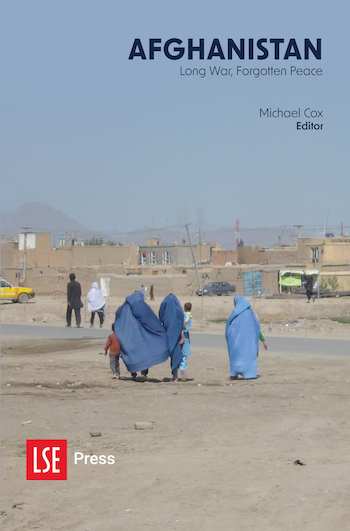
Afghanistan has been in the headlines for many years – but tragically for all the wrong reasons. First invaded by the Soviets in 1979, the country then experienced the trauma of civil war followed by yet another intervention, this time by the United States and allies, which ended with the West’s ignominious withdrawal in August 2021. Afghanistan: Long War, Forgotten Peace examines multiple dimensions of what happened and why, and what the future holds for the country now the Taliban are back in power.
Multidisciplinary in approach, this book features analysts from a variety of academic disciplines, including policy-makers and public intellectuals – many with direct experience of having lived and worked in Afghanistan. It explains why the Taliban finally triumphed, what this means for Afghan society, and how competing actors in the international system have reacted to the Taliban takeover. Questions include whether the West’s withdrawal represented a major or only a temporary setback for NATO and the United States, and whether and how there can be any amelioration of the situation in Afghanistan itself. The country and its people face multiple interrelated challenges, including those of women’s rights, the drugs economies and human trafficking and exploitation.
This volume is essential reading for all those concerned with what happens in Afghanistan over the coming months and years, the consequences for the Afghan people – and for the rest of the world.
Early praise for Afghanistan
“In this superb volume, Michael Cox has brought together a distinguished and interdisciplinary group of scholars to reflect on Afghanistan’s troubled recent past. Chapters range widely, probing the social challenges and religious upheavals within Afghan society as well as the regional geopolitical struggles and military interventions that have left the country so desperately in need of a better future. The book is essential reading for both scholars and policy-makers.”
Professor G.J. Ikenberry, Albert G. Milbank Professor of Politics and International Affairs at Princeton University in the Department of Politics and the Princeton School of Public and International Affairs
“Published in the midst of ‘Putin's Afghanistan’ in Ukraine, this bracing, salutary collection of essays reminds us that the original Afghanistan continues to suffer from decades of misconceived, sometimes disastrous, foreign adventurism and internal misrule. Written by a group of expert and thoughtful authors – knowledgeable, and adept at teasing out the broader implications of the war – the volume never forgets to put Afghanistan and the Afghan people back at the centre of their own story.”
Professor Gerry Simpson, FBA, Professor of International Public International Law, LSE Law School
“Afghanistan Long War, Forgotten Peace provides a unique, multidisciplinary approach employing different perspectives to explain how the West first became involved in Afghanistan, why in the end it left, and with what consequences. A brilliant volume that makes it possible to fully understand why NATO’s intervention failed and why the Taliban have returned.”
Professor Vittorio Emanuele Parsi, Professor of International Relations and Director of ASERI at Università Cattolica, Milan. Author of ‘Inevitable Alliance: Europe and the United States Beyond Iraq’ and ‘The Wrecking of the Liberal World Order’
“The Afghan tragedy still has a long way to go, writes Professor Michael Cox in his introductory essay to this excellent volume with contribution by leading experts in the field. Collectively, they draw critical lessons from an over 20-year long failure, showing that many of the mistakes made could have been avoided, and many of the opportunities lost, realized. What better advice could there be for students of international relations and politicians alike to ensure that such a tragedy will not repeat itself!”
Professor Helmut Anheier. President of the Hertie School Berlin (2009 to 2018) and Adjunct Professor of Social Welfare, Luskin School of Public Affairs, UCLA. Author of ‘Nonprofit Organizations: Theory Management, Policy’ and ‘The Future of the Liberal Order: The Key Questions'
Chapters
| Chapter | Author | Institution at publication |
|---|---|---|
| Introduction – Before and After the Towers: Afghanistan’s Forty-Year Crisis | ||
| Afghanistan: Learning from History? | ||
| Biden’s Realism, US Restraint, and the Future of the Transatlantic Partnership | ||
| China’s New Engagement with Afghanistan after the Withdrawal | ||
| Human Trafficking in Afghanistan – What Hope for Change? | ||
| Operationally Agile but Strategically Lacking: NATO’s Bruising Years in Afghanistan | ||
| Opium, Meth and the Future of International Drug Control in Taliban Afghanistan | ||
| Self-Defence and its Dangerous Variants: Afghanistan and International Law | ||
| The Rise and Fall of Women’s Rights in Afghanistan | ||
| Three Sins: The Disconnect Between de jure Institutions and de facto Power in Afghanistan | ||
| Why Did the Taliban Win (Again) in Afghanistan? | ||
| Women, War, and the Politics of Emancipation in Afghanistan |
Where its authors and editors are based
Countries of the institutions the book's authors, editors and chapter authors were affiliated to when it was published.
- AUTHORS / EDITORS
- CITATIONS Phase 2
- USAGE Phase 3
| Country | Authors / editors |
|---|---|
| United Kingdom | 1 |
About this data
These figures cover 13 works. Each value comes from the most trusted source that has it; a correction made by OBC staff outranks every source.
| Source | Confidence | Works |
|---|---|---|
| Thoth | 90 / 100 | 13 |
| Works with a publication date | 100% |
|---|---|
| Works with a DOI | 8% |
| Works with a funder recorded | 0% |
| Authors with an affiliation | 100% |
| Affiliations matched to an institution (ROR) | 0% |
| Affiliations with a country | 100% |
Countries come from the institution each author was affiliated to when they published, as recorded in ROR. A country is never guessed, so authors without a matched institution are not counted on the maps.
Funders come from OpenAlex for articles and Thoth for books, where publishers recorded them. Most works record none, so a funder's figures show what is recorded, not everything it funded.
Chapters count as works: their authors and editors, and the countries of their institutions, are in every figure where Thoth records an affiliation for them.
Citations (Phase 2) and usage (Phase 3) are not collected yet.