
Book view
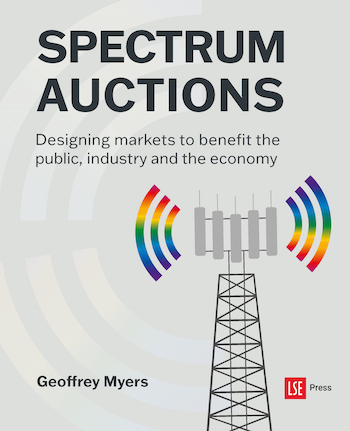
Spectrum Auctions
Designing markets to benefit the public, industry and the economy
Book information
- Publisher
- LSE Press
- Publication
- Published 15 February 2023
- Place
- UK: London
- Catalogue record
- View in the catalogue
Abstract
Access to the radio spectrum is vital for modern digital communication. It is an essential component for smartphone capabilities, the Cloud, the Internet of Things, autonomous vehicles, and multiple other new technologies. Governments use spectrum auctions to decide which companies should use what parts of the radio spectrum. Successful auctions can fuel rapid innovation in products and services, unlock substantial economic benefits, build comparative advantage across all regions, and create billions of dollars of government revenues. Poor auction strategies can leave bandwidth unsold and delay innovation, sell national assets to firms too cheaply, or create uncompetitive markets with high mobile prices and patchy coverage that stifles economic growth. Corporate bidders regularly complain that auctions raise their costs, while government critics argue that insufficient revenues are raised. The cross-national record shows many examples of both highly successful auctions and miserable failures.
Drawing on experience from the UK and other countries, senior regulator Geoffrey Myers explains how to optimise the regulatory design of auctions, from initial planning to final implementation. Spectrum Auctions offers unrivalled expertise for regulators and economists engaged in practical auction design or company executives planning bidding strategies. For applied economists, teachers, and advanced students this book provides unrivalled insights in market design and public management. Providing clear analytical frameworks, case studies of auctions, and stage-by-stage advice, it is essential reading for anyone interested in designing public-interested and successful spectrum auctions.
Chapters
Where its authors and editors are based
Countries of the institutions the book's authors, editors and chapter authors were affiliated to when it was published.
- AUTHORS / EDITORS
- CITATIONS Phase 2
- USAGE Phase 3
| Country | Authors / editors |
|---|---|
| United Kingdom | 1 |
About this data
These figures cover 17 works. Each value comes from the most trusted source that has it; a correction made by OBC staff outranks every source.
| Source | Confidence | Works |
|---|---|---|
| Thoth | 90 / 100 | 17 |
| Works with a publication date | 100% |
|---|---|
| Works with a DOI | 100% |
| Works with a funder recorded | 0% |
| Authors with an affiliation | 94% |
| Affiliations matched to an institution (ROR) | 100% |
| Affiliations with a country | 100% |
Countries come from the institution each author was affiliated to when they published, as recorded in ROR. A country is never guessed, so authors without a matched institution are not counted on the maps.
Funders come from OpenAlex for articles and Thoth for books, where publishers recorded them. Most works record none, so a funder's figures show what is recorded, not everything it funded.
Chapters count as works: their authors and editors, and the countries of their institutions, are in every figure where Thoth records an affiliation for them.
Citations (Phase 2) and usage (Phase 3) are not collected yet.