
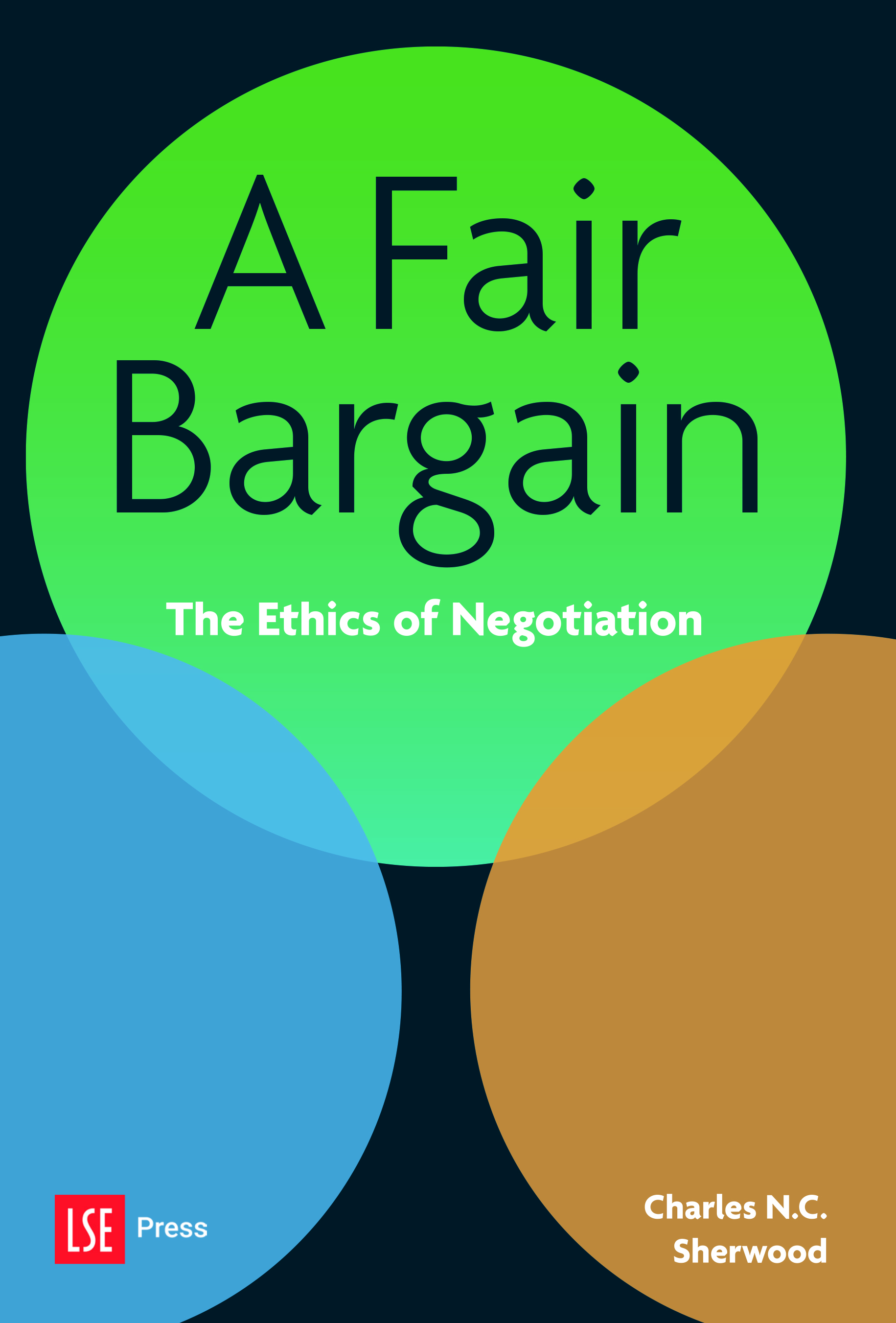
Book information
- Publisher
- LSE Press
- Publication
- Published 24 September 2026
- Place
- London
- Catalogue record
- View in the catalogue
Abstract
When negotiating, is it acceptable to lie? What about lying just a bit? Don’t we at least have a right to lie about the highest price we are prepared to pay, or the lowest we are prepared to accept? And in negotiations, to what extent are we obliged to consider the outcome for the ‘other side’? Is it acceptable to exploit another’s extreme vulnerability to ‘drive a hard bargain’?
These are all questions we face regularly in both our careers and our personal lives, and yet there is little discussion of them in ethical terms: what is right, fair, morally acceptable. Drawing on 30 years of experience in business negotiation, Charles N.C. Sherwood sets out to answer these questions.
Through a combination of philosophical rigour, provocative thought experiments, and applied real-life business situations he has developed a theory of negotiation as a social construct, designed to promote cooperative behaviour based on mutual consent. In doing so, he locates the fairness of a negotiation not in some abstract, objectively fair, single solution, but rather in the negotiating process itself. Moreover, he argues that this makes for better outcomes for all parties.
A Fair Bargain: The Ethics of Negotiation is therefore a work of moral philosophy, but one aimed at answering some quite pressing practical questions. It is essential reading for students of business ethics, practitioners, and all those with an interest in creating a fair process for negotiation in business and in life.
Chapters
| Chapter | Author | Institution at publication |
|---|---|---|
| Introduction | Charles N.C. Sherwood | |
| Fair process, fair outcome: negotiation as pure procedural justice | Charles N.C. Sherwood | |
| Basic honesty: a lie is a lie | Charles N.C. Sherwood | |
| Win/ win negotiating: the search for mutual benefit | Charles N.C. Sherwood | |
| The abuse of monopoly: extreme asymmetric negotiating leverage | Charles N.C. Sherwood | |
| The limits of obligation | Charles N.C. Sherwood | |
| Conclusion | Charles N.C. Sherwood |
Where its authors and editors are based
Countries of the institutions the book's authors, editors and chapter authors were affiliated to when it was published.
- AUTHORS / EDITORS
- CITATIONS Phase 2
- USAGE Phase 3
| Country | Authors / editors |
|---|---|
| United Kingdom | 1 |
About this data
These figures cover 8 works. Each value comes from the most trusted source that has it; a correction made by OBC staff outranks every source.
| Source | Confidence | Works |
|---|---|---|
| Thoth | 90 / 100 | 8 |
| Works with a publication date | 100% |
|---|---|
| Works with a DOI | 12% |
| Works with a funder recorded | 0% |
| Authors with an affiliation | 12% |
| Affiliations matched to an institution (ROR) | 0% |
| Affiliations with a country | 100% |
Countries come from the institution each author was affiliated to when they published, as recorded in ROR. A country is never guessed, so authors without a matched institution are not counted on the maps.
Funders come from OpenAlex for articles and Thoth for books, where publishers recorded them. Most works record none, so a funder's figures show what is recorded, not everything it funded.
Chapters count as works: their authors and editors, and the countries of their institutions, are in every figure where Thoth records an affiliation for them.
Citations (Phase 2) and usage (Phase 3) are not collected yet.