
Book view
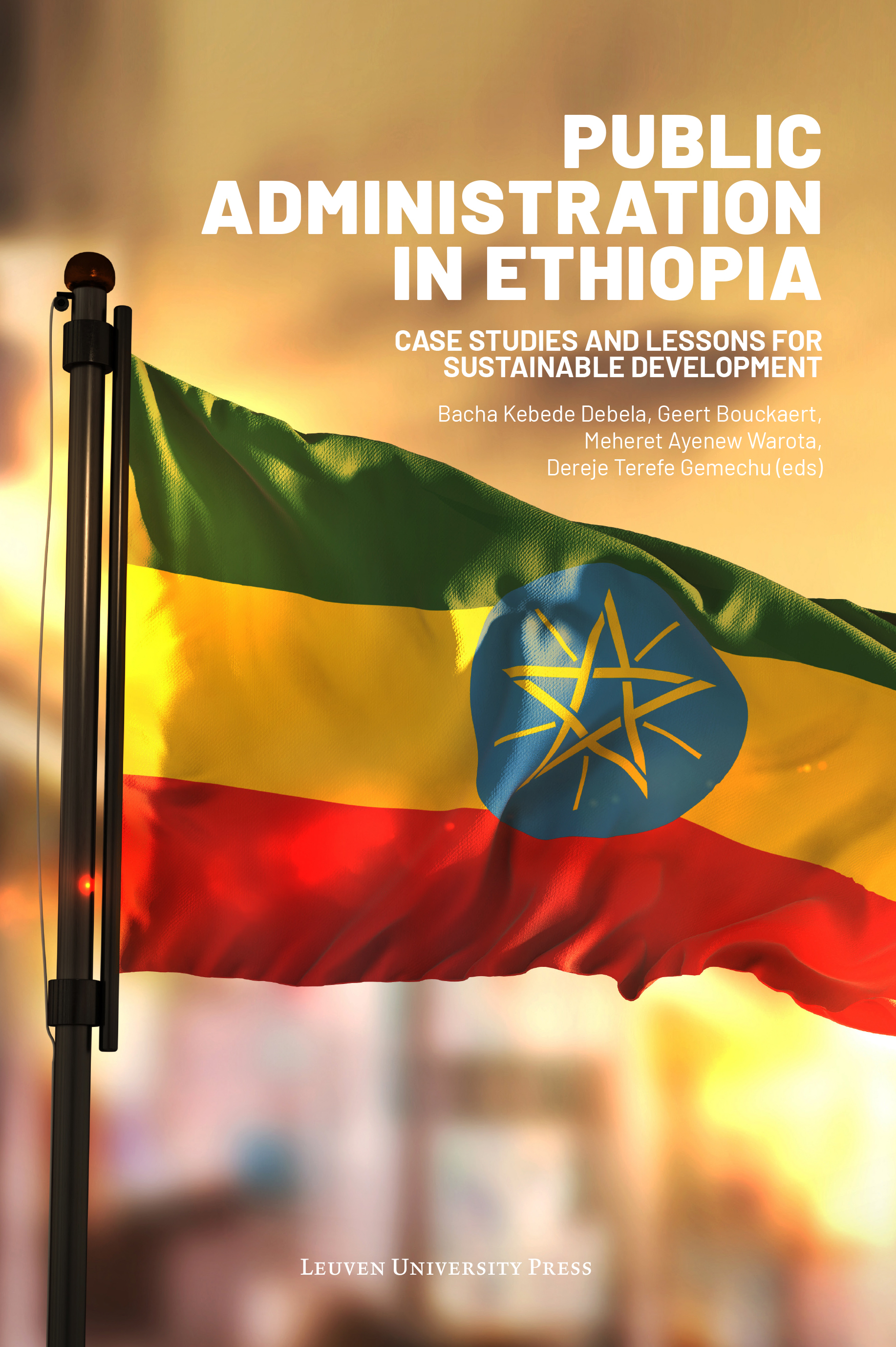
Public Administration in Ethiopia
Case Studies and Lessons for Sustainable Development
Edited by Bacha Kebede Debela, Geert Bouckaert, Meheret Ayenew Warota, Dereje Terefe Gemechu
Book information
- Publisher
- Leuven University Press
- Publication
- Published 20 November 2020
- Place
- Leuven, BE
- Catalogue record
- View in the catalogue
Abstract
First handbook on Ethiopian Public Administration
Building an effective, inclusive, and accountable public administration has become a major point of attention for policymakers and academics in Ethiopia who want to realise sustainable development. This first handbook on Ethiopian Public Administration is written by Ethiopian academics and practitioner-academics and builds on PhD studies and conference papers, including studies presented at the meetings of the Ethiopian Public Administration Association (EPAA), established in 2016.
Public Administration in Ethiopia presents a wide range of timely issues in four thematic parts: Governance, Human Resources, Performance and Quality, and Governance of Policies. Each of the individual chapters in this volume contributes in a different way to the overarching research questions: How can we describe and explain the contexts, the processes and the results of the post-1990 politico-administrative reforms in Ethiopia? And what are the implications for sustainable development?
This book is essential for students, practitioners, and theorists interested in public administration, public policy, and sustainable development. Moreover, the volume is a valuable stepping stone for PA teaching and PA research in Ethiopia.
Contributors: Adare Assefa Mitiku (Defense Construction Enterprise), Aklilu Wubet Lema (Addis Ababa University), Alebachew Asfaw Yimer (Bahir Dar University), Annie Hondeghem (KU Leuven), Bacha Kebede Debela (Ambo University), Bahiru Deti Heyi (Dilla University), Belayneh Bogale Zewdie (Kotebe Metropolitan University), Geert Bouckaert (KU Leuven), Gutata Goshu Amante (Addis Ababa University), Bruno Broucker (KU Leuven), Challa Amdissa Jiru (Addis Ababa University), Defferew Kebebe Tessema (Addis Ababa University), Denamo Addissie Nuramo (Addis Ababa University), Deribe Assefa Aga (Ethiopian Civil Service University), Dessalegn Kebede Kedida (Oromia Police College), Frehiwot Gebrehiwot Araya (Addis Ababa City Public Service and Human Resource Development Bureau), Henok Seyoum Assefa (Ethiopian Public Administration Association, EPAA), Hirko Wakgari Amanta (Oromia State University), Hiwot Amare Tadesse (Ambo University), Kassa Teshager Alemu (Ethiopian Civil Service University), Kiflie Worku Angaw (Dilla University),Moti Mosisa Gutema (Dilla University), Solomon Gebreyohans Gebru (KU Leuven), Steve Troupin (KU Leuven), Temesgen Genie Chekol (Dire Dawa Institute of Technology), Tewelde Mezgobo Ghrmay (Mekelle University), Trui Steen (KU Leuven), Meuriaw Ayalew (Assosa University / Addis Ababa University), Zekarias Minota Seiko (Ethiopian Civil Service University / Addis Ababa University)
Ebook available in Open Access.
Where its authors and editors are based
Countries of the institutions the book's authors, editors and chapter authors were affiliated to when it was published.
- AUTHORS / EDITORS
- CITATIONS Phase 2
- USAGE Phase 3
No affiliations with a known country in these years yet.
About this data
These figures cover 1 work. Each value comes from the most trusted source that has it; a correction made by OBC staff outranks every source.
| Source | Confidence | Works |
|---|---|---|
| Thoth | 90 / 100 | 1 |
| Works with a publication date | 100% |
|---|---|
| Works with a DOI | 100% |
| Works with a funder recorded | 0% |
| Authors with an affiliation | 0% |
Countries come from the institution each author was affiliated to when they published, as recorded in ROR. A country is never guessed, so authors without a matched institution are not counted on the maps.
Funders come from OpenAlex for articles and Thoth for books, where publishers recorded them. Most works record none, so a funder's figures show what is recorded, not everything it funded.
Chapters count as works: their authors and editors, and the countries of their institutions, are in every figure where Thoth records an affiliation for them.
Citations (Phase 2) and usage (Phase 3) are not collected yet.