
Book view
Making Home(s) in Displacement
Critical Reflections on a Spatial Practice
Edited by Luce Beeckmans, Alessandra Gola, Ashika Singh, Hilde Heynen
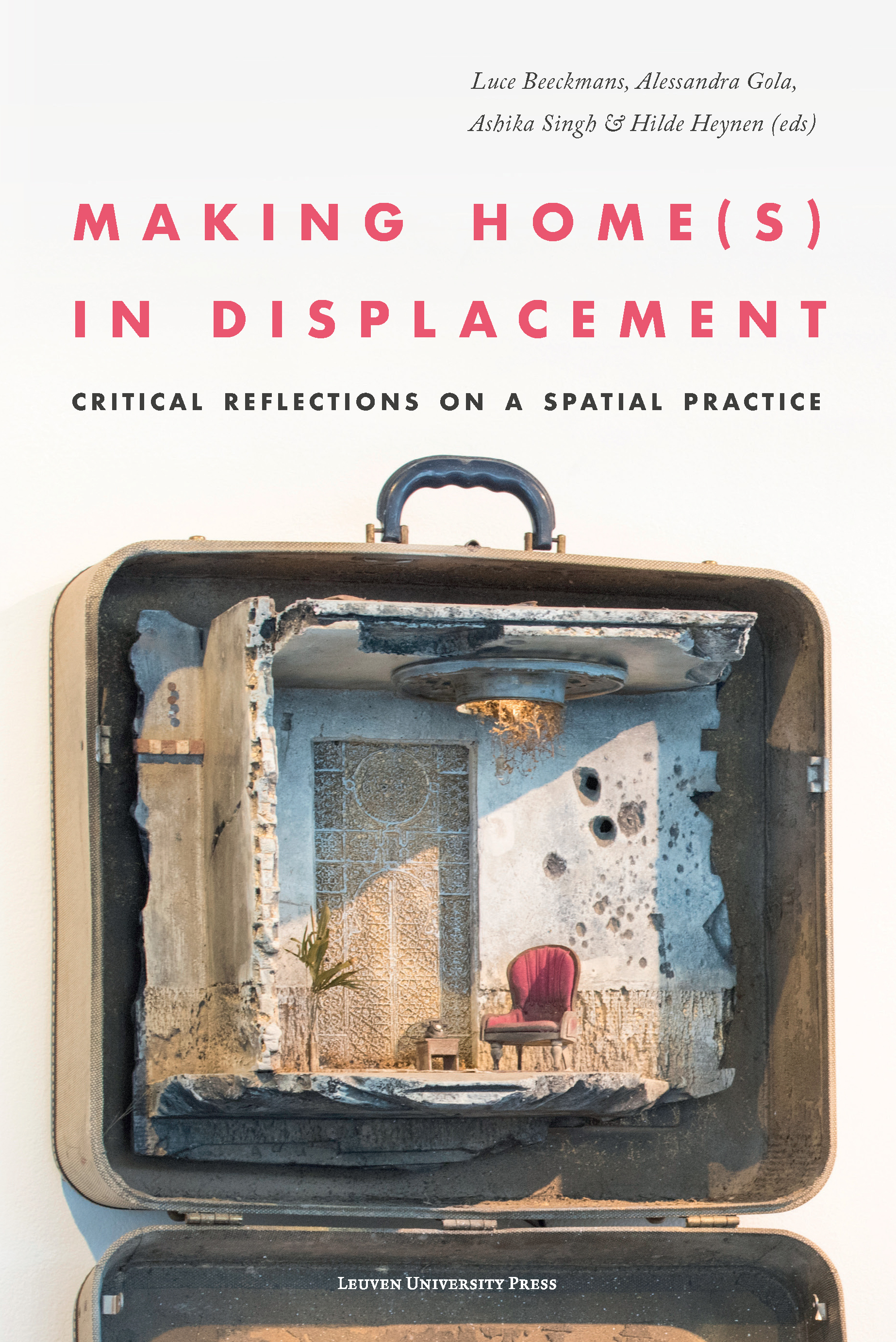
Book information
- Publisher
- Leuven University Press
- Publication
- Published 20 December 2021
- Place
- Leuven, BE
- Catalogue record
- View in the catalogue
Abstract
Making Home(s) in Displacement critically rethinks the relationship between home and displacement from a spatial, material, and architectural perspective. Recent scholarship in the social sciences has investigated how migrants and refugees create and reproduce home under new conditions, thereby unpacking the seemingly contradictory positions of making a home and overcoming its loss. Yet, making home(s) in displacement is also a spatial practice, one which intrinsically relates to the fabrication of the built environment worldwide.
Conceptually the book is divided along four spatial sites, referred to as camp, shelter, city, and house, which are approached with a multitude of perspectives ranging from urban planning and architecture to anthropology, geography, philosophy, gender studies, and urban history, all with a common focus on space and spatiality. By articulating everyday homemaking experiences of migrants and refugees as spatial practices in a variety of geopolitical and historical contexts, this edited volume adds a novel perspective to the existing interdisciplinary scholarship at the intersection of home and displacement. It equally intends to broaden the canon of architectural histories and theories by including migrants' and refugees' spatial agencies and place-making practices to its annals. By highlighting the political in the spatial, and vice versa, this volume sets out to decentralise and decolonise current definitions of home and displacement, striving for a more pluralistic outlook on the idea of home.
Contributors: Fatina Abreek-Zubiedat (ETH, Zurich), Nurhan Abujidi (Zuyd University of Applied Sciences), Menna Agha (University of Oregon), Esra Akcan (Cornell University), Aikaterini Antonopoulou (University of Liverpool), Luce Beeckmans (Ghent University), Paolo Boccagni (University of Trento), Wafa Butmeh (independent architect / UN-Habitat), Somayeh Chitchian (Harvard University), Bruno de Meulder (KU Leuven), Anna Di Giusto (independent researcher), Maretha Dreyer (Hasselt University), Alessandra Gola (KU Leuven), Hilde Heynen (KU Leuven), Annorada Iyer Siddiqi (Barnard College-Columbia University), Irit Katz (University of Cambridge), Romola Sanyal (LSE), Ashika Singh (KU Leuven), Aleksander Staničić (TU Delft), Huda Tayob (University of Johannesburg), Layla Zibar (Brandenburg University of Technology / KU Leuven)
Ebook available in Open Access.
This publication is GPRC-labeled (Guaranteed Peer-Reviewed Content).
Where its authors and editors are based
Countries of the institutions the book's authors, editors and chapter authors were affiliated to when it was published.
- AUTHORS / EDITORS
- CITATIONS Phase 2
- USAGE Phase 3
No affiliations with a known country in these years yet.
About this data
These figures cover 1 work. Each value comes from the most trusted source that has it; a correction made by OBC staff outranks every source.
| Source | Confidence | Works |
|---|---|---|
| Thoth | 90 / 100 | 1 |
| Works with a publication date | 100% |
|---|---|
| Works with a DOI | 100% |
| Works with a funder recorded | 100% |
| Authors with an affiliation | 0% |
Countries come from the institution each author was affiliated to when they published, as recorded in ROR. A country is never guessed, so authors without a matched institution are not counted on the maps.
Funders come from OpenAlex for articles and Thoth for books, where publishers recorded them. Not every work records one, so a funder's figures show what is recorded, not everything it funded.
Chapters count as works: their authors and editors, and the countries of their institutions, are in every figure where Thoth records an affiliation for them.
Citations (Phase 2) and usage (Phase 3) are not collected yet.